

IEC | INDONESIA EXPORT CENTER
Your Reliable Export & Sourcing Partner from Indonesia
IMPORT COCONUT COIR ROPE FROM INDONESIA
Supplier Verification | Product Specifications | Samples | Export Documentation | International Shipping
A Practical Guide to Importing Indonesian Coconut Coir Rope
Importing coconut coir rope from Indonesia can be a sourcing option for international businesses seeking natural fiber cordage for suitable landscaping, horticultural, craft, decorative, and manufacturing applications.
However, a successful import transaction requires more than identifying a product and negotiating a price.
Buyers must establish the exact product specification, verify the supplier, evaluate samples, confirm import requirements, agree on commercial terms, and organize the shipment.
Indonesia Export Center (IEC) facilitates Indonesian sourcing inquiries and helps international buyers communicate with potential suppliers throughout the procurement process.
This guide explains the key stages of importing coconut coir rope from Indonesia.
Step 1 – Identify the Correct Product
The first step is to define exactly what your business needs.
Coconut coir materials are available in different product categories, and these should not be confused.
| Product Category | General Description |
|---|---|
| Coir Rope | Twisted coconut fiber cordage |
| Coir Twine | Generally finer natural cordage |
| Coir Yarn | Twisted fiber input for manufacturing |
| Coir Netting | Manufactured mesh product |
| Coir Logs | Fiber-filled products for selected environmental applications |
| Coir Matting | Manufactured coir surface material |
A product suitable for decorative wrapping may not meet the requirements of greenhouse training or engineered erosion control.
Step 2 – Prepare Your Technical Specification
A detailed purchase specification should include:
- Product type.
- Raw material.
- Diameter.
- Diameter tolerance.
- Number of plies.
- Twist construction.
- Coil length.
- Coil weight.
- Moisture limits.
- Impurity limits.
- Required mechanical performance.
- Appearance requirements.
- Packaging.
- Order quantity.
- Intended application.
Where a parameter is not known, the buyer can ask potential suppliers to explain their available options.
Step 3 – Review the Reference Cocorope Specification
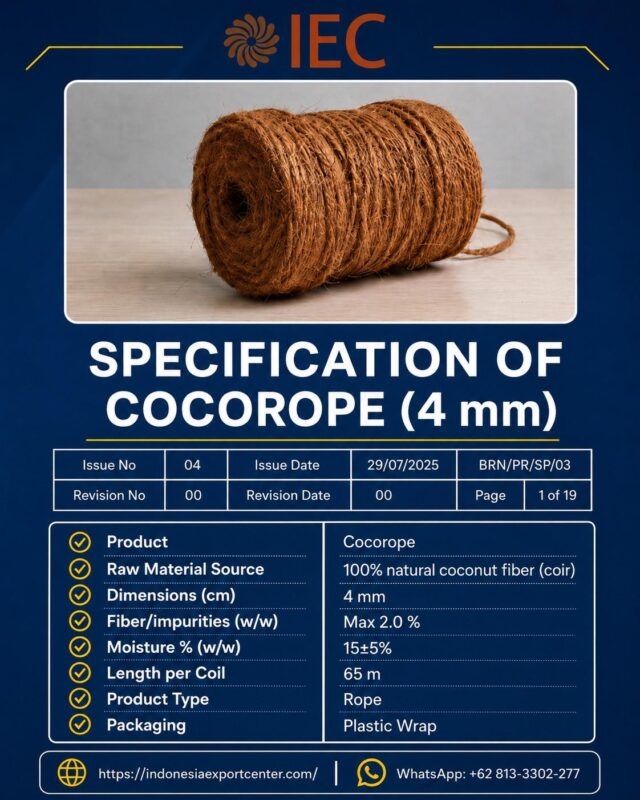
The supplied reference specification provides the following starting point.
| Specification | Value |
|---|---|
| Product | Cocorope |
| Material | 100% natural coconut fiber |
| Nominal Diameter | 4 mm |
| Length per Coil | 65 m |
| Moisture | 15 ± 5% |
| Fiber/Impurities | Maximum 2.0% |
| Product Type | Rope |
| Packaging | Plastic wrap |
Reference: BRN/PR/SP/03, Issue 04, dated 29 July 2025.
The document does not establish current stock, MOQ, production lead time, tensile strength, ply count, or alternative product formats.
Step 4 – Verify the Supplier
Before sending payment or signing a contract, request evidence of the supplier’s identity and operating role.
Legal Identity
Confirm the registered company name, business details, and authorized representatives.
Manufacturing or Trading Role
Determine whether the company manufactures the rope or sources it from another producer.
Production Capability
Request appropriate evidence of manufacturing capacity where relevant.
Export Experience
Ask about the proposed contracting seller and exporter of record.
Product Documentation
Request a current specification, photographs, and available quality information.
Commercial References
Where appropriate, request verifiable trade references without assuming that directory listings prove reliability.
Step 5 – Request Samples
Samples help buyers evaluate whether the material is suitable for their intended use.
A sample approval process may include:
- Confirming the sample product code.
- Measuring diameter.
- Checking ply construction.
- Evaluating texture and appearance.
- Measuring or confirming coil length.
- Testing flexibility and knotting.
- Assessing fiber shedding.
- Conducting mechanical tests if necessary.
- Testing the product in the intended application.
- Recording the approved sample for comparison.
Samples should be representative of the material proposed for bulk supply.
Step 6 – Confirm MOQ and Production Lead Time
MOQ can depend on whether the buyer orders standard coils, custom dimensions, or private label packaging.
Lead time may include raw material preparation, production, packing, inspection, inland transportation, and export arrangements.
The supplier should confirm the MOQ and lead time in writing.
Step 7 – Request a Commercial Quotation
A useful quotation should identify:
| Quotation Item | Required Detail |
|---|---|
| Seller | Legal company name |
| Product | Agreed specification |
| Quantity | Units, coils, or weight |
| Unit Price | Currency and unit |
| Total Price | Agreed calculation |
| MOQ | Confirmed amount |
| Packaging | Type and quantity |
| Production Lead Time | Written estimate |
| Incoterm | Named place or port |
| Payment Terms | Agreed schedule |
| Quotation Validity | Expiry date |
| Shipment Documents | Agreed documents |
Step 8 – Choose the Appropriate Incoterm
FCA – Free Carrier
FCA may be appropriate where the seller delivers goods to a named carrier or location.
FOB – Free on Board
FOB is used for sea or inland waterway transport and should identify the named shipment port.
CIF – Cost, Insurance and Freight
Under CIF, the seller arranges carriage and required minimum insurance to the named destination port, while risk generally transfers when the goods are loaded on board at origin.
Other Terms
Other Incoterms may be appropriate depending on the transaction.
The buyer and seller should agree on the exact term and named location under Incoterms 2020.
Step 9 – Confirm Import Regulations
Import requirements depend on the destination country and the actual product.
Buyers should verify:
- Correct customs classification.
- Applicable duties and taxes.
- Product admissibility.
- Any phytosanitary or treatment requirements, where applicable.
- Country-of-origin requirements.
- Labeling and product safety rules.
- Packaging regulations.
- Importer registration.
- Customs broker arrangements.
The reference Cocorope specification does not determine the applicable tariff code or import eligibility.
Step 10 – Confirm Shipping Documents
Typical international shipping documents may include:
| Document | Purpose |
|---|---|
| Commercial Invoice | Commercial transaction details |
| Packing List | Package and weight information |
| Bill of Lading | Sea transport document |
| Certificate of Origin | Origin evidence where required |
| Insurance Document | Where applicable |
| Product Specification | Material identification |
| Inspection Report | Where contractually required |
| Other Certificates | Destination- or product-specific requirements |
The required documents should be confirmed before dispatch.
Step 11 – Establish Quality Inspection
The purchase contract should define how the shipment will be inspected.
Possible checks include product identity, diameter, length, weight, appearance, moisture, impurities, packaging, and lot identification.
Mechanical testing should be included where necessary for the intended application.
Step 12 – Organize Freight and Delivery
The importer should confirm:
- Origin location.
- Origin port.
- Destination port.
- Cargo volume.
- Gross and net weight.
- Number of packages.
- Shipping method.
- Freight booking.
- Customs clearance.
- Inland delivery.
- Warehouse receiving arrangements.
Shipping cost comparisons should account for all relevant charges rather than ocean freight alone.
Step 13 – Receive and Inspect the Shipment
After delivery, the buyer should compare the goods with the contract, packing list, approved sample, and agreed inspection criteria.
Any discrepancy should be documented promptly under the contract’s claims procedure.
How IEC Facilitates the Import Process
IEC helps organize buyer requirements, identify potential Indonesian suppliers, request product information, coordinate samples, and facilitate quotations.
IEC does not automatically act as the manufacturer, contracting seller, exporter of record, importer of record, customs broker, or guarantor.
Those responsibilities must be clearly assigned for each transaction.
Common Importing Mistakes
Purchasing Without a Written Specification
This increases the risk of receiving an unsuitable product.
Confusing Rope with Twine or Geotextiles
Different coir products have different performance characteristics.
Ignoring Packaging Costs
Custom labels and retail packaging can affect pricing and MOQ.
Assuming Certifications Exist
Only verified documentation should be used to support claims.
Comparing Different Incoterms as Equivalent
FOB, FCA, and CIF quotations cover different responsibilities.
Failing to Check Destination Requirements
Customs and product compliance should be reviewed before shipment.
Complete Coconut Coir Rope Import RFQ
Subject: Coconut Coir Rope Import Inquiry – Indonesia
Dear Indonesia Export Center Team,
We would like to import coconut coir rope from Indonesia.
Company Name: [Company]
Country: [Country]
Website: [Website]
Application: [Description]
Product Type: [Rope / Twine / Other]
Diameter: [mm]
Diameter Tolerance: [Requirement]
Ply Construction: [Requirement]
Coil Length: [m]
Coil Weight: [kg]
Quantity: [Quantity]
Repeat Order Forecast: [If Applicable]
Moisture Requirement: [Details]
Impurity Requirement: [Details]
Mechanical/Test Requirements: [Details]
Packaging: [Details]
Required Certificates: [Details]
Destination Port: [Port]
Preferred Incoterm: [Term]
Target Shipment Date: [Date]
Please advise on supplier availability, technical specifications, sample terms, MOQ, lead time, and export quotation.
Best regards,
[Name]Frequently Asked Questions
Can I import coconut coir rope directly from Indonesia?
Yes, subject to supplier availability and the destination country’s import requirements.
What is the minimum order quantity?
MOQ must be confirmed with the selected supplier.
Can I request a sample?
Yes, subject to supplier availability and agreed sample terms.
Is 4 mm the only available diameter?
It is the only diameter documented in the supplied reference. Other sizes require confirmation.
Can IEC provide CIF pricing?
IEC can facilitate CIF quotation requests, subject to seller and freight confirmation.
Does IEC guarantee supplier quality?
No. Quality requirements should be documented and verified through samples, testing, and inspection.
What is the best shipping port?
It depends on the buyer’s destination, freight availability, and inland logistics.
Is coconut coir rope biodegradable?
The supplied reference does not provide a biodegradability test or certification. Any specific environmental claim requires appropriate evidence.
Request Your Indonesian Coco Rope Import Quotation
Start with a clear specification and a supplier verification process.
SEND YOUR COCONUT COIR ROPE IMPORT RFQ
IEC | INDONESIA EXPORT CENTER
Website: https://indonesiaexportcenter.com/
WhatsApp: +62 813-3302-277
Related Resources
Coco Rope for International Importers
Coco Rope RFQ Checklist for B2B Buyers
Coco Rope vs Coir Twine vs Coir Geotextiles
