

IEC | INDONESIA EXPORT CENTER
Indonesian Thermal Coal Export Procedures | Supplier Verification | International Trade Documentation
Understanding Coal Export from Indonesia
International importers researching coal export from Indonesia must understand how the country’s coal supply chain, export regulations, commercial contracts, quality inspection, and maritime logistics fit together.
A successful coal import transaction requires coordination among several parties, including the coal producer, authorized seller, exporter of record, independent surveyor, shipping provider, importer, and relevant authorities.
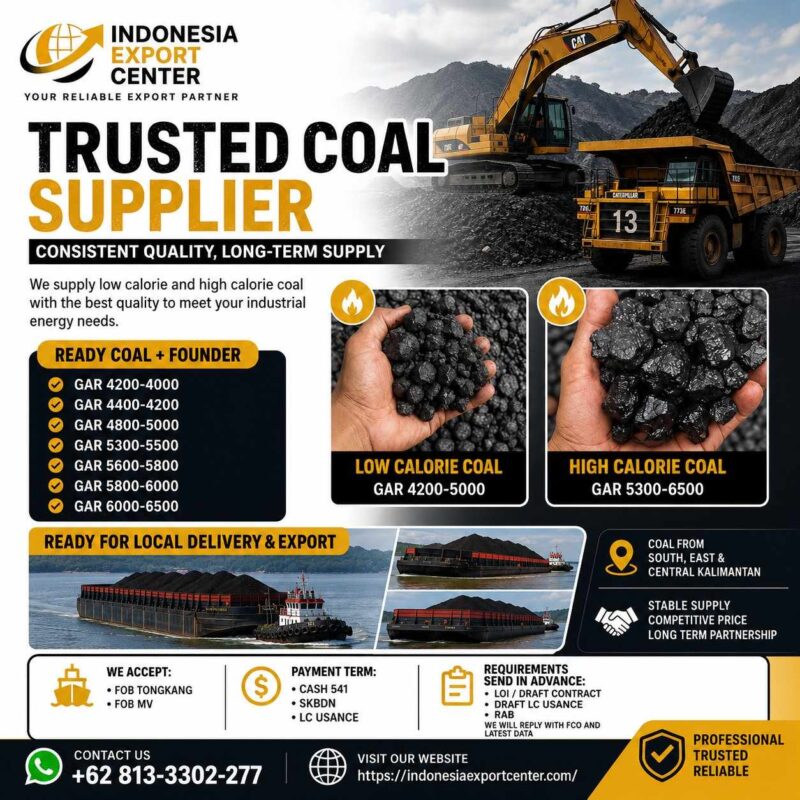
Indonesia Export Center (IEC) facilitates communication between overseas buyers and potential Indonesian coal suppliers. IEC can assist with organizing inquiries and clarifying documentation requests.
IEC does not automatically act as the exporter of record, mine owner, principal seller, or customs representative.
Indonesia’s Role in International Coal Trade
Indonesia is a major international supplier of thermal coal, with mining and trading activities concentrated in several producing regions.
Indonesian thermal coal may be considered by power utilities, industrial fuel purchasers, and international commodity trading houses.
However, reported national export activity does not establish the availability or eligibility of a specific cargo.
Buyers should verify current market conditions using reliable sources such as the International Energy Agency and official Indonesian trade information.
Step 1: Define the Coal Import Requirement
Before approaching suppliers, importers should prepare a detailed procurement specification.
| Procurement Parameter | Required Information |
|---|---|
| Coal Type | Thermal / Steam Coal |
| Calorific Value | GAR or NAR, with basis |
| Total Moisture | Maximum acceptable value |
| Ash | Maximum acceptable value |
| Total Sulfur | Maximum acceptable value |
| Volatile Matter | If required |
| HGI | If required |
| Particle Size | Agreed range |
| Shipment Quantity | Metric tons |
| Contract Period | Spot or term |
| Destination Port | Named port |
| Delivery Term | Incoterms 2020 |
| Payment Method | Proposed arrangement |
A clear specification helps suppliers determine whether their material matches the buyer’s requirements.
Step 2: Verify the Coal Supplier
Supplier verification should establish the company’s legal identity and actual role in the supply chain.
A company may operate as a mine owner, mining contractor, coal trader, exporter, or intermediary.
These roles carry different responsibilities.
The buyer should request relevant company registration, licenses or authorizations, evidence of the coal source, and proof that the seller has the authority to offer the cargo.
Step 3: Confirm the Mining Source
Coal offered for export should be traceable to a legitimate source.
Depending on the transaction, relevant records may include mining-license information, source declarations, purchase contracts, transport documentation, and other evidence establishing the chain of supply.
Buyers should not assume that a trading company owns the mine supplying its coal.
Step 4: Check Indonesian Export Eligibility
Coal exports are subject to applicable Indonesian laws and administrative requirements.
The responsible exporter should verify current mining, trading, export, customs, tax, royalty, and other relevant obligations.
Regulatory requirements can change, so historical export arrangements should not be treated as proof of present eligibility.
The buyer should also check applicable sanctions, trade restrictions, and destination-country import requirements.
Step 5: Review Coal Quality Documentation
A potential supplier may provide an indicative coal analysis or historical laboratory report.
However, a historical report does not establish the quality of a new shipment.
Buyers should request:
- Product specifications.
- Available Certificate of Analysis (COA).
- Sampling and testing methods.
- Laboratory or surveyor information.
- Coal origin.
- Relevant analytical basis.
- Agreed quality tolerances.
Step 6: Obtain a Seller-Issued Commercial Offer
The seller’s quotation should identify the coal specification, quantity, price basis, delivery term, shipment schedule, payment conditions, and validity period.
A Full Corporate Offer (FCO), when used, should be issued or authorized by the actual contracting seller.
IEC’s introduction or coordination of an inquiry does not itself constitute a binding sales offer.
Step 7: Negotiate the Sales Contract
The sales contract should address:
- Contracting parties.
- Coal source and specifications.
- Quantity and shipment tolerance.
- Price and adjustment mechanism.
- Sampling and testing.
- Loading and discharge conditions.
- Payment terms.
- Delivery and risk transfer.
- Required documentation.
- Claims and dispute resolution.
Step 8: Arrange Independent Inspection
Independent surveyors may be appointed to perform sampling, laboratory testing, draft surveys, and other agreed services.
The parties should define the inspection method and whether particular results are binding for contractual purposes.
Step 9: Prepare Export Documentation
| Document | Purpose |
|---|---|
| Commercial Invoice | Commercial transaction details |
| Packing or Cargo Details | Cargo information where applicable |
| Bill of Lading | Maritime transport record |
| Certificate of Origin | Origin evidence where required |
| Coal Quality Certificate | Agreed analytical results |
| Quantity or Weight Certificate | Cargo quantity verification |
| Export Customs Declaration | Applicable customs formalities |
| Other Regulatory Documents | Transaction-specific requirements |
The exact documents depend on current law and the contract.
Step 10: Arrange Coal Loading and Shipment
Coal may move through mine logistics, stockpiles, barges, terminals, or mother vessels depending on the source and shipment arrangement.
The seller and buyer should confirm loading location, cargo readiness, vessel requirements, survey arrangements, and responsibility for costs.
Step 11: Monitor Shipping Performance
During shipment, the parties should monitor contractual milestones, documentation, loading completion, vessel movement, and destination arrangements.
Discharge-port requirements should be verified before the vessel arrives.
Common Coal Export Risks
Important risks include:
- Misrepresentation of supplier authority.
- Unverified mining origin.
- Unsupported quality claims.
- Cargo substitution.
- Inaccurate quantity certificates.
- Unclear delivery terms.
- Fraudulent banking instructions.
- Export authorization problems.
- Shipment delays.
- Disputes over analytical results.
How IEC Supports the Inquiry Process
IEC can facilitate preliminary supplier communication, request available technical documentation, and help buyers organize the information needed for commercial evaluation.
Legal, technical, and financial verification remains the responsibility of the relevant contracting parties and their professional advisers.
Frequently Asked Questions
Can overseas buyers import coal directly from Indonesia?
A transaction may be possible when the buyer, seller, product, and shipment meet all applicable requirements.
Is every Indonesian coal trader an authorized exporter?
No.
Does a supplier COA guarantee shipment quality?
Not unless the report is appropriately linked to the actual cargo and accepted under the contract.
Can IEC issue an export license?
No.
Who prepares the export declaration?
The responsible exporter or its authorized representative, as applicable.
Can IEC coordinate inquiries about FOB or CIF shipments?
Yes, subject to actual seller capabilities.
Send Your Coal Import Requirements
SEND COAL IMPORT REQUIREMENTS TO IEC
INDONESIA EXPORT CENTER
Website: https://indonesiaexportcenter.com/
WhatsApp: +62 813-3302-277
Related Resources
Indonesian Coal Export Supplier Verification Checklist
Coal Procurement from Indonesia: RFQ Requirements
Industry Reference
IEA – Coal Mid-Year Update 2026: Trade
