

INDONESIA EXPORT CENTER
Connecting Indonesian Products to Global Markets
Cinnamon Oleoresin Documentation | International Trade Compliance | Supplier Verification | Import Procurement
Understanding Cinnamon Oleoresin Export Documentation
International buyers sourcing cinnamon oleoresin from Indonesia need more than a commercial invoice and a product description. Successful import procurement depends on obtaining accurate technical documents, identifying the actual seller and exporter, confirming botanical origin, and understanding the regulatory requirements of the destination market.
Cinnamon oleoresin is a concentrated botanical preparation used or evaluated in flavor, seasoning, and selected industrial applications. Its composition can vary depending on the cinnamon species, plant part, extraction process, and finished formulation.
For food ingredient importers, documentation is essential to assess whether a specific product is suitable for the intended application and destination country.
Indonesia Export Center (IEC) facilitates inquiries with potential Indonesian suppliers and assists buyers in requesting relevant technical and commercial information.
IEC does not automatically serve as the manufacturer, seller, or exporter of record. The actual supplier must confirm product availability, documentation, export capabilities, and commercial terms.
Request Cinnamon Oleoresin TDS, COA, Safety Documentation, Export Information, and Supplier-Approved Quotations.
CONTACT INDONESIA EXPORT CENTER
1. What Documents Are Needed to Import Cinnamon Oleoresin?
There is no single universal documentation package applicable to every cinnamon oleoresin shipment.
Requirements depend on the product’s composition, intended use, destination country, customs classification, shipping method, and commercial agreement.
A typical buyer’s documentation review may include three categories:
- Technical product documentation.
- Quality and safety documentation.
- Commercial and international shipping documentation.
Importers should establish which documents are legally required and which are part of their internal supplier approval procedures.
2. Essential Technical Product Documents
Technical Data Sheet (TDS)
A TDS provides information about the finished ingredient and its intended technical characteristics.
Buyers may request:
- Product name and description.
- Scientific botanical name.
- Plant part used.
- Country of origin.
- Extraction process.
- Appearance and physical properties.
- Chemical composition.
- Solubility or dispersibility.
- Storage conditions.
- Shelf-life information.
- Packaging specifications.
A TDS should describe the actual commercial product, not a generic cinnamon extract.
Certificate of Analysis (COA)
A COA records analytical results for a particular production batch.
Relevant parameters may include cinnamaldehyde, coumarin, other specified constituents, physical properties, and risk-based contaminant testing.
The report should identify the batch, test method, result, specification limit, and issuing laboratory or quality function.
Safety Data Sheet (SDS)
An SDS communicates relevant hazard and handling information under the applicable classification system.
Buyers should confirm that the SDS matches the actual supplied formulation.
An SDS is not a substitute for a food safety assessment or regulatory authorization.
3. Botanical Identity and Origin Documentation
The botanical identity of cinnamon oleoresin is particularly important because different cinnamon species have different chemical characteristics.
Indonesia is associated with Cinnamomum burmannii, but an Indonesian trading origin does not prove the species used in a particular extract.
| Botanical Information | Verification Requirement |
|---|---|
| Scientific name | Supplier declaration |
| Plant part | Confirmation of bark or other material |
| Raw material origin | Traceable sourcing information |
| Processing location | Actual manufacturing facility |
| Extraction method | Supplier documentation |
| Batch identification | Traceability records |
Buyers should distinguish the origin of the raw cinnamon from the country where extraction and packaging occur.
4. Preliminary Product Specifications
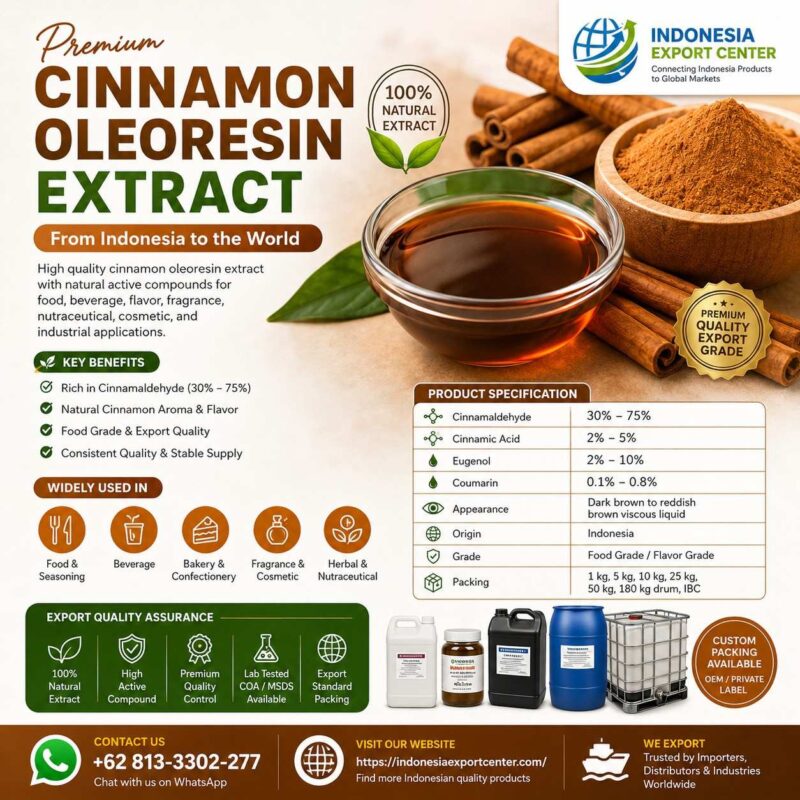
The following values are preliminary references supplied for commercial planning. They have not been verified for an actual production batch.
| Parameter | Preliminary Reference |
|---|---|
| Product | Cinnamon Oleoresin |
| Proposed Origin | Indonesia |
| Botanical Species | To be confirmed |
| Appearance | Dark brown to reddish-brown viscous liquid |
| Cinnamaldehyde | 30–75% proposed |
| Cinnamic Acid | 2–5% proposed |
| Eugenol | 2–10% proposed |
| Coumarin | 0.1–0.8% proposed |
| Extraction Solvent | Supplier declaration required |
| Solubility | To be confirmed |
| Food-Grade Status | Not established |
| Shelf Life | Supplier evidence required |
These proposed chemical ranges should not be treated as a verified specification or evidence of regulatory compliance.
5. Quality and Food Safety Documentation
Food ingredient buyers may request additional information based on their risk assessment.
| Document or Test | Purpose |
|---|---|
| Residual Solvent Report | Assess extraction-related residues |
| Heavy Metal Analysis | Evaluate relevant contaminants |
| Pesticide Residue Report | Assess agricultural residue risks |
| Microbiological Analysis | Support microbiological quality review |
| Allergen Statement | Identify relevant allergen considerations |
| Composition Declaration | Identify carriers and added ingredients |
| Traceability Records | Establish batch and material history |
| Stability Information | Support storage and shelf-life assessment |
| Certification Evidence | Verify specific certification claims |
The exact tests and acceptance limits should be determined for the intended market and application.
6. Commercial Export Documents
Depending on the transaction, documents may include:
Commercial Invoice
Identifies the seller, buyer, product, quantity, value, currency, and agreed commercial information.
Packing List
Describes the shipment’s packages, quantities, and relevant weights.
Bill of Lading or Air Waybill
Provides transport-related shipment information.
Certificate of Origin
May be required or requested depending on customs treatment, trade arrangements, and destination-country rules.
Customs and Regulatory Documents
Additional declarations, permits, or certificates may apply to the actual product and destination.
The importer and exporter should confirm the correct documentation before dispatch.
7. Identifying the Exporter of Record
The exporter of record is the party responsible for the relevant export declaration and obligations under applicable law.
Buyers should confirm:
- Legal name of the seller.
- Legal name of the exporter.
- Manufacturer identity.
- Export registration or eligibility where applicable.
- Party issuing the commercial invoice.
- Party responsible for customs declarations.
- Party responsible for shipment documentation.
IEC acts as a sourcing facilitator unless a separate written arrangement establishes another role.
8. Destination-Specific Import Compliance
Import requirements vary across countries and product applications.
For example, the United States, European Union, United Kingdom, Japan, and other markets may apply different rules concerning food ingredients, flavorings, customs classification, and documentation.
Importers should verify product eligibility and applicable requirements before shipment.
Particular attention may be needed for coumarin content, permitted uses, ingredient composition, and relevant food safety obligations.
No universal authorization for cinnamon oleoresin can be assumed.
9. Packaging and Shipping Documentation
The preliminary product brief proposes packaging options of 1 kg, 5 kg, 10 kg, 25 kg, 50 kg, 180 kg drums, and IBCs.
Actual packaging availability and suitability require supplier confirmation.
Shipment records should identify the relevant product, quantity, batch, packaging, and handling requirements.
10. Document Verification Before Payment
Before finalizing a commercial transaction, buyers should check that:
- The supplier’s legal identity is consistent.
- The product name matches across documents.
- The botanical species is clearly identified.
- The COA relates to the relevant batch.
- The commercial invoice matches the quotation.
- Packaging and quantities are consistent.
- The exporter and shipping responsibilities are established.
- Required destination-country documents have been identified.
Frequently Asked Questions
Is a COA mandatory for every shipment?
Requirements depend on applicable law, buyer specifications, and commercial agreements. Many industrial buyers require a batch COA as part of supplier qualification.
Is an SDS the same as a COA?
No. An SDS provides hazard and handling information, while a COA reports analytical results.
Does a certificate of origin prove the cinnamon species?
No. A certificate of origin addresses origin under applicable rules and does not independently authenticate botanical species.
Can IEC provide export documents?
IEC can coordinate document requests. The actual supplier and exporter must confirm what is available.
Is food-grade certification guaranteed?
No. Food-use suitability and any certification claims require verification.
Can buyers request documents before placing an order?
Yes. Buyers may submit documentation requirements during the supplier qualification process.
Request Cinnamon Oleoresin Export Documentation
Indonesia Export Center welcomes inquiries from import compliance managers, food manufacturers, ingredient distributors, and international procurement teams.
Share your destination country, intended application, technical specifications, and documentation checklist.
REQUEST EXPORT DOCUMENTS, TDS, COA AND QUOTATION
INDONESIA EXPORT CENTER
Your Indonesian Export Sourcing Partner
Website: https://indonesiaexportcenter.com/
WhatsApp: +62 813-3302-277
Related Resources
- Indonesian Cinnamon Oleoresin Export Sourcing
- Cinnamon Oleoresin Supplier in Indonesia
- Food-Grade Cinnamon Oleoresin
