

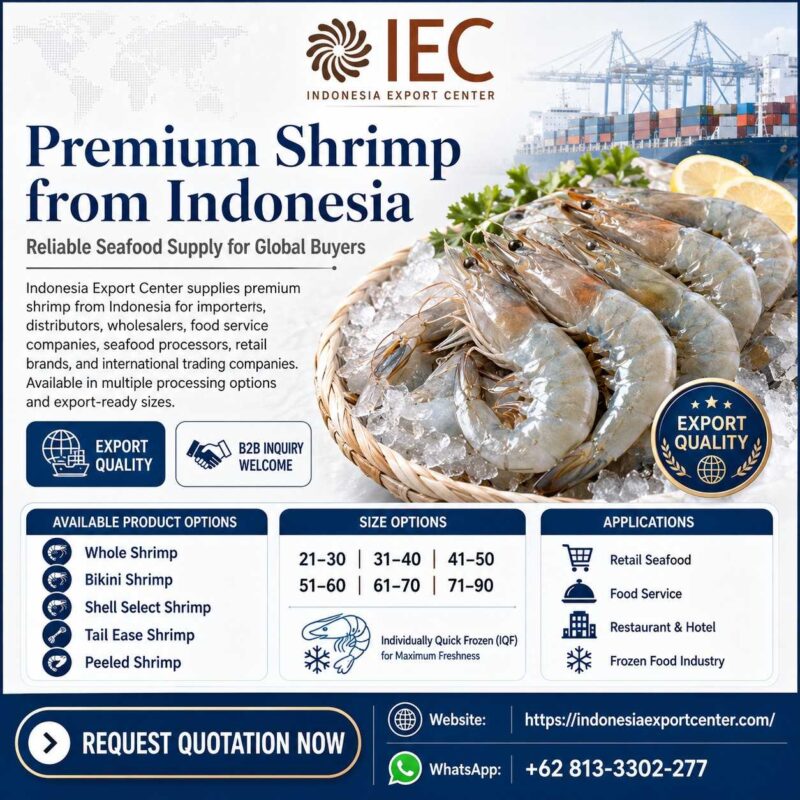
Understand FOB and CIF Before Purchasing Frozen Shrimp from Indonesia
International seafood buyers frequently request FOB or CIF quotations when sourcing frozen vannamei shrimp from Indonesia.
These commercial terms influence transportation responsibilities, freight costs, cargo insurance, delivery arrangements, and the point at which cargo risk transfers between the seller and buyer.
Understanding these differences is important when comparing supplier quotations and calculating the actual cost of imported frozen seafood.
Indonesia Export Center (IEC) assists international buyers with sourcing inquiries for Indonesian vannamei shrimp based on their technical specifications, order quantities, destination ports, and preferred commercial terms.
This guide explains the differences between FOB and CIF under Incoterms 2020, important considerations for reefer shipments, and practical methods for comparing export quotations.
What Are Incoterms?
Incoterms are standardized international commercial rules published by the International Chamber of Commerce.
They help define selected responsibilities between sellers and buyers, including delivery, transportation costs, export and import formalities, and risk transfer.
Incoterms do not independently establish every aspect of a sales contract.
They do not determine product quality, payment terms, ownership transfer, remedies for defective goods, or all contractual obligations.
The commercial contract should address these matters separately.
What Is FOB Shrimp Pricing?
FOB stands for Free On Board.
Under FOB Incoterms 2020, the seller delivers the goods on board the vessel nominated by the buyer at the named port of shipment.
The seller generally handles applicable export clearance and bears the relevant costs and risks until delivery on board.
The buyer generally arranges the main ocean transportation and assumes cargo risk after delivery on board.
FOB is intended for sea or inland waterway transportation.
Seller Responsibilities Under FOB
The seller’s responsibilities generally include:
- Providing the goods according to the contract.
- Preparing appropriate packaging.
- Providing agreed commercial documentation.
- Completing applicable export clearance.
- Arranging delivery to the nominated vessel.
- Bearing applicable costs and risks until delivery on board.
The exact operational arrangements should be established in the commercial agreement.
Buyer Responsibilities Under FOB
The buyer generally arranges:
- Main ocean freight.
- Vessel or carrier nomination.
- Cargo insurance if desired.
- Destination import clearance.
- Import duties and taxes.
- Destination handling.
- Cold storage.
- Inland refrigerated transportation.
Under FOB, the seller is not required by the Incoterm to arrange cargo insurance for the buyer.
What Is CIF Shrimp Pricing?
CIF stands for Cost, Insurance and Freight.
Under CIF Incoterms 2020, the seller arranges and pays for ocean freight and the required minimum cargo insurance to the named destination port.
However, cargo risk generally transfers from the seller to the buyer when the goods are delivered on board the vessel at the port of shipment.
This distinction is important.
Although the seller pays freight to the destination port, the seller does not automatically retain cargo risk until arrival.
Seller Responsibilities Under CIF
The seller generally handles:
- Goods according to the contract.
- Appropriate packaging.
- Applicable export clearance.
- Delivery on board the vessel.
- Main ocean freight to the named destination port.
- Required minimum cargo insurance.
- Relevant transportation and commercial documents.
The actual insurance coverage should be reviewed before shipment.
Buyer Responsibilities Under CIF
The buyer generally handles:
- Applicable destination import clearance.
- Import duties and taxes.
- Destination costs not included in the seller’s carriage arrangement.
- Inland transportation.
- Cold storage.
- Cargo receiving inspection.
- Additional insurance coverage if required.
The buyer should verify which destination handling charges are included in the freight arrangement.
FOB vs CIF Comparison
| Responsibility | FOB | CIF |
|---|---|---|
| Product Preparation | Seller | Seller |
| Export Clearance | Seller | Seller |
| Delivery on Board | Seller | Seller |
| Main Ocean Freight | Buyer | Seller |
| Required Cargo Insurance | Not required of seller | Seller |
| Risk Transfer | On board at origin | On board at origin |
| Import Clearance | Buyer | Buyer |
| Import Duties and Taxes | Buyer | Buyer |
| Inland Destination Delivery | Generally buyer | Generally buyer |
The commercial contract and transportation arrangements should clarify operational details and any additional agreed responsibilities.
Important Consideration for Containerized Frozen Shrimp
Frozen shrimp is commonly transported in refrigerated containers.
In containerized trade, the seller may deliver cargo to a terminal or carrier before the container is loaded on board the vessel.
Because FOB and CIF establish delivery on board, they may not always align with the actual physical handover arrangement.
FCA or CIP may be more appropriate in certain containerized transactions.
Buyers should evaluate the selected Incoterm with their freight forwarder and commercial partners.
What Is FCA?
FCA stands for Free Carrier.
Under FCA Incoterms 2020, delivery occurs when the seller delivers the goods to the carrier or another nominated party at the agreed named place according to the rule’s requirements.
The precise delivery responsibilities depend on whether the named place is the seller’s premises or another location.
FCA may be considered when the buyer arranges main transportation and the cargo is handed over before vessel loading.
What Is CIP?
CIP stands for Carriage and Insurance Paid To.
Under CIP Incoterms 2020, the seller arranges transportation and the required insurance to the named destination.
Risk generally transfers when the goods are delivered to the carrier according to the agreed delivery arrangement.
CIP generally requires broader default insurance coverage than CIF under Incoterms 2020, unless otherwise agreed.
The actual insurance policy must still be reviewed for frozen seafood risks.
FOB, CIF, FCA and CIP Comparison
| Incoterm | Main Freight Arranged By | General Risk Transfer Point | Transport Mode |
|---|---|---|---|
| FOB | Buyer | On board vessel at origin | Sea or inland waterway |
| CIF | Seller | On board vessel at origin | Sea or inland waterway |
| FCA | Buyer | Agreed carrier delivery point | Any mode |
| CIP | Seller | Agreed carrier delivery point | Any mode |
The appropriate term depends on the actual transportation and commercial arrangements.
What Is Included in an FOB Shrimp Quotation?
An FOB quotation may include the product purchase price and the seller’s relevant costs up to delivery on board at the named origin port.
The quotation should identify:
- Product description.
- Processing form.
- Size grade.
- Count basis.
- Freezing method.
- Glaze.
- Net weight.
- Packaging.
- Quantity.
- Unit price.
- Currency.
- Named origin port.
- Incoterms version.
- Included documentation.
- Payment terms.
- Quotation validity.
Buyers should confirm any additional charges before accepting the offer.
What Is Included in a CIF Shrimp Quotation?
A CIF quotation generally includes the product and relevant seller costs, main ocean freight, and required minimum cargo insurance to the named destination port.
However, CIF does not automatically include import duties, taxes, customs brokerage, destination cold storage, or inland delivery.
Destination terminal charges may depend on the carriage contract.
The buyer should request a clear description of included and excluded costs.
Indonesian Shrimp FOB Price Factors
Frozen shrimp export prices may be influenced by:
- Raw material availability.
- Harvest conditions.
- Shrimp size.
- Processing form.
- Production yield.
- Raw or cooked condition.
- Freezing method.
- Glaze.
- Net weight.
- Packaging.
- Order volume.
- Laboratory testing.
- Certification requirements.
- Production scheduling.
- Origin logistics.
IEC does not publish fixed FOB prices without current supplier confirmation.
CIF Shrimp Price Factors
In addition to product-related costs, CIF pricing may be influenced by:
- Destination port.
- Reefer container availability.
- Ocean freight rates.
- Carrier schedules.
- Shipping season.
- Fuel-related surcharges.
- Route and transshipment arrangements.
- Insurance premium.
- Freight validity.
- Cargo loading configuration.
Freight rates may change before the booking is confirmed.
The quotation should establish its validity period and any applicable adjustment conditions.
Illustrative FOB vs CIF Price Comparison
Consider a hypothetical shipment of 10,000 kg of frozen shrimp.
| Cost Component | FOB Purchase | CIF Purchase |
|---|---|---|
| Product and Agreed Origin Costs | USD 50,000 | Included |
| International Freight | USD 3,500 | Included |
| Cargo Insurance | USD 300 | Included |
| CIF Quoted Value | Not applicable | USD 54,200 |
| Comparable Cost Before Destination Charges | USD 53,800 | USD 54,200 |
In this example, the FOB arrangement is USD 400 less expensive before destination charges.
However, actual freight availability, insurance coverage, service quality, and commercial responsibilities must also be considered.
These figures are hypothetical and do not represent current IEC quotations.
Calculate the Landed Cost of Imported Shrimp
Landed cost represents the relevant total expense of bringing imported goods to the buyer’s intended receiving location.
A general landed cost calculation may include:
Product Cost + Freight + Insurance + Duties + Applicable Taxes + Clearance + Inspection + Port Handling + Cold Storage + Inland Transportation
The exact cost components depend on the transaction and selected Incoterm.
Costs already included in the supplier quotation should not be added twice.
Illustrative Landed Cost Calculation
| Cost Component | Hypothetical Amount |
|---|---|
| FOB Product Value | USD 50,000 |
| International Freight | USD 3,500 |
| Cargo Insurance | USD 300 |
| Customs Duties | USD 1,500 |
| Inspection and Clearance | USD 600 |
| Destination Handling | USD 900 |
| Inland Refrigerated Transportation | USD 1,200 |
| Cold Storage | USD 500 |
| Total Illustrative Landed Cost | USD 58,500 |
For a net shrimp quantity of 10,000 kg, the illustrative landed cost is USD 5.85 per net kilogram.
Applicable taxes and other transaction-specific charges would need to be considered separately where relevant.
The figures are examples only.
Landed Cost per Usable Kilogram
Industrial buyers may also evaluate the cost of the usable shrimp ingredient.
If the hypothetical landed cost is USD 5.85 per net kilogram and the measured usable yield is 80%, the usable ingredient cost is:
USD 5.85 ÷ 0.80 = approximately USD 7.31 per usable kilogram.
This calculation may help food manufacturers compare shrimp products with different processing yields.
Actual yield should be measured using representative samples.
Glaze and Commercial Weight Basis
A supplier quotation should clearly establish whether the unit price is based on net shrimp weight, glazed product weight, carton weight, or another commercial basis.
Protective glaze should be distinguished from actual shrimp tissue.
Two offers with identical prices per kilogram may represent different commercial value if their weight bases differ.
Buyers should compare quotations using equivalent specifications and applicable legal net quantity requirements.
Reefer Container Loading and Freight Cost
The amount of frozen shrimp that can be transported in a refrigerated container depends on the actual cargo configuration.
Relevant factors include:
- Container payload.
- Product net weight.
- Gross cargo weight.
- Packaging dimensions.
- Carton strength.
- Palletization.
- Cargo loading arrangement.
- Airflow requirements.
- Applicable transport restrictions.
No fixed loading capacity should be assumed without a confirmed loading plan.
Cargo Insurance for Frozen Shrimp
Frozen seafood transportation involves risks that may differ from ordinary dry cargo.
Potential concerns include temperature deviations, equipment malfunction, delays, physical damage, and handling incidents.
CIF’s required minimum insurance does not automatically cover all frozen cargo deterioration.
Buyers should review the actual policy for relevant coverage, exclusions, temperature-related provisions, insured value, and claims procedures.
Additional coverage may be commercially appropriate.
Cold-Chain Responsibilities
The parties should establish responsibilities for frozen storage, product temperature before loading, reefer settings, monitoring, terminal handling, transportation, and destination receiving.
Approximately -18°C or colder is a common frozen storage reference, subject to the approved product specification and applicable requirements.
Incoterms alone do not define every technical cold-chain obligation.
These requirements should be included in the commercial contract and transportation arrangements.
Potential Indonesian Origin Ports
Depending on supplier location and logistics arrangements, buyers may request quotations involving suitable Indonesian ports such as Tanjung Priok, Tanjung Perak, or other appropriate export gateways.
These are examples of possible quotation locations rather than confirmed IEC shipping routes.
The actual port should be established according to the processing facility, freight availability, export procedures, and cold-chain arrangements.
Potential International Destination Ports
IEC welcomes commercial freight inquiries for international markets.
| Market | Illustrative Destination Port |
|---|---|
| United States | Los Angeles or Long Beach |
| China | Shanghai or Qingdao |
| Japan | Yokohama or Osaka |
| South Korea | Busan |
| Spain | Valencia or Vigo |
| France | Le Havre |
| Germany | Hamburg |
| United Kingdom | Felixstowe or Southampton |
| UAE | Jebel Ali |
| Saudi Arabia | Jeddah or Dammam |
These destinations are examples for quotation requests.
Actual freight availability, entry eligibility, transit time, and border arrangements must be confirmed.
Quotation Validity and Price Changes
Frozen shrimp quotations may have limited validity due to changes in raw material prices, freight rates, exchange rates, production availability, and packaging costs.
The buyer should establish:
- Quotation issuance date.
- Offer validity.
- Currency.
- Product price basis.
- Freight validity.
- Order confirmation conditions.
- Production lead time.
- Payment schedule.
- Shipment window.
- Applicable price adjustment conditions.
A quotation should not be assumed valid indefinitely.
FOB vs CIF Supplier Comparison Worksheet
| Comparison Parameter | FOB Offer | CIF Offer |
|---|---|---|
| Supplier Name | ||
| Product Form | ||
| Size Grade | ||
| Count Basis | ||
| Glaze | ||
| Net Weight | ||
| Packaging | ||
| Order Quantity | ||
| Product Price | ||
| Freight | ||
| Insurance | ||
| Destination Charges | ||
| Estimated Landed Cost | ||
| Payment Terms | ||
| Lead Time | ||
| Price Validity |
Comparisons should use equivalent products, quantities, and cost boundaries.
When Might FOB Be Appropriate?
FOB may be considered when the buyer has established freight relationships, wants to manage carrier selection, or prefers to arrange its own cargo insurance.
The buyer must have the capability to coordinate the relevant transportation responsibilities.
For containerized cargo handed over before vessel loading, FCA may be more appropriate.
When Might CIF Be Appropriate?
CIF may be considered when the buyer prefers the seller to arrange main ocean freight and the required minimum insurance.
However, the buyer must understand that cargo risk generally transfers on board at origin.
CIF does not automatically provide door-to-door delivery or comprehensive frozen cargo insurance.
The buyer should review the actual freight and insurance arrangements.
How IEC Coordinates Shrimp Export Quotations
Indonesia Export Center assists international buyers with independent sourcing and commercial quotation inquiries.
Our support may include supplier matching, technical specification coordination, packaging discussions, documentation requests, FOB inquiries, CIF inquiries, and other suitable delivery-term discussions.
Actual quotations depend on supplier availability, product specifications, order quantities, freight arrangements, and commercial confirmation.
IEC does not guarantee fixed prices or shipping schedules without confirmed offers.
Frequently Asked Questions
Is CIF shrimp pricing always more expensive than FOB?
CIF generally includes additional freight and insurance costs, but the total commercial comparison depends on the actual offers.
Does CIF mean the seller bears all risk until destination arrival?
No. Under CIF Incoterms 2020, risk generally transfers when the goods are delivered on board the vessel at origin.
Does CIF include import duties?
Generally no. Import clearance, duties, and taxes remain the buyer’s responsibility under CIF.
Does FOB include international freight?
Generally no. The buyer arranges the main transportation under FOB.
Is CIF insurance sufficient for frozen shrimp?
Not necessarily. The actual policy should be reviewed for temperature-related risks and exclusions.
Can I request FCA or CIP instead?
Yes. Alternative Incoterms may be considered according to the actual transportation arrangement.
Can IEC provide current FOB and CIF shrimp prices?
IEC can coordinate current quotation inquiries based on the buyer’s complete specification.
Request an FOB or CIF Vannamei Shrimp Quotation
| RFQ Field | Buyer Requirement |
|---|---|
| Company Name | |
| Destination Country | |
| Product Form | |
| Size Grade | |
| Count Basis | |
| Raw or Cooked | |
| Freezing Method | |
| Glaze | |
| Net Weight | |
| Packaging | |
| Order Quantity | |
| Monthly Requirement | |
| Origin Port Preference | |
| Destination Port | |
| Preferred Incoterm | |
| Insurance Requirements | |
| Required Documents | |
| Payment Proposal | |
| Target Shipment Date |
Contact Indonesia Export Center
INDONESIA EXPORT CENTER (IEC)
Premium Shrimp from Indonesia
Global B2B Seafood Sourcing
Website: https://indonesiaexportcenter.com/
WhatsApp: +62 813-3302-277
Direct inquiry: https://wa.me/628133302277
Request Your Indonesian Frozen Vannamei Shrimp FOB or CIF Export Quotation Today.
Compare suitable product specifications, commercial terms, packaging options, and destination freight arrangements through a structured B2B sourcing inquiry.
Related resources:
- How to Import Vannamei Shrimp from Indonesia
- Frozen Vannamei Shrimp Export Documents Guide
- Vannamei Shrimp Sizes and Count Chart
- Vannamei Shrimp Supply for Seafood Distributors
All example prices and landed cost calculations are hypothetical. Actual shrimp prices, freight, insurance, duties, taxes, MOQ, and shipping arrangements require current confirmation.
