

Understand Frozen Shrimp Size Grades Before Importing
Shrimp size grading is one of the most important technical parameters in international seafood procurement.
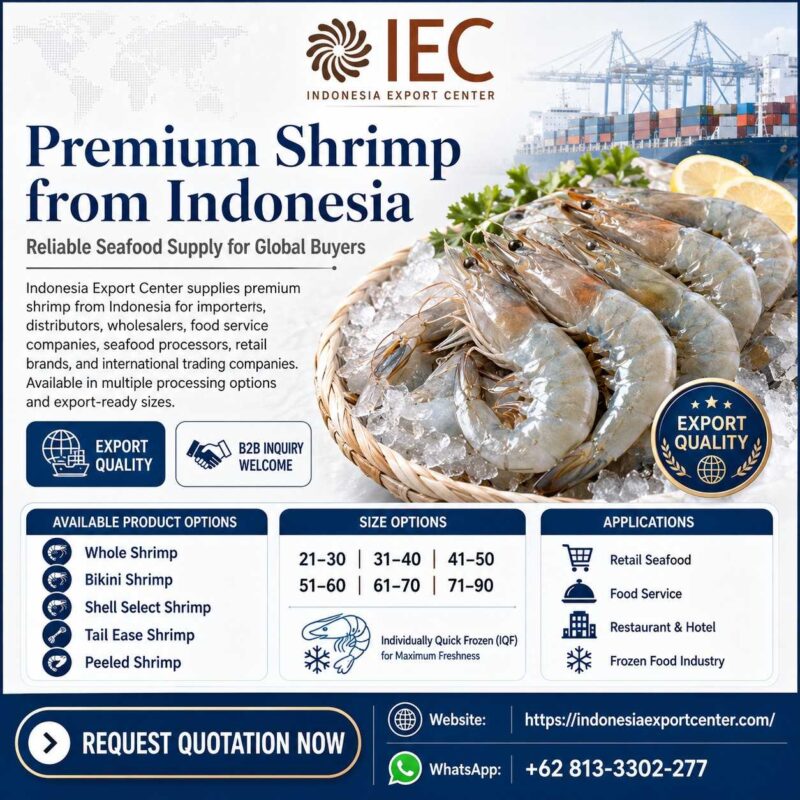
Buyers frequently encounter commercial size descriptions such as 21/30, 31/40, 41/50, 51/60, 61/70, and 71/90.
These numerical ranges generally indicate the number of shrimp pieces within a specified weight unit.
However, the numbers are incomplete unless the counting unit and processing form are clearly identified.
A shrimp grade measured in pieces per pound is significantly different from the same numerical grade measured in pieces per kilogram.
Indonesia Export Center (IEC) assists international buyers with Indonesian vannamei shrimp sourcing inquiries.
This guide explains shrimp size grading, weight conversions, portion calculations, size tolerance, and important purchasing considerations.
What Does Shrimp Size Count Mean?
A shrimp size count generally indicates the number of individual shrimp pieces within an agreed weight.
For example, a 21/30 count may indicate between 21 and 30 pieces per pound or between 21 and 30 pieces per kilogram, depending on the product specification.
Within the same counting system and processing condition, a lower numerical count generally represents larger individual shrimp.
A higher numerical count generally represents smaller individual shrimp.
IEC Vannamei Shrimp Size References
The preliminary IEC promotional product information includes:
| Size Reference | General Relative Size |
|---|---|
| 21–30 | Larger |
| 31–40 | Relatively large |
| 41–50 | Intermediate |
| 51–60 | Relatively smaller |
| 61–70 | Smaller |
| 71–90 | Smallest within this listed range |
These relative descriptions apply only when the counting unit and processing form are the same.
The original promotional information does not establish whether these grades are expressed per pound or per kilogram.
The buyer must obtain supplier confirmation.
Pieces per Pound Versus Pieces per Kilogram
International seafood suppliers may use different counting conventions.
Processed shrimp is frequently traded using pieces per pound, while whole shrimp may be graded using pieces per kilogram.
However, commercial practices vary.
The buyer should never assume the counting unit solely from the shrimp processing form.
One pound equals approximately 453.592 grams.
One kilogram equals approximately 2.20462 pounds.
Consequently, a count expressed per pound represents a different individual shrimp weight from the same count expressed per kilogram.
Shrimp Size Chart: Pieces per Pound
The following table illustrates theoretical individual shrimp weights for grades expressed in pieces per pound.
| Count per Pound | Approximate Individual Weight | Approximate Pieces per kg |
|---|---|---|
| 21/30 | 15.12–21.60 g | 46–66 |
| 31/40 | 11.34–14.63 g | 68–88 |
| 41/50 | 9.07–11.06 g | 90–110 |
| 51/60 | 7.56–8.89 g | 112–132 |
| 61/70 | 6.48–7.44 g | 134–154 |
| 71/90 | 5.04–6.39 g | 157–198 |
The individual weight ranges are calculated by dividing 453.592 grams by the endpoints of each count range.
These are theoretical conversion references, not verified individual shrimp weight specifications.
Shrimp Size Chart: Pieces per Kilogram
The following table illustrates theoretical individual weights when the same numerical grades are expressed in pieces per kilogram.
| Count per Kilogram | Approximate Individual Weight | Approximate Pieces per lb |
|---|---|---|
| 21/30 | 33.33–47.62 g | 9.5–13.6 |
| 31/40 | 25.00–32.26 g | 14.1–18.1 |
| 41/50 | 20.00–24.39 g | 18.6–22.7 |
| 51/60 | 16.67–19.61 g | 23.1–27.2 |
| 61/70 | 14.29–16.39 g | 27.7–31.8 |
| 71/90 | 11.11–14.08 g | 32.2–40.8 |
These calculations demonstrate why the counting unit must be established before purchasing.
Actual individual shrimp weights may vary within a commercial production lot.
Why 21/30 per Pound Is Different from 21/30 per Kilogram
Consider two shrimp products with the same numerical grade.
| Parameter | Product A | Product B |
|---|---|---|
| Size Grade | 21/30 | 21/30 |
| Counting Unit | Pieces per pound | Pieces per kilogram |
| Theoretical Individual Weight | 15.12–21.60 g | 33.33–47.62 g |
| Relative Individual Size | Smaller | Larger |
At the same numerical count, the pieces-per-kilogram product has approximately 2.20462 times the theoretical individual weight of the pieces-per-pound product.
Ordering the wrong counting basis may significantly affect portioning, menu presentation, and manufacturing performance.
How to Convert Shrimp Count per Pound to Count per Kilogram
Use the following mathematical conversion:
Count per kg = Count per lb × 2.20462
For example:
A shrimp product averaging 40 pieces per pound corresponds to approximately 88.18 pieces per kilogram.
Commercial count ranges should be converted using both endpoints.
The converted range should not automatically be assigned a different commercial grade without supplier agreement.
How to Convert Shrimp Count per Kilogram to Count per Pound
Use the following conversion:
Count per lb = Count per kg × 0.453592
For example:
A shrimp product averaging 60 pieces per kilogram corresponds to approximately 27.22 pieces per pound.
These conversions are mathematical references and do not account for processing changes, glaze, or sampling differences.
How to Calculate Average Individual Shrimp Weight
When the count is expressed per kilogram:
Average Individual Weight (g) = 1,000 ÷ Pieces per kg
For example, a product averaging 50 pieces per kilogram has a theoretical average individual weight of 20 grams.
When the count is expressed per pound:
Average Individual Weight (g) = 453.592 ÷ Pieces per lb
A product averaging 50 pieces per pound has a theoretical average individual weight of approximately 9.07 grams.
Actual individual weights may vary.
Additional Commercial Shrimp Size Grades
International seafood buyers may encounter other size descriptions.
| Illustrative Grade | General Meaning |
|---|---|
| U/10 | Under 10 pieces per specified unit |
| U/15 | Under 15 pieces per specified unit |
| 16/20 | 16–20 pieces per specified unit |
| 21/25 | 21–25 pieces per specified unit |
| 26/30 | 26–30 pieces per specified unit |
| 31/40 | 31–40 pieces per specified unit |
| 41/50 | 41–50 pieces per specified unit |
| 51/60 | 51–60 pieces per specified unit |
| 61/70 | 61–70 pieces per specified unit |
| 71/90 | 71–90 pieces per specified unit |
| 91/110 | 91–110 pieces per specified unit |
These are examples of commercial grading terminology.
They do not establish IEC’s current stock or supplier availability.
HOSO Shrimp Size Grading
Head-On Shell-On shrimp includes the head, shell, and tail in the product’s processing condition.
Its individual weight therefore differs from the weight of the same shrimp after head removal or peeling.
HOSO buyers should establish the counting unit, product condition, net weight basis, and grading tolerance.
The numerical HOSO count should not automatically be applied to the processed shrimp obtained after peeling.
HLSO Shrimp Size Grading
Headless Shell-On shrimp has the head removed.
Its weight is affected by head removal and the retained shell configuration.
The buyer should establish whether grading occurs after processing and according to which commercial weight basis.
The supplier should confirm the actual count specification.
Peeled Shrimp Size Grading
Peeled shrimp has undergone shell removal and may also have the tail removed.
Its individual weight depends on the actual processing configuration.
Peeled shrimp count grades may differ substantially from the original whole shrimp grade.
Buyers should specify the required finished-product count rather than assuming a direct conversion from raw whole shrimp size.
PDTO Shrimp Dimensions
For presentation-focused products such as tempura, numerical count grading may not be sufficient.
Manufacturers may require additional dimensions, individual piece weights, tail specifications, and acceptable curvature.
The supplier should confirm its ability to meet these requirements.
Representative samples should be evaluated before commercial approval.
What Is Shrimp Size Tolerance?
Commercial shrimp lots may contain natural variation in individual piece weights.
A size tolerance specification establishes how the buyer and supplier assess acceptable variation.
Relevant considerations may include:
- Average count.
- Individual piece weight distribution.
- Percentage of pieces outside the agreed range.
- Oversized pieces.
- Undersized pieces.
- Broken pieces.
- Sampling quantity.
- Sampling frequency.
- Measurement procedure.
No universal tolerance should be assumed without an agreed product specification.
Average Count Versus Individual Piece Uniformity
A sample may meet its average count requirement while containing individual shrimp with different weights.
For example, a lot averaging 40 pieces per kilogram may include both relatively large and relatively small shrimp.
If visual uniformity or individual portion accuracy is important, the buyer should establish additional requirements concerning piece weight distribution.
Average count alone may not fully describe the product.
How to Verify Shrimp Count
The buyer and supplier should agree on a representative sampling and measurement procedure.
A general count calculation is:
Count per kg = Number of Pieces ÷ Sample Net Weight in kg
For example, if a representative sample contains 45 shrimp pieces and has a net shrimp weight of 0.9 kg, the calculated count is:
45 ÷ 0.9 = 50 pieces per kilogram.
The measurement should follow the agreed method for handling glaze, broken pieces, packaging tare, and product condition.
Glaze and Size Count Accuracy
Protective glaze contributes additional frozen weight but is not shrimp tissue.
Count measurements based on glazed weight may differ from measurements based on deglazed shrimp weight.
The buyer should establish the agreed grading and weight basis.
For commercial comparisons, net shrimp weight should be clearly distinguished from protective glaze and packaging.
Applicable legal net quantity requirements must also be followed.
Shrimp Size Selection for Restaurants
Restaurant buyers may select grades based on the number of shrimp served per portion.
Larger shrimp may be considered for presentation-focused dishes, while smaller shrimp may be suitable for pasta, rice dishes, sauces, and mixed seafood recipes.
The appropriate grade depends on the menu and actual counting unit.
Shrimp Size Selection for Food Manufacturers
Food manufacturers may prioritize consistent ingredient weight, piece dimensions, and production yield.
Smaller peeled shrimp may be considered for prepared meals, dumplings, sauces, and seafood mixes.
The buyer should establish the desired number of pieces per finished product and validate manufacturing performance.
Calculate Shrimp Portions per Kilogram
When the count is expressed per kilogram:
Portions per kg = Pieces per kg ÷ Pieces per Portion
For example, a product averaging 60 pieces per kilogram and served at five pieces per portion would provide approximately 12 portions per kilogram before processing losses.
When count is expressed per pound, convert it to pieces per kilogram first.
Actual portion yield should be measured using the approved product.
Estimate Shrimp Pieces per Retail Pack
For a hypothetical shrimp product averaging 50 pieces per kilogram:
| Net Pack Weight | Approximate Piece Count |
|---|---|
| 200 g | 10 |
| 250 g | 12–13 |
| 400 g | 20 |
| 500 g | 25 |
| 1 kg | 50 |
| 2 kg | 100 |
These estimates assume the stated average count and net shrimp weight.
Actual packs may contain different piece counts due to natural variation.
How Shrimp Size Affects Commercial Price
Shrimp pricing may be influenced by size availability, harvest conditions, processing yield, demand, freezing, packaging, and order volume.
Larger shrimp may command different prices from smaller grades, but no universal price relationship should be assumed.
A buyer should request current quotations for each required processing form and count grade.
Common Shrimp Size Purchasing Mistakes
International buyers should avoid:
- Requesting a numerical grade without a counting unit.
- Comparing HOSO and peeled counts directly.
- Confusing glazed weight with net shrimp weight.
- Assuming every piece has the theoretical average weight.
- Ignoring size tolerance.
- Ordering without a representative sample.
- Using unverified marketing descriptions such as jumbo or large.
- Assuming a count conversion automatically establishes a commercial grade.
Shrimp Size RFQ Checklist
| Parameter | Buyer Requirement |
|---|---|
| Species | Vannamei shrimp |
| Processing Form | |
| Count Grade | |
| Counting Unit | |
| Average Individual Weight | |
| Individual Weight Tolerance | |
| Required Dimensions | |
| Raw or Cooked | |
| Glaze | |
| Net Weight | |
| Sampling Method | |
| Acceptable Defects | |
| Packaging | |
| Quantity | |
| Destination Port |
Frequently Asked Questions
Does 21/30 shrimp mean 21 to 30 pieces per kilogram?
Not necessarily. It may refer to pieces per pound or kilogram depending on the specification.
Which is larger, 21/30 or 61/70?
Within the same counting unit and processing form, 21/30 generally represents larger shrimp.
Can I convert pieces per pound into pieces per kilogram?
Yes. Multiply the count per pound by approximately 2.20462.
Is HOSO 31/40 the same size as peeled 31/40?
Not necessarily. Processing form and counting basis must be considered.
Can I request a specific individual shrimp weight?
Yes. Include the required weight range and acceptable tolerance in the RFQ.
Are IEC’s listed grades confirmed as pieces per kilogram?
No. The preliminary promotional information does not specify the counting unit.
Can I request additional shrimp grades?
Yes, subject to supplier availability and production capability.
Request a Vannamei Shrimp Size-Based Quotation
Send your required processing form, size grade, count basis, individual weight requirements, glaze, net weight, packaging, order quantity, destination port, and preferred Incoterms.
Indonesia Export Center can coordinate sourcing inquiries according to your actual commercial specification.
Contact Indonesia Export Center
INDONESIA EXPORT CENTER (IEC)
Website: https://indonesiaexportcenter.com/
WhatsApp: +62 813-3302-277
Direct inquiry: https://wa.me/628133302277
Request Your Indonesian Vannamei Shrimp Quotation Based on the Correct Size and Count Specification Today.
Related resources:
- Vannamei Shrimp Product Types Guide
- Vannamei Shrimp for Restaurants and Hotels
- Frozen Shrimp for Food Manufacturers
- How to Import Vannamei Shrimp from Indonesia
All mathematical conversions are theoretical references. Actual grading, individual piece weights, tolerance, product availability, and commercial specifications require supplier confirmation.
