

Understand Vannamei Shrimp Processing Formats Before Purchasing
International seafood buyers frequently encounter abbreviations such as HOSO, HLSO, PD, PDTO, PTO, and PUD when requesting frozen shrimp quotations.
These abbreviations describe different processing configurations and can significantly affect product appearance, preparation requirements, usable yield, packaging, and commercial price.
Selecting the wrong processing format may result in unexpected preparation costs, unsuitable menu presentation, or incompatibility with industrial food manufacturing requirements.
Indonesia Export Center (IEC) assists international buyers with sourcing inquiries for Indonesian vannamei shrimp.
This guide explains common shrimp processing formats and the important considerations involved in selecting the appropriate product.
What Is HOSO Shrimp?
HOSO stands for Head-On Shell-On.
This format retains the shrimp’s head, shell, and tail.
Whole HOSO shrimp may be considered for applications where natural whole-shrimp presentation is important.
Potential buyers include seafood wholesalers, restaurants, traditional seafood markets, hotels, and further processing businesses.
HOSO Product Characteristics
- Head retained.
- Shell retained.
- Tail retained.
- Whole shrimp presentation.
- Requires additional preparation when an edible peeled ingredient is needed.
The exact processing and cleaning requirements should be confirmed.
Potential HOSO Applications
HOSO shrimp may be considered for grilling, seafood platters, traditional seafood dishes, restaurant presentation, and whole shrimp retail.
Buyers should evaluate head attachment, shell integrity, discoloration, physical defects, and size consistency.
What Is HLSO Shrimp?
HLSO stands for Headless Shell-On.
The shrimp head has been removed while the shell remains.
The tail is generally retained, but the exact processing specification should be confirmed.
HLSO shrimp may be considered by buyers requiring shell-on seafood with reduced head-removal preparation.
HLSO Product Characteristics
- Head removed.
- Shell retained.
- Tail condition according to specification.
- Different commercial weight basis from HOSO.
- Additional peeling may be required.
Potential HLSO Applications
HLSO shrimp may be evaluated for grilling, restaurant dishes, seafood processing, and further peeling.
Buyers should inspect head removal quality, shell condition, tail integrity, size grading, and net weight.
What Is PDTO Shrimp?
PDTO stands for Peeled Deveined Tail-On.
This format generally refers to shrimp with the head and body shell removed, the required vein removed, and the tail retained according to the approved specification.
The exact shell segments retained near the tail should be established with the supplier.
PDTO Product Characteristics
- Head removed.
- Body shell removed.
- Deveined according to specification.
- Tail retained.
- Suitable for evaluation in presentation-focused dishes.
Potential PDTO Applications
PDTO shrimp may be considered for appetizers, tempura, hotel buffets, seafood platters, restaurant dishes, and selected retail products.
Buyers should evaluate tail condition, shell trimming, vein removal, individual dimensions, and physical appearance.
HOSO vs HLSO vs PDTO Comparison
| Feature | HOSO | HLSO | PDTO |
|---|---|---|---|
| Head | Retained | Removed | Removed |
| Body Shell | Retained | Retained | Removed |
| Tail | Retained | Usually retained | Retained |
| Deveining | Confirm specification | Confirm specification | Required by format |
| Preparation Requirement | Generally greater | Intermediate | Generally reduced |
| Whole Shrimp Appearance | Yes | No | No |
| Typical Inquiry | Whole seafood | Shell-on seafood | Presentation-focused peeled shrimp |
Actual processing configurations must be confirmed.
What Is Peeled Deveined Shrimp?
Peeled deveined shrimp, commonly abbreviated PD, refers to shrimp with the required shell removal and deveining completed.
Tail condition should be specified because commercial terminology may vary.
Some suppliers may use PD to refer to a tail-off product, while others may require additional clarification.
The buyer should not rely on the abbreviation alone.
What Is PTO Shrimp?
PTO generally stands for Peeled Tail-On.
The body shell is removed while the tail is retained.
The abbreviation does not necessarily establish whether the shrimp has been deveined.
Buyers should explicitly confirm vein removal requirements.
What Is PUD Shrimp?
PUD stands for Peeled Undeveined.
The shrimp is peeled but the vein has not been removed according to a deveined specification.
This format may be considered by buyers whose subsequent processing requirements permit it.
The actual tail condition and shell removal quality must be established.
What Is Peeled Tail-Off Shrimp?
Peeled tail-off shrimp generally has the head, shell, and tail removed.
The buyer should separately confirm whether the product is deveined.
This format may be considered for prepared meals, pasta, rice dishes, dumplings, sauces, and industrial seafood ingredients.
What Is Easy Peel Shrimp?
Easy Peel shrimp generally refers to a shell-on product prepared to facilitate shell removal.
The shell may be cut or otherwise processed according to the supplier’s method.
Easy Peel should not automatically be treated as equivalent to peeled shrimp.
Buyers should confirm the exact shell cut, head condition, tail condition, and deveining requirements.
Understanding IEC’s Promotional Shrimp Product Names
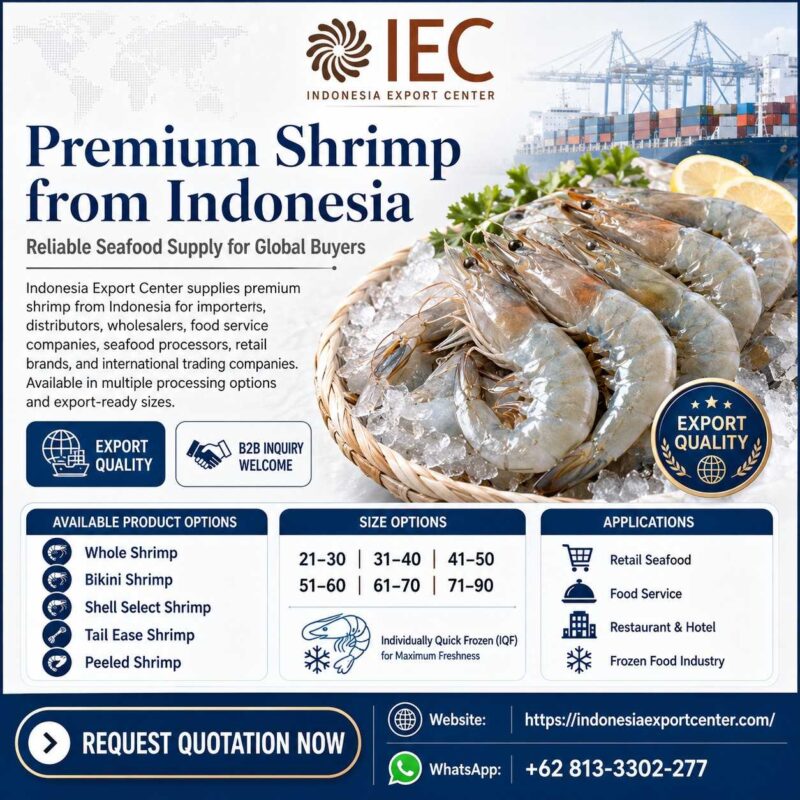
IEC’s preliminary promotional range includes Whole Shrimp, Bikini Shrimp, Shell Select Shrimp, Tail Ease Shrimp, and Peeled Shrimp.
These commercial product names should be evaluated individually.
| IEC Product Name | Required Clarification |
|---|---|
| Whole Shrimp | Confirm whole HOSO configuration |
| Bikini Shrimp | Confirm retained shell segments |
| Shell Select Shrimp | Confirm shell removal pattern |
| Tail Ease Shrimp | Confirm tail and shell configuration |
| Peeled Shrimp | Confirm tail and deveining condition |
Bikini Shrimp, Shell Select Shrimp, and Tail Ease Shrimp should not be automatically assigned standardized HLSO, PDTO, or Easy Peel definitions without supplier documentation.
Raw Versus Cooked Shrimp
Processing form and cooking status are separate characteristics.
For example, a buyer may request raw PDTO shrimp or cooked PDTO shrimp.
The product abbreviation alone does not establish cooking status.
Buyers should specify whether the product is raw, partially cooked, fully cooked, ready to eat, or intended for further cooking.
Cooked shrimp is not automatically ready to eat.
IQF Versus Block Frozen Shrimp
IQF and block frozen describe freezing configurations rather than shell removal formats.
IQF shrimp is intended to remain individually separated.
Block frozen shrimp is frozen together in a block or other grouped configuration.
A buyer may request IQF HOSO, IQF peeled shrimp, or another supplier-confirmed combination.
The appropriate freezing method depends on storage, preparation, portioning, and manufacturing requirements.
How Processing Form Affects Usable Yield
Different shrimp processing formats contain different amounts of head, shell, tail, and edible shrimp tissue.
A whole shrimp purchase may require additional processing before the edible ingredient is obtained.
Peeled shrimp may provide a greater proportion of usable ingredient per purchased net kilogram, depending on the actual specification.
However, no universal yield percentage should be assumed.
Yield varies with shrimp size, raw material condition, processing method, and intended use.
Illustrative Yield Comparison
Consider the following hypothetical procurement example.
| Product | Net Purchase Weight | Hypothetical Usable Yield | Usable Weight |
|---|---|---|---|
| HOSO | 100 kg | 50% | 50 kg |
| HLSO | 100 kg | 75% | 75 kg |
| Peeled Tail-Off | 100 kg | 95% | 95 kg |
These percentages are examples used to demonstrate yield calculations.
They are not verified commercial yield ranges or IEC product specifications.
Buyers should establish actual yield through representative product testing.
Compare Cost per Usable Kilogram
A hypothetical buyer receives the following offers.
| Product | Purchase Price/kg | Measured Yield | Usable Cost/kg |
|---|---|---|---|
| HOSO | USD 4.00 | 50% | USD 8.00 |
| HLSO | USD 5.00 | 75% | USD 6.67 |
| Peeled | USD 6.00 | 95% | USD 6.32 |
Although the peeled product has the highest purchase price, it produces the lowest usable ingredient cost in this hypothetical example.
The appropriate product also depends on presentation, preparation, and menu requirements.
These prices are illustrative and do not represent current market quotations.
How Processing Form Affects Size Grading
The same shrimp may have different individual weights before and after head removal or peeling.
Consequently, HOSO and peeled shrimp count grades cannot be directly compared without understanding the actual weight basis.
Buyers should specify:
- Processing condition at the time of grading.
- Pieces per kilogram or pound.
- Size range.
- Acceptable variation.
- Sampling method.
- Glaze and net weight basis.
Product Selection by Industry
| Buyer Industry | Potential Format |
|---|---|
| Seafood Wholesale | HOSO, HLSO or mixed assortment |
| Seafood Restaurants | HOSO, HLSO or PDTO |
| Hotels | PDTO, peeled or whole shrimp |
| Catering | Peeled shrimp |
| Ready Meal Factories | Peeled tail-off or suitable cooked shrimp |
| Supermarkets | Whole, peeled or Easy Peel |
| Tempura Manufacturers | Dimension-controlled PDTO |
| Industrial Processors | HLSO or buyer-defined ingredients |
The actual format should be selected according to the approved application.
Quality Inspection for Different Shrimp Formats
HOSO inspection may emphasize head attachment, shell condition, and whole product appearance.
HLSO inspection may emphasize head removal quality, shell integrity, and tail condition.
Peeled shrimp inspection may emphasize shell fragments, vein removal, tail configuration, and physical defects.
All formats should be evaluated for species identity, size grading, glaze, net weight, packaging, and applicable food safety requirements.
Ordering Checklist for International Shrimp Buyers
Before requesting a quotation, confirm:
- Required species.
- Country of origin.
- Processing abbreviation.
- Exact head condition.
- Exact shell configuration.
- Tail condition.
- Deveining requirements.
- Raw or cooked condition.
- Size grade.
- Counting unit.
- Freezing method.
- Glaze.
- Net weight.
- Ingredient restrictions.
- Packaging.
- Required documentation.
- Order quantity.
- Destination port.
Representative photographs and technical specifications may help avoid misunderstandings.
Frequently Asked Questions
What is the main difference between HOSO and HLSO?
HOSO retains the head, while HLSO has the head removed. Both retain the shell according to their specifications.
What is the difference between PDTO and PTO?
PDTO includes a deveining requirement, while PTO alone does not necessarily establish deveining.
Is PDTO shrimp cooked?
Not necessarily. PDTO describes processing configuration, not cooking status.
Is Easy Peel shrimp fully peeled?
Generally no. The shell is prepared for easier removal.
Which shrimp format has the best yield?
Actual usable yield depends on processing condition, product quality, and intended use. It should be measured.
Can I request customized shell removal?
Yes, as a sourcing inquiry, subject to supplier capability.
Are Bikini Shrimp and PDTO the same?
Not necessarily. The actual shell configuration must be confirmed.
Request an Indonesian Vannamei Shrimp Product Quotation
Indonesia Export Center welcomes inquiries for whole, shell-on, peeled, tail-on, tail-off, and other supplier-confirmed shrimp products.
Send your required processing form, product photographs or specification, size grade, count basis, freezing method, glaze, net weight, packaging, quantity, destination port, and preferred Incoterms.
Contact Indonesia Export Center
INDONESIA EXPORT CENTER (IEC)
Website: https://indonesiaexportcenter.com/
WhatsApp: +62 813-3302-277
Direct inquiry: https://wa.me/628133302277
Find the Right Indonesian Vannamei Shrimp Processing Format for Your Business Today.
Related guides:
- Vannamei Shrimp Sizes and Count Chart
- How to Import Vannamei Shrimp from Indonesia
- Frozen Shrimp for Food Manufacturers
- Vannamei Shrimp for Restaurants and Hotels
Processing definitions, product availability, yield, customized specifications, MOQ, and commercial prices require supplier confirmation.
