

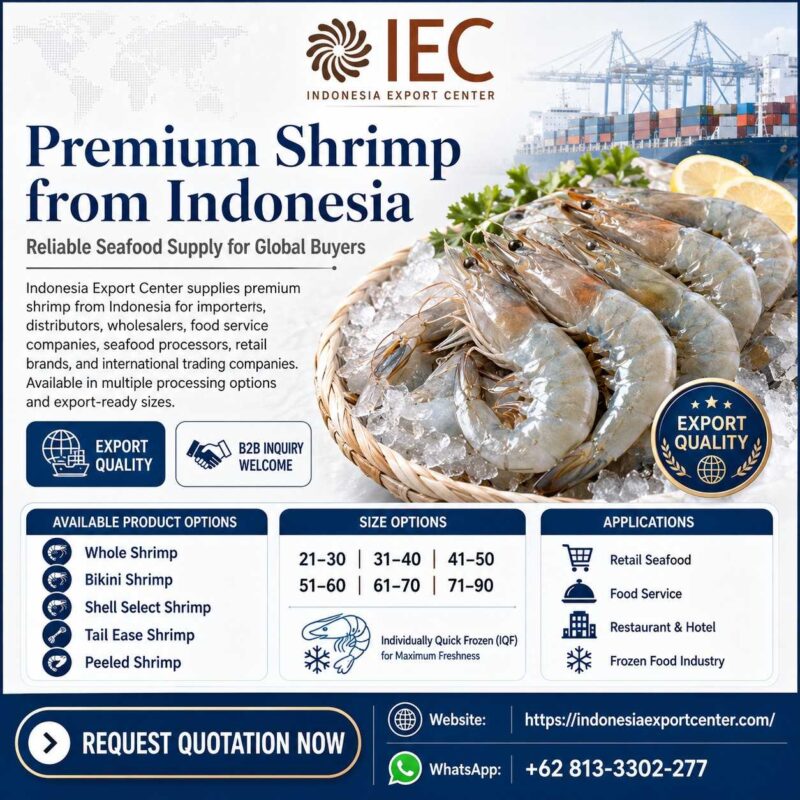
Source Indonesian Frozen Vannamei Shrimp for Germany
Indonesia Export Center (IEC) assists German seafood importers, frozen food distributors, supermarket suppliers, private-label brands, foodservice wholesalers, and industrial food manufacturers with Indonesian vannamei shrimp sourcing inquiries.
German seafood procurement programs may require detailed product specifications, consistent net weights, verified traceability, appropriate food safety documentation, and responsible sourcing information.
IEC helps international buyers communicate these requirements to potential Indonesian seafood suppliers and processing facilities.
Whether your company requires individually quick frozen peeled shrimp, retail-packed whiteleg shrimp, industrial seafood ingredients, or recurring container shipments, IEC welcomes your commercial inquiry.
Actual supplier capability, product availability, certification status, and European Union export eligibility must be verified.
Indonesian Whiteleg Shrimp for German Buyers
Vannamei shrimp, scientifically known as Litopenaeus vannamei, is a widely cultivated shrimp species used in international seafood manufacturing.
German buyers may use commercial search terms such as Vannamei Garnelen, Tiefkühlgarnelen, or Weißbeingarnelen when evaluating frozen shrimp sourcing opportunities.
The legally applicable product designation should be confirmed before commercial labeling.
Indonesian vannamei shrimp may be considered for supermarket frozen seafood, prepared meals, seafood pasta, restaurant distribution, frozen seafood mixes, and private-label products.
Peeled Vannamei Shrimp for German Retailers
Peeled shrimp may support convenient consumer preparation and commercial ingredient handling.
Potential product inquiries include peeled deveined shrimp, peeled tail-off shrimp, and peeled deveined tail-on shrimp.
The buyer should establish the required processing quality, shell removal, deveining, tail condition, count grade, glaze, net weight, and ingredient declaration.
Products should be evaluated through representative samples before commercial approval.
IQF Vannamei Shrimp for German Frozen Food Distribution
Individually Quick Frozen shrimp may support flexible portioning and convenient frozen storage.
IQF products are intended to remain individually separated, allowing buyers or consumers to handle the required quantity.
Actual separation and product quality depend on freezing, glazing, packaging, and cold-chain conditions.
German buyers may inspect representative samples for clumping, physical damage, discoloration, processing defects, net weight, and size consistency.
Product Options for Germany
| Product Form | Potential Commercial Application |
|---|---|
| Peeled Deveined Shrimp | Retail and prepared foods |
| Peeled Tail-Off Shrimp | Frozen meals and industrial ingredients |
| PDTO Shrimp | Foodservice and appetizers |
| HLSO Shrimp | Further processing |
| HOSO Shrimp | Whole seafood distribution |
| Easy Peel Shrimp | Retail convenience |
| Cooked Frozen Shrimp | Selected prepared seafood |
| IQF Shrimp | Retail and wholesale |
| Breaded Shrimp | Value-added frozen food inquiries |
The availability of each product format must be confirmed.
Shrimp Size References
IEC’s preliminary promotional material includes:
| Size Reference | Potential Application |
|---|---|
| 21–30 | Larger shrimp portions |
| 31–40 | Retail and foodservice |
| 41–50 | Prepared foods |
| 51–60 | Industrial ingredients |
| 61–70 | Frozen meal manufacturing |
| 71–90 | Smaller seafood ingredients |
The counting unit must be confirmed before purchasing.
German buyers should specify whether grading is based on pieces per pound, pieces per kilogram, or another agreed measurement.
Private-Label Frozen Shrimp for Germany
German retail brands may require private-label frozen seafood products developed according to their own commercial specifications.
A private-label project may involve product selection, sample approval, packaging materials, artwork development, label review, quality inspection, production planning, and shipment coordination.
Potential consumer pack sizes include 200 g, 250 g, 300 g, 400 g, 500 g, and 1 kg.
These are illustrative packaging requirements rather than confirmed supplier options.
Actual printing capability, packaging MOQ, and production lead time must be established.
German-Language Retail Packaging
Retail seafood packaging should communicate accurate product information in accordance with applicable EU and German requirements.
Potential information includes:
- Product designation.
- Scientific species name where required.
- Production method and origin where applicable.
- Ingredient declaration.
- Crustacean shellfish allergen information.
- Net quantity excluding protective glaze where required.
- Storage instructions.
- Date marking.
- Lot identification.
- Nutrition information where applicable.
- Responsible food business information.
The importer should review the artwork before production.
Unverified claims concerning sustainability, naturalness, environmental performance, or product purity should not appear on the label.
Sustainability and Responsible Shrimp Sourcing
Some German retailers and seafood distributors establish procurement policies covering responsible aquaculture, environmental performance, social responsibility, and supply-chain transparency.
Buyers may request information about farm identity, production practices, feed sourcing, veterinary drug management, environmental controls, and labor standards.
Relevant certification inquiries may include ASC, BAP, or other buyer-recognized programs.
However, the existence of a certification logo in marketing material does not establish that the actual commercial shipment is covered.
Buyers should verify certificate validity, scope, certified sites, product coverage, and applicable chain-of-custody arrangements.
Farm-to-Product Traceability
A traceability program may connect farm or raw material records with processing batches, packaging lots, warehouse information, and export shipments.
German procurement teams may request documentation demonstrating the origin and movement of the product.
The supplier should explain its traceability system and ability to retrieve relevant records.
IEC does not independently certify farm origin or sustainability performance.
EU Import Eligibility for Germany
Germany applies relevant European Union requirements for imported seafood.
The importer should verify the actual processing establishment’s eligibility, product category, official certification, border control procedures, and applicable documentation.
Potential verification areas include:
| Compliance Area | Buyer Action |
|---|---|
| Country and Establishment Eligibility | Verify current official status |
| Official Health Certificate | Confirm applicable certificate |
| Border Control Post | Confirm appropriate entry point |
| TRACES NT | Establish relevant notification procedures |
| Food Safety | Verify product-specific requirements |
| Veterinary Drug Residues | Review applicable controls |
| Traceability | Request supporting records |
| Food Labeling | Verify EU and German requirements |
A supplier’s ability to export to another country does not automatically establish EU eligibility.
Food Safety Management and Supplier Audits
German buyers may require detailed food safety documentation or supplier audits.
Potential requests include HACCP-related records, sanitation programs, laboratory reports, traceability information, recall procedures, and relevant food safety certifications.
Certifications such as IFS Food, BRCGS, FSSC 22000, or ISO 22000 may be relevant to certain purchasing programs.
These certifications have different scopes and requirements.
The actual certificate and facility coverage must be verified.
Microbiological and Chemical Quality
Food safety testing may include relevant microbiological parameters, veterinary drug residues, contaminants, and processing additives.
The applicable testing requirements depend on the product, intended use, and destination regulations.
Raw shrimp and ready-to-eat cooked shrimp may require different food safety assessments.
A batch-specific laboratory report should identify the tested product and lot.
No universal acceptance limits are claimed without an approved specification.
Additives and Moisture-Retention Requirements
German food manufacturers and retailers may establish restrictions concerning processing additives or moisture-retention treatments.
Buyers should request a complete ingredient declaration and information about relevant processing treatments.
The supplier should confirm whether additives are used and provide appropriate supporting documentation.
Products should not be described as additive-free or untreated without verification.
Glazing and Net Weight Accuracy
Protective glaze may help maintain frozen shrimp quality.
However, actual shrimp weight should be distinguished from protective ice.
For glazed foods, applicable EU rules generally require the declared net quantity to exclude glaze.
German buyers should establish the glaze calculation convention, target or maximum percentage, required net weight, sampling procedure, and acceptance criteria.
Accurate weight verification supports fair commercial comparison and consumer information.
Industrial Shrimp for German Food Manufacturers
Peeled shrimp may be evaluated for frozen pasta, ready meals, seafood pizzas, prepared sauces, frozen rice dishes, and seafood mixes.
Industrial buyers should consider usable yield, portion consistency, ingredient handling, cooking performance, and total manufacturing cost.
A lower purchase price does not necessarily result in a lower cost per usable kilogram.
Production trials should be conducted before approving a new ingredient supplier.
Cold-Chain and Packaging Management
Frozen shrimp requires suitable temperature-controlled transportation and storage.
Approximately -18°C or colder is a common frozen storage reference, subject to applicable requirements and the approved product specification.
The buyer should establish packaging integrity, carton strength, reefer settings, temperature monitoring, and handling procedures.
Packaging materials should be appropriate for their intended food-contact and frozen storage use.
Shipping Indonesian Shrimp to Germany
Potential destination-port inquiries include Hamburg, Bremerhaven, and other suitable European entry ports.
The importer may also consider entry through another EU country followed by inland distribution, subject to applicable border and customs procedures.
Actual freight availability, transit time, reefer capacity, border control suitability, and destination handling must be confirmed.
FOB and CIF Germany Quotations
German buyers may request FOB Indonesia or CIF quotations to a named destination port.
The quotation should specify the exact product, packaging, net weight basis, quantity, currency, delivery terms, payment terms, and validity period.
CIF quotations require confirmed freight arrangements.
For containerized cargo, alternative Incoterms such as FCA or CIP may be considered where appropriate.
Indonesian Shrimp Price for Germany
Pricing may depend on raw material availability, size grade, processing form, yield, freezing, glaze, packaging, certification requirements, testing, order quantity, and international freight.
German importers should also consider duties, taxes, border inspection, storage, handling, and inland transportation.
Sustainability-related requirements or customized packaging may influence procurement costs.
IEC recommends requesting a current quotation based on a complete specification.
Long-Term Supply for German Retail Programs
Retailers and frozen food distributors may require recurring supply according to approved product specifications.
A commercial agreement should establish expected monthly volume, production schedules, packaging standards, quality tolerances, inspection requirements, and non-conformity procedures.
Actual production capacity and delivery commitments must be confirmed by the supplier.
Why Work with Indonesia Export Center?
IEC provides independent sourcing assistance, supplier matching, product specification coordination, sample inquiries, certification requests, commercial quotations, and export logistics discussions.
We help German buyers evaluate potential Indonesian seafood sourcing opportunities according to their technical and commercial needs.
IEC is not the manufacturer or certification authority.
Frequently Asked Questions
Can IEC source peeled IQF shrimp for Germany?
Yes. Peeled and IQF shrimp inquiries are welcome, subject to supplier capability.
Can I request ASC-certified shrimp?
Yes, as a procurement requirement. Actual certification and shipment coverage must be verified.
Can I request German-language private-label packaging?
Yes, subject to packaging capability and approved artwork.
Are all Indonesian shrimp suppliers eligible for the EU?
No. The actual establishment and product eligibility must be verified.
Can I request CIF Hamburg?
Yes, subject to current supplier and freight offers.
Can I request shrimp without particular additives?
Yes. Submit your ingredient restrictions for supplier evaluation.
Can IEC guarantee recurring supply?
No. Capacity and shipment schedules require supplier confirmation.
Request a Vannamei Shrimp Quotation for Germany
| RFQ Information | Buyer Requirement |
|---|---|
| Company Name | |
| Distribution Channel | |
| Product Form | |
| Size Grade and Count Basis | |
| Raw or Cooked | |
| Freezing Method | |
| Glaze | |
| Net Weight | |
| Packaging | |
| German Label Requirements | |
| Additive Restrictions | |
| Sustainability Requirements | |
| Food Safety Certifications | |
| EU Establishment Documentation | |
| Initial Quantity | |
| Monthly Requirement | |
| Destination Port | |
| Preferred Incoterms | |
| Shipment Schedule |
Contact Indonesia Export Center
INDONESIA EXPORT CENTER (IEC)
Global Trading & Export Solution
Website: https://indonesiaexportcenter.com/
WhatsApp: +62 813-3302-277
Direct inquiry: https://wa.me/628133302277
Request Your Indonesian IQF Vannamei Shrimp and Private-Label Seafood Quotation for Germany Today.
Explore related sourcing pages:
- Vannamei Shrimp Supplier Indonesia
- IQF Vannamei Shrimp Supplier
- Peeled Deveined Vannamei Shrimp
- Indonesian Farmed Vannamei Shrimp
- Custom Pack Frozen Vannamei Shrimp
Product specifications, sustainability claims, certifications, EU eligibility, production capacity, prices, and shipping arrangements require verification.
