

Farmed Whiteleg Shrimp Sourcing from Indonesia
International seafood buyers increasingly consider aquaculture practices, traceability, food safety, and supplier transparency when purchasing farmed shrimp.
Indonesia Export Center (IEC) supports buyers seeking Indonesian farmed vannamei shrimp supplier options and helps coordinate requests for relevant sourcing information.
Vannamei shrimp, scientifically known as Litopenaeus vannamei, is a widely farmed shrimp species.
However, farming practices and documentation vary between producers.
Buyers should evaluate the actual farm and processing supply chain rather than relying on broad claims about sustainability or quality.
Understanding Vannamei Shrimp Aquaculture
Vannamei shrimp can be produced through managed aquaculture systems.
Production conditions depend on the farm, location, management approach, and applicable regulations.
A buyer may wish to understand how the shrimp was raised, harvested, transported, processed, and frozen.
The level of traceability available depends on the supplier’s recordkeeping and supply-chain arrangements.
Why Farm Traceability Matters
Traceability can help connect a finished shrimp product with its source and processing history.
Relevant records may include farm identification, harvest information, receiving records, processing batch numbers, and shipment references.
These records can support food safety investigations, supplier qualification, and responsible sourcing programs.
Farm-Origin Verification
Buyers may request confirmation of the farm or production area associated with the offered product.
The supplier should explain whether the shrimp originates from a single farm, multiple farms, or an aggregated sourcing system.
If several farms contribute to a processing batch, the traceability system should be evaluated accordingly.
Aquaculture Management Considerations
Depending on the buyer’s requirements, relevant topics may include:
- Water quality monitoring.
- Stocking and production management.
- Feed sourcing.
- Animal health monitoring.
- Biosecurity practices.
- Veterinary medicine controls.
- Harvest handling.
- Environmental management.
- Worker safety.
- Recordkeeping.
The supplier must provide evidence for any specific claim.
Antibiotic and Residue Controls
Seafood importers may have strict requirements concerning veterinary drug residues and prohibited substances.
Buyers should request information about relevant controls and testing.
No product should be described as antibiotic-free or residue-free without appropriate evidence and a clearly defined claim.
Harvest and Post-Harvest Handling
Product quality can be affected by the period between harvest and processing.
Buyers may request information about handling procedures, temperature management, transport to the processing facility, and receiving controls.
The responsible supplier should confirm the actual procedures.
Processing and Freezing
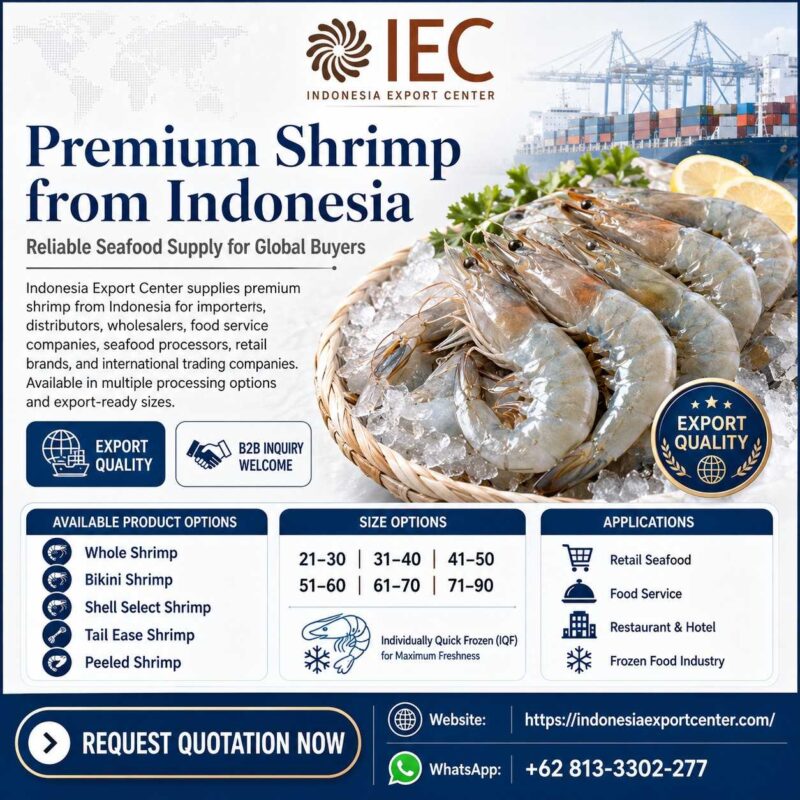
The preliminary IEC promotional material identifies IQF as a freezing option.
Buyers should confirm the processing facility, product form, freezing method, and storage requirements.
The final product specification should be consistent with the purchasing contract.
Product Forms and Sizes
Listed commercial options include Whole Shrimp, Bikini Shrimp, Shell Select Shrimp, Tail Ease Shrimp, and Peeled Shrimp.
Listed size ranges are 21–30, 31–40, 41–50, 51–60, 61–70, and 71–90.
Processing definitions, count units, and availability require supplier confirmation.
Sustainability Documentation
Some buyers request third-party aquaculture certification or environmental documentation.
Any certification must be checked for validity, scope, facility coverage, and relevance to the actual product.
IEC does not claim that all potential suppliers hold a particular certification.
Responsible Sourcing Questions
| Topic | Question for Supplier |
|---|---|
| Farm Origin | Can the source be identified? |
| Traceability | Can batches be linked to farm records? |
| Feed | Is relevant sourcing information available? |
| Animal Health | What management controls apply? |
| Residue Testing | What tests are performed? |
| Processing Facility | Which establishment handles the product? |
| Certification | What valid certificates apply? |
| Environmental Practices | What documented controls exist? |
| Labor Practices | What policies and evidence are available? |
Buyer Audits
Some procurement teams conduct supplier audits or request third-party assessments.
The audit scope should reflect the buyer’s risks and requirements.
IEC may facilitate communication about available documentation, but does not independently certify farm practices.
International Market Requirements
Different destination markets may impose specific food safety, traceability, and documentation requirements.
Importers should confirm applicable rules with qualified advisers.
Frequently Asked Questions
Is vannamei shrimp farmed in Indonesia?
Yes. Vannamei shrimp is an aquaculture species produced in Indonesia.
Does every supplier provide farm-level traceability?
No. Traceability capabilities must be verified.
Is all Indonesian farmed shrimp sustainability-certified?
No such universal claim can be made.
Can I request farm-origin information?
Yes. Availability depends on the supplier.
Can I request residue testing?
Yes. Testing requirements and available results must be confirmed.
Does IEC audit every farm?
IEC is a sourcing intermediary and does not claim to independently audit every potential farm.
Request Farmed Vannamei Shrimp Sourcing Information
Company Name:
Country:
Product Form:
Size and Count Basis:
Quantity:
Farm Traceability Requirements:
Residue Testing Requirements:
Sustainability Requirements:
Required Certifications:
Packaging:
Destination Port:
Shipment Schedule:
Indonesia Export Center (IEC)
Website: https://indonesiaexportcenter.com/
WhatsApp: https://wa.me/628133302277
Contact IEC to discuss Indonesian farmed vannamei shrimp sourcing and supplier-confirmed traceability documentation.
Related pages:
- Vannamei Shrimp Supplier Indonesia
- Indonesian Whiteleg Shrimp Supplier
- Vannamei Shrimp Sourcing Indonesia
Farm origin, sustainability practices, certification, residue testing, and traceability require supplier-specific evidence.
