

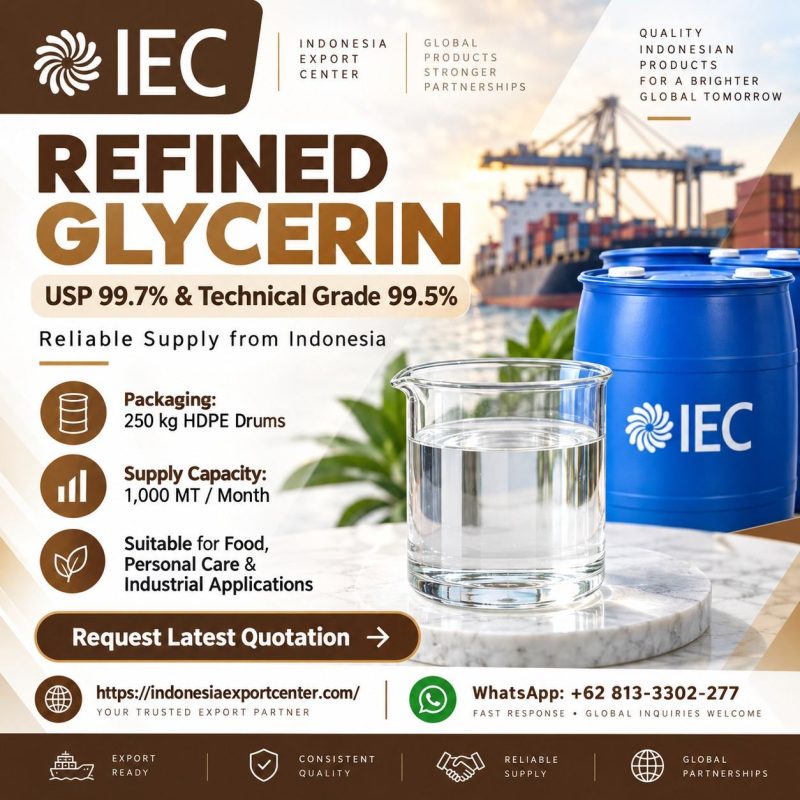
Understanding Refined Glycerin Quality Before Bulk Purchasing
For international manufacturers, a refined glycerin purchasing decision should never depend on nominal purity alone.
A supplier may advertise USP 99.7% or Technical Grade 99.5%, but the actual suitability of the product depends on its complete specification, analytical results, manufacturing controls, and intended application.
Indonesia Export Center (IEC) supports international buyers seeking Indonesian refined glycerin supplier options and technical documentation.
This guide explains how to evaluate refined glycerin COA specifications, including glycerol assay, water content, color, identity, impurities, sampling, and batch traceability.
What Is a Certificate of Analysis?
A Certificate of Analysis, commonly called a COA, is a document reporting analytical results for an identified product sample or batch.
It may include the product name, batch number, manufacturing or testing information, analytical parameters, test methods, specification limits, and actual results.
A COA is an important quality-control document, but it should not automatically be treated as proof that an entire shipment meets every requirement.
Its reliability depends on representative sampling, appropriate methods, laboratory competence, and traceability.
What Is a Technical Data Sheet?
A Technical Data Sheet, or TDS, describes the general technical characteristics of a product.
It may contain typical properties, intended grade, recommended handling information, and relevant specifications.
A TDS usually describes the product grade rather than reporting the actual analytical results of a particular shipment.
For commercial qualification, buyers may need both the TDS and a batch-specific COA.
Preliminary Refined Glycerin Grades
| Product | Stated Purity | Main Sourcing Focus |
|---|---|---|
| USP 99.7% Refined Glycerin | 99.7% | Higher-specification applications requiring verification |
| Technical Grade Glycerin | 99.5% | Industrial chemical and manufacturing applications |
The actual specification and grade designation must be verified against current supplier documents.
Glycerol Assay
The glycerol assay measures the concentration of glycerol according to an identified analytical method.
The stated percentages of 99.7% and 99.5% should be interpreted in the context of the supplier’s test method and specification.
A difference in assay does not automatically explain all differences in product quality.
Buyers should also consider relevant impurities and intended-use requirements.
Water Content
Glycerin is hygroscopic and can absorb moisture.
Water content may influence product concentration, processing behavior, and formulation consistency.
The appropriate limit depends on the product grade and intended application.
Buyers should confirm the test method and actual result.
Color and Appearance
Refined glycerin is generally expected to have an appearance consistent with its specification.
Color may matter in transparent products, cosmetics, food ingredients, and certain chemical processes.
A visual assessment alone cannot establish chemical purity.
Acidity and Alkalinity
These characteristics may influence formulation compatibility and downstream chemical processing.
Buyers should establish acceptable limits for the intended use.
Ash and Inorganic Residues
Ash and other inorganic residues may be relevant to certain industrial processes.
The acceptable level depends on the product specification.
Chloride Content
Chlorides may be important in applications sensitive to inorganic impurities or corrosion.
Buyers should request the relevant analytical information where necessary.
Organic Impurities
A product may have high glycerol assay while still containing impurities that are unsuitable for a particular application.
The relevant impurity profile depends on feedstock, manufacturing process, grade, and end use.
Diethylene Glycol and Ethylene Glycol
Diethylene glycol (DEG) and ethylene glycol (EG) are hazardous contaminants that require particular attention in glycerin used for pharmaceutical and other sensitive applications.
Appropriate testing, supplier qualification, and supply-chain controls are essential.
A statement of 99.7% glycerol purity does not establish that DEG and EG requirements have been met.
Manufacturers should apply the relevant current regulatory and compendial requirements.
Identity Testing
Identity testing helps confirm that the material is what it is represented to be.
This is especially important when materials have similar appearances or commercial names.
Buyers should verify which identity tests are required for their intended application.
USP Compliance vs Nominal Purity
A product described as USP 99.7% must not be assumed compliant solely from its assay.
USP compliance requires satisfaction of the applicable monograph requirements, including relevant identity and impurity controls.
Manufacturers must confirm that the supplier’s evidence is sufficient for their quality system.
Food Grade Verification
Food-grade suitability requires compliance with applicable food ingredient requirements.
A USP label does not automatically establish food-grade status in every market.
Buyers should review the applicable standards, documentation, and regulatory conditions.
Cosmetic Ingredient Verification
Cosmetic manufacturers should assess the ingredient’s quality, impurity profile, traceability, and regulatory suitability.
The finished formulation may also require stability and safety evaluation.
Technical Grade Evaluation
Industrial buyers may prioritize different parameters depending on their manufacturing process.
A soap manufacturer, resin producer, and chemical processor may not have identical specifications.
The correct technical grade should be selected based on actual process requirements.
COA Review Checklist
| Inspection Item | What to Verify |
|---|---|
| Product Name | Correct glycerin grade |
| Supplier Identity | Responsible issuing company |
| Batch Number | Shipment traceability |
| Testing Date | Relevant analytical record |
| Glycerol Assay | Result and method |
| Water Content | Result and method |
| Color | Applicable specification |
| Acidity or Alkalinity | Applicable result |
| Inorganic Impurities | Relevant parameters |
| DEG and EG | Appropriate testing where required |
| Identity | Required confirmation |
| Specification Limits | Clearly defined acceptance criteria |
| Authorized Approval | Document authenticity |
Sampling and Independent Testing
For high-value or sensitive transactions, buyers may request independent sampling and laboratory analysis.
Sampling procedures should be representative and agreed before shipment.
The parties should define the laboratory, test methods, sample custody, and treatment of conflicting results.
Where accreditation is required, buyers should verify that the relevant tests fall within the laboratory’s accredited scope.
Batch Traceability
Batch traceability helps connect the product, packaging, COA, and shipment records.
Buyers should verify that batch identifiers are consistent across the relevant documents.
For recurring purchases, traceability can support investigations and corrective action.
Quality Requirements in the Sales Contract
The contract should identify the agreed product specification and applicable analytical methods.
It should also establish inspection procedures, acceptance criteria, notification deadlines, and remedies for non-conforming cargo.
A general statement such as “high quality” is not an adequate substitute for measurable requirements.
Frequently Asked Questions
Is a COA the same as a TDS?
No. A TDS describes general product characteristics, while a COA reports analytical results for an identified sample or batch.
Does 99.7% purity prove USP compliance?
No. All applicable compendial requirements must be verified.
Why are DEG and EG important?
They are hazardous contaminants requiring appropriate controls, particularly in pharmaceutical and other sensitive uses.
Should buyers request a COA for every shipment?
Buyers should establish batch documentation requirements according to their quality system and contract.
Can independent testing be requested?
Yes, subject to agreement with the supplier and inspection provider.
Does IEC issue the supplier’s COA?
IEC is a sourcing intermediary. Quality documentation must originate from the responsible supplier or testing organization.
Are all technical specification values publicly available?
Not necessarily. Actual values should be obtained from verified supplier documentation.
Request the Latest Refined Glycerin COA
Company Name:
Country:
Required Grade:
Intended Application:
Applicable Standard:
Required Glycerol Assay:
Required Impurity Limits:
Required Test Methods:
Initial Quantity (MT):
Expected Monthly Volume (MT):
Destination Port:
Required Documentation:
Indonesia Export Center (IEC)
Website: https://indonesiaexportcenter.com/
WhatsApp: +62 813-3302-277
Request supplier-confirmed refined glycerin technical specifications and COA documentation before making your bulk purchasing decision.
Related pages:
No analytical limits, test results, certifications, or regulatory approvals should be assumed without current supplier documentation.
