

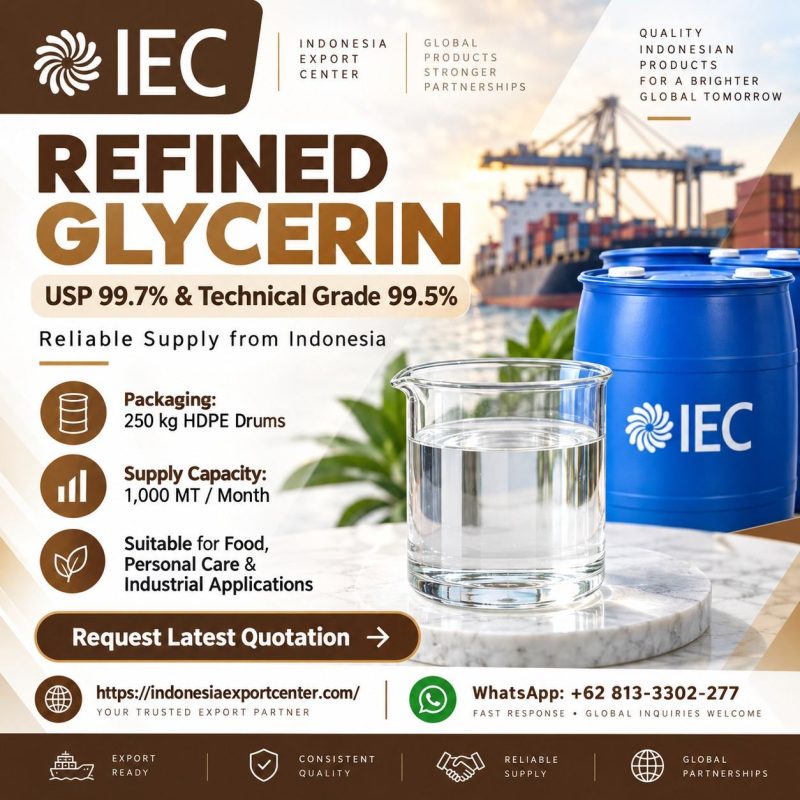
Step-by-Step Refined Glycerin Import Sourcing
Importing refined glycerin from Indonesia can be an option for international chemical distributors, industrial manufacturers, food ingredient companies, and personal care businesses seeking bulk glycerol supply.
However, successful importing requires more than finding a supplier and requesting a price.
Buyers must verify the product grade, supplier credentials, quality documentation, applicable customs classification, regulatory requirements, packaging, payment conditions, and shipping arrangements.
Indonesia Export Center (IEC) helps international buyers navigate the sourcing inquiry process for Indonesian refined glycerin.
This guide explains how to import refined glycerin from Indonesia through a structured B2B purchasing workflow.
Step 1: Identify the Exact Glycerin Product
Refined glycerin, also known as glycerol, is available in different grades.
The preliminary IEC sourcing range identifies:
USP 99.7% Refined Glycerin: A proposed higher-specification product requiring documentary verification of any USP or application-specific claims.
Technical Grade Glycerin 99.5%: A proposed industrial product intended for appropriate manufacturing applications.
The buyer should not select a grade solely by comparing nominal purity percentages.
Step 2: Define Your Intended Application
The intended application determines the necessary technical and regulatory requirements.
A food manufacturer may need food ingredient compliance documentation.
A cosmetic manufacturer may focus on impurity controls, formulation compatibility, and applicable cosmetic regulations.
A chemical processor may prioritize industrial assay, water content, and process-specific impurity limits.
Pharmaceutical manufacturers may require particularly stringent supplier qualification and contaminant testing.
Step 3: Prepare a Technical Specification
A purchasing specification should describe the exact requirements the material must meet.
Relevant parameters may include:
- Glycerol assay.
- Water content.
- Color and appearance.
- Acidity or alkalinity.
- Chlorides.
- Ash.
- Relevant organic impurities.
- Diethylene glycol and ethylene glycol controls.
- Identity and compendial tests where applicable.
- Feedstock origin, if required.
Numerical acceptance limits should be established using applicable standards and supplier-confirmed documentation.
Step 4: Verify the Indonesian Supplier
Supplier verification should include legal identity, commercial role, product source, and documentation.
Determine whether the seller is a manufacturer, distributor, trader, or exporter.
Buyers should also independently verify the company receiving payment.
Do not assume that a sourcing intermediary owns a manufacturing facility.
Step 5: Request the TDS, COA and SDS
The Technical Data Sheet describes the product’s technical characteristics.
The Certificate of Analysis reports analytical results for an identified batch or sample.
The Safety Data Sheet provides relevant safety and handling information.
These documents serve different purposes and should not be treated as interchangeable.
Step 6: Confirm the HS Classification
The preliminary reference identifies HS code 2905.45.00 for glycerol.
However, customs classification depends on the actual product and the destination country’s tariff schedule.
The importer should verify the applicable classification with a qualified customs broker or relevant authority.
An HS code listed in a commercial brochure does not automatically determine the correct import declaration.
Step 7: Check Import Licenses and Regulations
Requirements vary by country and intended application.
Some transactions may involve chemical registration, importer licensing, food ingredient rules, cosmetic requirements, or pharmaceutical controls.
Buyers must confirm the rules applicable to their jurisdiction before purchasing.
IEC does not provide blanket regulatory approval for every destination market.
Step 8: Confirm Packaging
The preliminary product brief identifies 250 kg HDPE drums.
The proposed arrangement of 80 drums per 20-foot container represents a nominal 20 MT net quantity.
Actual loading must be verified against container payload and cargo securing requirements.
For sensitive applications, packaging suitability may also require additional documentation.
Step 9: Determine the Order Quantity
The supplied sourcing reference mentions a 100 MT trial quantity and 1,000 MT monthly capacity.
Both figures require supplier confirmation.
Buyers should distinguish between requested quantity, supplier MOQ, available inventory, and contracted production capacity.
Step 10: Request a Commercial Quotation
A complete quotation should identify:
| Quotation Item | Required Detail |
|---|---|
| Product | Refined Glycerin |
| Grade | USP 99.7% or Technical 99.5% |
| Quantity | Metric tons |
| Packaging | Confirmed format |
| Unit Price | Currency and price per MT |
| Trade Terms | Named Incoterms rule |
| Loading Port | Confirmed location |
| Shipment Period | Supplier estimate |
| Payment | Agreed conditions |
| Documents | Required quality and export documents |
| Offer Validity | Expiration date |
Step 11: Select FOB or CIF
Under FOB, the buyer generally arranges the main ocean carriage.
Under CIF, the seller arranges carriage and required insurance to the named destination port, while risk generally transfers on board at shipment.
The parties should select the appropriate Incoterms rule for the actual transport arrangement.
Step 12: Arrange Inspection and Sampling
Buyers may request independent inspection or laboratory testing.
The contract should define the sampling procedure, analytical methods, acceptance criteria, and treatment of non-conforming material.
For pharmaceutical-related applications, additional qualification requirements may apply.
Step 13: Review the Sales Contract
The purchase contract should identify the product, specification, quantity, packaging, price, payment conditions, delivery terms, inspection procedures, documentation, and claims arrangements.
Important transactions should be reviewed by qualified legal and trade advisers.
Step 14: Prepare Export Documents
Typical documents may include the Commercial Invoice, Packing List, Bill of Lading, COA, SDS, and Certificate of Origin where applicable.
Destination-specific requirements must be confirmed separately.
Step 15: Coordinate International Shipment
Shipment planning may involve product readiness, packing, inspection, container loading, freight booking, and document preparation.
The responsible parties should provide the necessary updates according to the contract.
Estimated dates should not be presented as guaranteed arrival dates.
Step 16: Complete Destination Customs Clearance
The importer or its appointed representative is responsible for the applicable import procedures.
This may include customs declarations, duties, taxes, permits, and other required documentation.
Incorrect classification or missing documents may delay clearance.
Step 17: Inspect the Cargo on Arrival
The buyer should verify quantity, packaging condition, and agreed quality requirements.
Any discrepancies should be documented promptly.
Claims should follow the contractual procedures and deadlines.
Calculating Total Landed Cost
The complete import budget may include product value, ocean freight, insurance, destination handling, duties, taxes, inland transportation, storage, inspection, and financing expenses.
Comparing only the FOB price can lead to an incomplete purchasing decision.
Common Importing Mistakes
Common errors include confusing USP and technical grades, accepting unverified quality claims, failing to check import regulations, overlooking cargo insurance, and using unclear payment arrangements.
A structured procurement process can help reduce these risks.
Frequently Asked Questions
Can international buyers import refined glycerin from Indonesia?
Potentially, subject to supplier availability and applicable regulations.
What grades can I inquire about?
USP 99.7% and Technical Grade 99.5% are identified in the preliminary sourcing brief.
What is the HS code?
2905.45.00 is a reference classification, but the importing country must confirm the applicable tariff code.
Is a COA required?
The buyer should request appropriate batch documentation and confirm regulatory requirements.
Is 100 MT a fixed MOQ?
No. It is a preliminary trial reference requiring confirmation.
Can I request CIF pricing?
Yes, subject to supplier and freight confirmation.
Can IEC handle customs clearance in my country?
IEC acts as a sourcing intermediary. Destination customs arrangements must be confirmed separately.
Start Your Refined Glycerin Import Inquiry
Company Name:
Destination Country:
Required Grade:
Intended Application:
Technical Specifications:
Initial Quantity (MT):
Monthly Volume (MT):
Packaging:
Destination Port:
Preferred Incoterms:
Required Import Documents:
Target Shipment Date:
Indonesia Export Center (IEC)
Website: https://indonesiaexportcenter.com/
WhatsApp: +62 813-3302-277
Contact IEC to discuss refined glycerin import sourcing from Indonesia.
Related pages:
- Refined Glycerin Supplier Indonesia
- Refined Glycerin COA and Specifications
- Glycerin CIF Export Indonesia
Customs classification, import permits, product suitability, and regulatory obligations must be verified for the destination country.
