

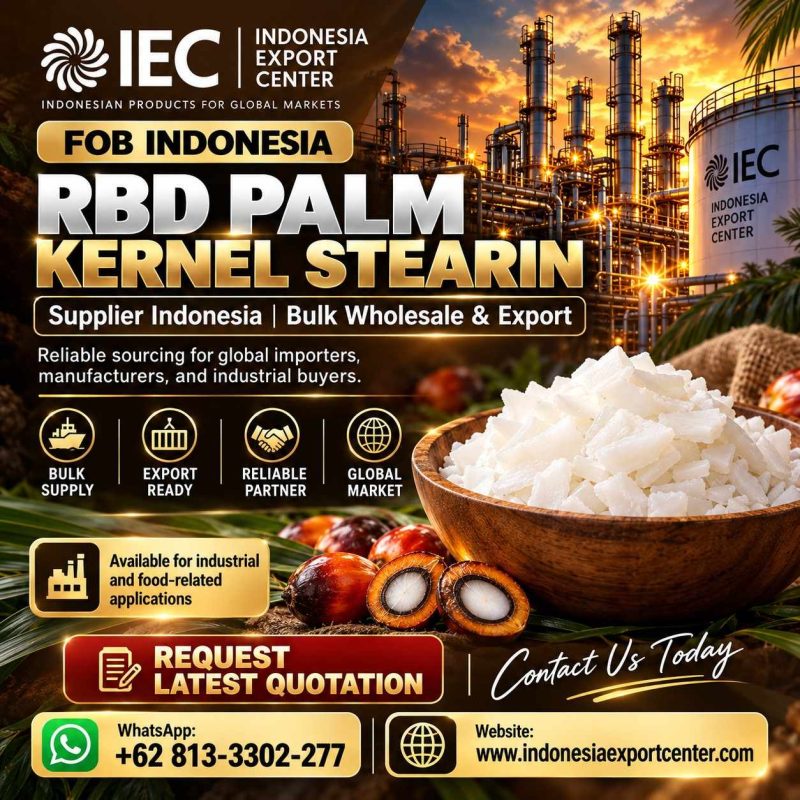
Technical Specifications for International RBD Palm Kernel Stearin Buyers
Quality specifications are essential when purchasing RBD Palm Kernel Stearin from Indonesia.
For manufacturers producing specialty fats, confectionery ingredients, or downstream industrial products, the raw material’s physical and chemical characteristics may directly affect processing and finished-product performance.
Indonesia Export Center (IEC) supports international buyers seeking supplier-confirmed technical information, Certificates of Analysis, and bulk sourcing quotations for RBD Palm Kernel Stearin.
This guide explains the main quality parameters, how to evaluate technical documents, and how to establish an appropriate incoming-material inspection process.
Understanding the Product
RBD Palm Kernel Stearin is the higher-melting fraction obtained from palm kernel oil through refining and fractionation.
Palm kernel oil is a lauric oil derived from the seed of the oil palm fruit.
Fractionation separates portions of the oil according to their physical characteristics, producing fractions with different melting behavior.
Palm kernel stearin is generally more solid than palm kernel olein under comparable conditions.
However, the exact melting profile and composition depend on the supplier’s grade.
Why Product Specifications Matter
A technical specification establishes the characteristics that a product must meet.
Without a written specification, buyers and suppliers may interpret the same product name differently.
For industrial applications, differences in melting behavior, iodine value, or fatty acid composition can influence formulation and processing.
Therefore, procurement teams should approve the exact grade rather than relying solely on the commercial product name.
Important Technical Parameters
| Parameter | Abbreviation | Purpose |
|---|---|---|
| Free Fatty Acid | FFA | Quality assessment |
| Iodine Value | IV | Degree of unsaturation |
| Slip Melting Point | SMP | Melting characteristics |
| Fatty Acid Composition | FAC | Chemical characterization |
| Moisture and Impurities | M&I | Cleanliness and moisture control |
| Color | — | Appearance |
| Solid Fat Content | SFC | Temperature-dependent physical behavior |
| Peroxide Value | PV | Oxidation-related assessment, if specified |
| Other Application Tests | — | Buyer-specific performance |
Numerical specifications must be obtained from the actual supplier’s current TDS or COA.
1. Free Fatty Acid
Free Fatty Acid is a commonly measured quality parameter in the fats and oils industry.
It may provide information relevant to refining quality and product condition.
The result should identify its reporting basis and units.
Buyers should avoid comparing FFA values that use different reference bases without appropriate interpretation.
2. Iodine Value
Iodine value provides information about the degree of unsaturation.
It can be relevant when comparing different palm kernel fractions.
However, iodine value alone does not establish the complete melting or crystallization characteristics of a fat.
A manufacturer may need additional thermal testing.
3. Slip Melting Point
Slip melting point is particularly relevant for higher-melting fat fractions.
It provides a standardized indication of melting behavior under defined test conditions.
For specialty fat manufacturing, the target SMP should reflect the intended formulation and processing requirements.
The test method and acceptance range should be agreed with the supplier.
4. Fatty Acid Composition
A fatty acid profile helps characterize the material.
Palm kernel-derived fats are associated with substantial lauric fatty acid content.
Fractionation can change the relative composition of the resulting fractions.
For specialized applications, the buyer may need a detailed profile rather than a general product description.
5. Moisture and Impurities
Moisture and impurities are relevant to product quality and handling.
Buyers should confirm whether the supplier reports moisture separately or as a combined parameter.
The testing method should also be identified.
6. Color
Color may be relevant to refining-related quality assessment and finished-product appearance.
The measurement scale and method should be stated.
Results from different color measurement systems should not be compared without appropriate interpretation.
7. Solid Fat Content
Solid Fat Content measures the proportion of solid fat under defined conditions.
An SFC profile across several temperatures can be valuable when developing specialty fats or confectionery ingredients.
It may help formulators understand how the material behaves during storage, processing, and consumption.
Nevertheless, SFC data should be interpreted alongside crystallization behavior and formulation testing.
8. Oxidation-Related Parameters
Depending on the application, buyers may request peroxide value or other relevant oxidation-related tests.
The applicable requirements should be based on the intended use and the supplier’s analytical capabilities.
What Is a Certificate of Analysis?
A Certificate of Analysis, or COA, reports analytical results for an identified sample, batch, or lot.
A COA may include the product name, batch number, testing date, analytical methods, results, and issuing organization.
Buyers should determine whether the document relates to the actual cargo proposed for purchase.
A historical COA is not a guarantee of future shipment quality.
TDS vs COA vs SDS
| Document | Main Purpose |
|---|---|
| Technical Data Sheet | Describes product characteristics and specifications |
| Certificate of Analysis | Reports analytical results for an identified sample or batch |
| Safety Data Sheet | Communicates relevant safety and handling information |
| Inspection Certificate | Records the findings of an agreed inspection |
These documents serve different functions.
How to Review a Supplier COA
A buyer should check:
- Exact product name.
- Supplier or laboratory identity.
- Batch or lot reference.
- Date of analysis.
- Test methods.
- Reported units.
- Analytical results.
- Acceptance limits.
- Document authenticity.
- Relevance to the actual shipment.
Quality Requirements for CBS Feedstock
Manufacturers developing cocoa butter substitute systems may require additional information about melting characteristics, fatty acid composition, and crystallization behavior.
Some applications may require further processing of palm kernel stearin.
The suitability of a grade should be established through technical evaluation.
Quality Requirements for Specialty Fat Manufacturing
Specialty fat formulators may require SFC curves, thermal behavior data, and information about compatibility with other fats.
A general COA may not contain every measurement needed for formulation development.
Buyers should identify these requirements before requesting samples.
Independent Testing
For major purchases, buyers may arrange independent laboratory testing.
The parties should agree on sampling methods, the laboratory, analytical procedures, and treatment of conflicting results.
Retained samples may be useful in subsequent quality investigations.
Batch Consistency and Repeat Purchasing
Manufacturers often require consistent raw material characteristics across deliveries.
A supplier qualification program may include routine COA review, incoming inspection, trend analysis, and change-control procedures.
The purchasing contract should define the agreed quality requirements.
Frequently Asked Questions
What is the standard iodine value for RBD Palm Kernel Stearin?
The applicable value depends on the grade. Buyers should request the supplier-confirmed specification.
Why is slip melting point important?
It helps characterize the thermal behavior of the fat.
Does a COA confirm product suitability for CBS manufacturing?
A COA provides analytical information, but application suitability may require additional testing and processing evaluation.
Can I request a fatty acid profile?
Yes. Include it in your technical documentation request.
Is a TDS the same as a COA?
No. A TDS describes specifications, while a COA reports actual analytical results for an identified sample or batch.
Can IEC arrange technical document discussions?
IEC can facilitate requests for available supplier documentation.
Are numerical specifications guaranteed?
Only agreed, supplier-confirmed specifications can form the basis of a purchasing commitment.
Request RBD Palm Kernel Stearin Specifications and COA
Company Name:
Country:
Intended Application:
Required FFA:
Required Iodine Value:
Required Slip Melting Point:
Required Fatty Acid Profile:
Additional Tests:
Initial Quantity (MT):
Destination Port:
Required Documents:
Indonesia Export Center (IEC)
Website: https://indonesiaexportcenter.com/
WhatsApp: +62 813-3302-277
Contact IEC to request available RBD Palm Kernel Stearin technical specifications, COA information, and bulk sourcing quotations.
No numerical specification, laboratory result, certification, or product performance is guaranteed without current supplier verification.
