

Indonesia Export Center (IEC) | Plant-Based Sweetener Comparison and Product Development
Understanding the Differences Between Coconut Nectar, Coconut Sugar and Honey
Food manufacturers and ingredient buyers frequently compare coconut blossom nectar syrup, coconut sugar and honey when developing sweetened foods and beverages.
Although these ingredients can contribute sweetness, they differ in physical form, origin, moisture, flavour, processing behaviour and regulatory considerations.
Understanding these differences is important when evaluating ingredient substitutions or developing new products.
Indonesia Export Center (IEC) facilitates sourcing inquiries for Indonesian coconut blossom nectar syrup, including VEGANECTAR.
This guide compares coconut nectar vs coconut sugar vs honey from a practical B2B purchasing and food formulation perspective.
What Is Coconut Blossom Nectar Syrup?
Coconut blossom nectar syrup is a liquid sweetening ingredient derived from coconut palm sap.
Its properties depend on the raw material, processing conditions and final product specification.
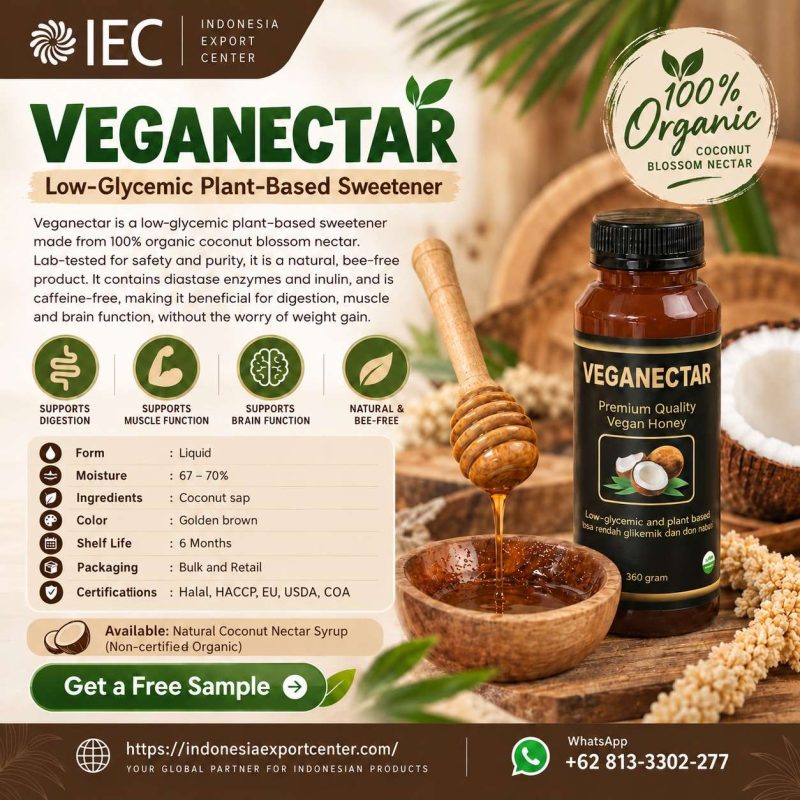
VEGANECTAR is presented in promotional material as a golden-brown liquid sweetener made from coconut blossom nectar.
The flyer references moisture of 67–70% and a six-month shelf life.
These values require verification through current technical documents.
What Is Coconut Sugar?
Coconut sugar is generally a solid sweetener produced by concentrating coconut palm sap and converting it into a granulated or crystalline form.
Its physical characteristics may include granule size, colour, moisture content, flowability and dissolution behaviour.
Coconut sugar is not the same physical ingredient as liquid coconut nectar.
Replacing one with the other changes the amount of water and solids introduced into a formulation.
What Is Honey?
Honey is a sweet substance produced by bees through biological processes involving nectar or other permitted sources under applicable definitions.
Its composition and characteristics vary according to botanical source and other factors.
Honey is an animal-derived product and is therefore not suitable for products that require exclusively plant-derived ingredients.
Coconut nectar should not be represented as chemically identical to honey.
Coconut Nectar vs Coconut Sugar vs Honey: Comparison Table
| Characteristic | Coconut Nectar Syrup | Coconut Sugar | Honey |
|---|---|---|---|
| Primary origin | Coconut palm sap | Coconut palm sap | Produced by bees |
| Typical form | Liquid syrup | Granules or crystals | Viscous liquid or crystallized product |
| Plant-derived | Yes, subject to ingredient verification | Yes, subject to ingredient verification | No |
| Bee-free | Yes, if composition and handling support the claim | Yes, if composition and handling support the claim | No |
| Moisture | Product-specific | Generally lower than syrup | Product-specific |
| Sweetness | Requires evaluation | Requires evaluation | Requires evaluation |
| Flavour | Product- and process-dependent | Product- and process-dependent | Botanical-source-dependent |
| Viscosity | Relevant | Not applicable in dry form | Relevant |
| Organic status | Requires certification | Requires certification | Requires certification |
| Formulation replacement | Testing required | Testing required | Testing required |
No universal numerical equivalence is implied.
VEGANECTAR Product Reference
| Parameter | Promotional Information |
|---|---|
| Product | VEGANECTAR |
| Ingredient claim | 100% Organic Coconut Blossom Nectar |
| Form | Liquid |
| Colour | Golden Brown |
| Moisture | 67–70% |
| Shelf life | 6 months |
| Packaging | Bulk and retail referenced |
| Certification references | Halal, HACCP, EU, USDA |
| Alternative | Natural Coconut Nectar Syrup |
All specifications and certifications should be verified.
Difference 1: Ingredient Origin
Coconut nectar and coconut sugar originate from coconut palm sap.
However, their production processes and final physical forms differ.
Honey is produced by bees.
For vegan food development, this distinction is especially important.
A brand making a vegan claim should also assess other ingredients, processing aids and relevant supply-chain practices.
Difference 2: Moisture Content
Moisture is one of the most important formulation differences.
Liquid coconut nectar contributes water as well as soluble solids.
Granulated coconut sugar contributes comparatively less water.
Honey also contains water, but its actual composition depends on the product.
A formulation change must account for these differences.
For example, replacing a dry sweetener with a liquid syrup may require adjustments to other liquid ingredients.
Difference 3: Sweetness and Sugar Composition
Coconut nectar, coconut sugar and honey may differ in the relative proportions of individual sugars.
Sweetness perception also depends on concentration, temperature, acidity, flavour and the overall formulation.
Buyers should request a sugar profile where it is important to product development.
A one-to-one replacement ratio should not be assumed.
Difference 4: Flavour and Aroma
Coconut nectar may contribute characteristic flavour notes associated with its source and processing.
Coconut sugar may have a different flavour profile because of its concentration and drying process.
Honey flavour varies according to botanical origin.
Manufacturers should conduct sensory trials to determine which ingredient best suits the intended product.
Difference 5: Colour
Colour may influence the appearance of beverages, baked goods, sauces and confectionery.
VEGANECTAR is described as golden brown.
Coconut sugar colour can vary by product.
Honey colour can also vary considerably.
A product developer should evaluate colour contribution at the actual use level.
Difference 6: Viscosity and Handling
Liquid ingredients require attention to viscosity, pumping, pouring and dispensing.
Granulated coconut sugar introduces different handling considerations, including flowability, dust, moisture uptake and dissolution.
The appropriate ingredient depends partly on the manufacturer’s processing equipment.
Difference 7: Thermal Performance
Heating can influence flavour, colour and texture.
Coconut nectar, coconut sugar and honey should not be assumed to behave identically during baking, cooking, concentration or confectionery processing.
Manufacturers should test the ingredients under the actual time and temperature conditions of their production process.
Difference 8: Shelf Life and Storage
Shelf life depends on composition, processing, packaging and storage conditions.
VEGANECTAR promotional material reports a six-month shelf life.
This does not establish the shelf life of coconut sugar or honey, nor does it guarantee VEGANECTAR stability under every storage condition.
Buyers should request packaging-specific shelf-life evidence.
Difference 9: Vegan Product Development
Coconut nectar and coconut sugar may be considered for vegan formulations because they originate from plants.
Honey is generally excluded from vegan products because it is produced by bees.
However, finished-product vegan claims should be based on a complete ingredient and processing assessment.
Difference 10: Organic Certification
Organic status is separate from ingredient origin.
A plant-derived ingredient is not automatically certified organic.
VEGANECTAR is marketed as organic in promotional material, but the actual certification must be verified.
The natural non-certified coconut nectar variant should not be marketed as certified organic.
Can Coconut Nectar Replace Honey?
Coconut nectar may be investigated as a bee-free alternative in selected formulations.
However, it should not be assumed to provide the same viscosity, sugar profile, flavour, water activity or functional performance as honey.
Product developers should conduct controlled trials and adjust the formulation as needed.
Can Coconut Nectar Replace Coconut Sugar?
A liquid syrup may replace a dry sweetener in certain applications after formulation adjustments.
Important considerations include:
- Water contribution.
- Total soluble solids.
- Sweetness.
- Texture.
- Colour.
- Processing temperature.
- Mixing behaviour.
- Shelf stability.
The appropriate replacement ratio must be determined experimentally.
Application Comparison
| Application | Coconut Nectar | Coconut Sugar | Honey |
|---|---|---|---|
| Coffee and tea | Evaluate liquid sweetening | Evaluate dissolution | Evaluate flavour and mixing |
| Bakery | Adjust moisture balance | Evaluate dry formulation | Adjust moisture and flavour |
| Granola bars | Evaluate binding | Evaluate with binder system | Evaluate binding |
| Sauces | Evaluate viscosity and sweetness | Requires dissolution or formulation | Evaluate viscosity and flavour |
| Dessert toppings | Evaluate pourability | May require preparation | Evaluate pourability |
| Vegan products | Potentially suitable | Potentially suitable | Generally unsuitable |
| Dry premixes | Liquid format may be unsuitable | Potentially suitable | Liquid format may be unsuitable |
All applications require testing.
Glycemic Index and Health Claims
The VEGANECTAR promotional material describes the product as low-glycemic and refers to various health-related benefits.
Those claims have not been independently substantiated in the information supplied.
Buyers should not assume that coconut nectar has a proven lower glycemic response than every type of sugar or honey.
Coconut nectar, coconut sugar and honey all contain sugars.
Claims about diabetes suitability, weight management, digestion, brain function or other health outcomes require appropriate evidence and regulatory review.
Product Comparison Testing Checklist
Food manufacturers may evaluate:
- Ingredient identity.
- Moisture.
- Brix where relevant.
- Sugar composition.
- Sweetness at target dosage.
- Flavour.
- Colour.
- Viscosity.
- pH.
- Water activity where relevant.
- Thermal performance.
- Microbiological quality.
- Finished-product stability.
- Packaging compatibility.
- Shelf-life performance.
The test programme should reflect the intended application.
Choosing the Right Sweetener for Your Product
A liquid beverage formulation may benefit from evaluating a liquid sweetener.
A dry ingredient blend may require a granulated ingredient.
A vegan product may exclude honey.
A premium specialty food product may prioritize sensory characteristics.
The best ingredient depends on the desired formulation, product claims, processing equipment, quality requirements and commercial objectives.
No single sweetener is automatically superior for every application.
B2B Product Comparison RFQ Template
Subject: Coconut Nectar vs Coconut Sugar vs Honey – Technical Ingredient Comparison
Company: [Company Name]
Country: [Country]
Product application: [Application]
Current sweetener: [Ingredient]
Target ingredient: [Coconut Nectar / Coconut Sugar]
Required quantity: [KG or MT]
Required moisture: [Range]
Required Brix: [Range, if applicable]
Required sugar profile: [Details]
Certification requirements: [Details]
Packaging: [Details]
Destination port: [Port]
Please provide available technical specifications, COA, product samples, packaging options, MOQ, lead time and export quotation for suitable Indonesian coconut-derived sweeteners.
Frequently Asked Questions
Is coconut nectar the same as coconut sugar?
No. Coconut nectar is a liquid syrup, while coconut sugar is a solid sweetener.
Is coconut nectar the same as honey?
No. Their origins, composition and functional properties differ.
Is coconut nectar vegan?
It is derived from a plant source, but a verified vegan claim should consider the complete product and supply chain.
Can coconut nectar replace honey at a 1:1 ratio?
A universal 1:1 substitution cannot be recommended without testing.
Does coconut nectar contain sugar?
Yes. It is a sweetening ingredient containing sugars.
Is coconut nectar always lower-glycemic than honey?
No universal conclusion should be made without appropriate comparative evidence.
Is VEGANECTAR certified organic?
The promotional material references organic certification, but current evidence must be verified.
Can manufacturers request comparison samples?
Buyers may request samples, subject to supplier availability.
Request Coconut Nectar Product Comparison Specifications
Indonesia Export Center welcomes inquiries from product developers, food manufacturers, ingredient importers and wholesale distributors evaluating Indonesian coconut-derived sweeteners.
REQUEST PRODUCT COMPARISON SPECS
Indonesia Export Center (IEC)
Website: https://indonesiaexportcenter.com/
WhatsApp: +62 813-3302-277
Ingredient performance, nutritional characteristics, organic status, certifications, pricing and commercial supply require product-specific verification.
Related Resources
Liquid Coconut Sap Sweetener from Indonesia
Vegan Honey Alternative Supplier Indonesia
Coconut Nectar for Food Manufacturers
Coconut Nectar Certificate of Analysis Guide
