

INDONESIA EXPORT CENTER (IEC)
Granola Ingredient Sourcing, Binder Evaluation, Moisture Control and Commercial Coconut Nectar Inquiries
Coconut Nectar for Granola and Cereal Bar Manufacturing
Granola and cereal bar manufacturers require careful control of ingredient binding, texture, sweetness, moisture, flavour, and shelf stability.
For snack producers evaluating plant-derived liquid sweeteners, coconut nectar for granola bars may be an ingredient worth investigating.
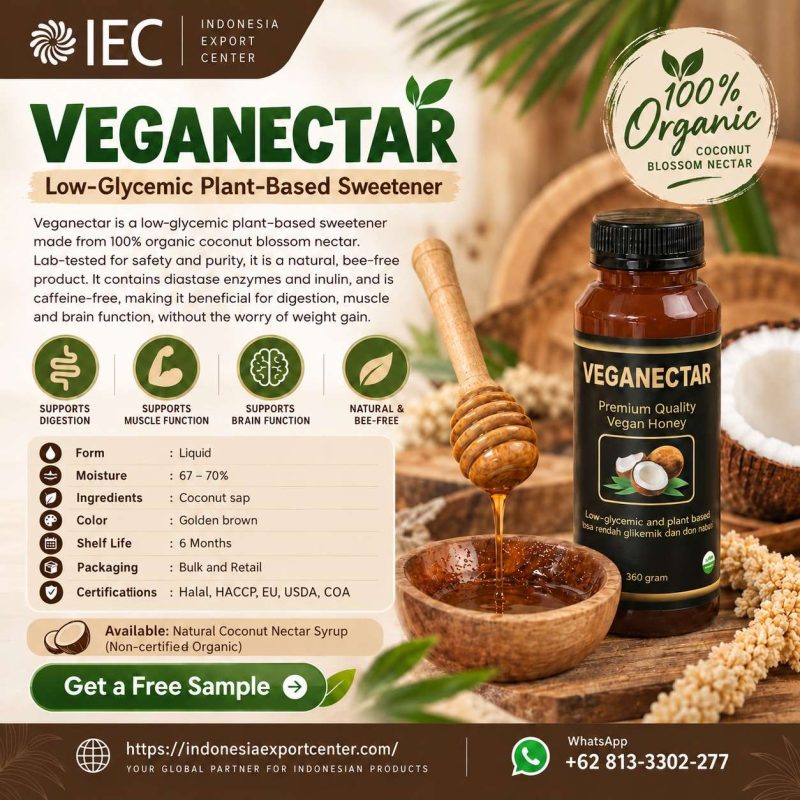
Indonesia Export Center (IEC) facilitates sourcing inquiries for Indonesian coconut blossom nectar syrup, including VEGANECTAR.
The IEC promotional material describes VEGANECTAR as a golden-brown liquid sweetener made from coconut sap.
Liquid sweeteners can play different roles in snack formulations, but the actual binding performance of VEGANECTAR has not been established by the promotional flyer.
Manufacturers should therefore conduct structured trials before using the ingredient in commercial production.
What Is Coconut Blossom Nectar Syrup?
Coconut blossom nectar syrup is a liquid sweetening ingredient derived from coconut palm sap.
Its liquid format may make it relevant to selected snack formulations where sweeteners are mixed with cereals, grains, seeds, nuts, or other ingredients.
However, performance depends on syrup composition, solids content, viscosity, processing temperature, and the finished-product formulation.
VEGANECTAR Reference Product Specifications
| Parameter | Promotional Information |
|---|---|
| Product | VEGANECTAR |
| Source | Coconut Sap |
| Ingredient Claim | 100% Organic Coconut Blossom Nectar |
| Form | Liquid |
| Colour | Golden Brown |
| Moisture | 67–70% |
| Shelf Life | 6 Months |
| Packaging | Bulk and Retail |
| Certification References | Halal, HACCP, EU, USDA |
The specifications require verification.
Potential Granola Applications
Baked Granola
Manufacturers may evaluate coconut nectar as part of a sweetening or coating system.
The effect on coating uniformity, drying, colour, and crispness should be tested.
Granola Clusters
Granola clusters require sufficient cohesion to maintain the desired structure.
Coconut nectar may be assessed as one component of a binding formulation.
Cereal Bars
Cereal bar manufacturers may test coconut nectar in selected binder systems.
The ingredient’s contribution to texture and stability must be established.
Nut and Seed Bars
Manufacturers may evaluate coconut nectar in formulations containing nuts, seeds, and cereals.
Plant-Based Snack Bars
Brands developing plant-based snacks may investigate coconut nectar as a sweetening ingredient.
Vegan and organic claims require supporting documentation.
Understanding Binder Functionality
A binder helps hold ingredients together.
For granola and cereal bars, binder performance may depend on:
- Viscosity.
- Solids content.
- Water content.
- Temperature.
- Mixing conditions.
- Ingredient particle size.
- Compression.
- Cooling.
- Drying.
- Packaging.
The VEGANECTAR flyer does not provide enough information to guarantee binding performance.
Moisture Control in Granola
The reported VEGANECTAR moisture range is 67–70%.
This is important because granola products often depend on controlled moisture for texture and shelf stability.
Manufacturers should evaluate:
- Water introduced by the syrup.
- Moisture after processing.
- Water activity.
- Drying requirements.
- Texture changes.
- Packaging moisture protection.
Coating Uniformity
Granola manufacturers may need a sweetener that distributes consistently across the ingredient mix.
Trial measurements may include:
- Mixing time.
- Coating coverage.
- Clumping.
- Uneven distribution.
- Product appearance.
- Batch consistency.
Cluster Formation
For cluster-style granola, manufacturers should evaluate:
- Cluster size.
- Cohesion.
- Breakage.
- Texture.
- Handling resistance.
- Storage stability.
These outcomes depend on the full formulation.
Cereal Bar Texture
Different cereal bars require different textures.
Some products are designed to be chewy, while others are crisp or firm.
Coconut nectar’s effect should be evaluated according to the intended product.
Potential test parameters include:
- Hardness.
- Chewiness.
- Cohesion.
- Stickiness.
- Breakage.
- Texture changes during storage.
Sweetness and Sensory Evaluation
Coconut nectar may contribute sweetness and flavour.
Manufacturers should evaluate:
- Sweetness intensity.
- Aroma.
- Flavour compatibility.
- Aftertaste.
- Colour.
- Texture.
- Overall consumer acceptance.
Shelf-Life and Stability Testing
A granola bar’s shelf life cannot be inferred from the ingredient’s promotional shelf life.
The flyer reports six months for VEGANECTAR, but finished snack products require their own stability studies.
Testing may include:
- Water activity.
- Moisture migration.
- Texture retention.
- Microbiological quality.
- Oxidative stability of other ingredients where relevant.
- Packaging performance.
- Sensory changes.
Organic Granola Applications
The flyer promotes VEGANECTAR as organic.
Organic snack manufacturers should verify the certificate and applicable chain-of-custody requirements before using organic claims.
Sample Evaluation Checklist
| Evaluation | Purpose |
|---|---|
| Product Specification | Confirm ingredient identity |
| Moisture | Understand water contribution |
| Brix | Assess soluble solids |
| Viscosity | Evaluate mixing and coating |
| Binding | Assess cohesion |
| Texture | Evaluate chewiness or crispness |
| Colour | Assess product appearance |
| Sensory | Confirm flavour acceptance |
| Water Activity | Support stability assessment |
| Shelf Life | Validate finished product |
Recommended Granola Trial Program
Stage 1: Review the product specification.
Stage 2: Obtain a representative sample.
Stage 3: Establish a control recipe.
Stage 4: Prepare small test batches.
Stage 5: Evaluate coating and binding.
Stage 6: Measure moisture and water activity.
Stage 7: Test texture and breakage.
Stage 8: Evaluate storage stability.
Stage 9: Calculate cost per finished product.
Stage 10: Approve the commercial formulation.
Wholesale Packaging and Supply
Manufacturers should request information about:
- Available bulk formats.
- Food-contact suitability.
- MOQ.
- Lead time.
- Product capacity.
- Storage conditions.
- Export documentation.
- Current pricing.
The flyer does not confirm these commercial details.
Granola and Cereal Bar RFQ Template
Subject: Coconut Nectar Syrup for Granola and Cereal Bars
Company: [Name]
Country: [Country]
Product: [Granola / Cereal Bar / Nut Bar]
Sweetener: VEGANECTAR Coconut Blossom Nectar
Variant: [Organic / Natural]
Initial Quantity: [KG or MT]
Monthly Demand: [Quantity]
Required Technical Specifications: [Details]
Packaging: [Details]
Certification Requirements: [Details]
Destination: [Port]
Please provide current specifications, COA, sample feasibility, packaging options, MOQ, lead time, and quotation.
Frequently Asked Questions
Can coconut nectar be used in granola?
It may be evaluated in selected formulations.
Can coconut nectar act as a granola binder?
Its binding performance must be tested.
Is coconut nectar suitable for cereal bars?
It may be evaluated through application trials.
Does coconut nectar guarantee crunchy granola?
No.
What moisture content is reported?
67–70%.
Can coconut nectar be used in organic granola?
Potentially, if certification and other requirements are satisfied.
Can manufacturers request application samples?
Sample feasibility requires confirmation.
Is bulk packaging available?
The flyer references bulk packaging, subject to supplier confirmation.
Request Granola and Cereal Bar Application Samples
Contact IEC to explore coconut nectar syrup for snack manufacturing and ingredient development.
REQUEST GRANOLA APPLICATION SAMPLE INFORMATION
INDONESIA EXPORT CENTER (IEC)
Website: https://indonesiaexportcenter.com/
WhatsApp: +62 813-3302-277
Binding performance, product specifications, samples, certifications, packaging, MOQ, pricing, and supply arrangements require verification.
Related Resources
Coconut Nectar for Food Manufacturers
Coconut Nectar Syrup for Bakeries
Coconut Nectar Syrup for Energy Bars
