

INDONESIA EXPORT CENTER (IEC)
Cookie and Biscuit Manufacturing Trials, Colour Evaluation, Texture Testing and Indonesian Ingredient Sourcing
Coconut Nectar for Industrial Cookie and Biscuit Production
Cookie and biscuit manufacturers must carefully control sweetness, dough consistency, spread, texture, moisture, colour, and finished-product stability.
For manufacturers exploring plant-derived sweeteners, coconut nectar for cookies and biscuits may be considered as an ingredient for experimental formulations.
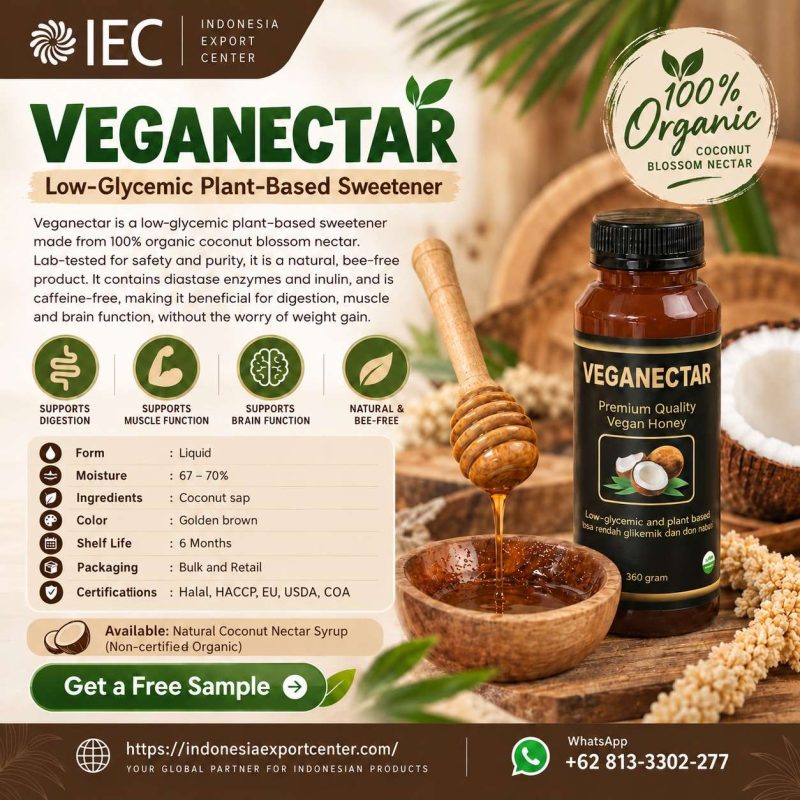
Indonesia Export Center (IEC) facilitates sourcing inquiries for Indonesian coconut blossom nectar syrup, including VEGANECTAR.
The promotional material describes VEGANECTAR as a golden-brown liquid sweetener derived from coconut sap.
However, the flyer does not establish that VEGANECTAR performs identically to granulated sugar, honey, or other syrups in cookie production.
Industrial bakeries should conduct controlled formulation trials before commercial adoption.
Why Cookie Formulations Require Special Evaluation
Cookies and biscuits rely on carefully balanced ingredients and processing conditions.
Changes to a sweetener can influence:
- Dough consistency.
- Mixing behaviour.
- Spread.
- Shape.
- Surface colour.
- Crispness.
- Chewiness.
- Moisture.
- Shelf life.
- Packaging requirements.
Because coconut nectar is liquid, it introduces a different moisture contribution from dry sugar.
VEGANECTAR Reference Specifications
| Parameter | Flyer Information |
|---|---|
| Product | VEGANECTAR |
| Source | Coconut Sap |
| Form | Liquid |
| Colour | Golden Brown |
| Moisture | 67–70% |
| Shelf Life | 6 Months |
| Packaging | Bulk and Retail |
| Organic Positioning | Claimed; Verification Required |
| Certification References | Halal, HACCP, EU, USDA |
These are promotional references.
Coconut Nectar in Soft Cookies
Soft-cookie manufacturers may evaluate coconut nectar for its sweetness and flavour.
However, the ingredient’s effect on moisture, chewiness, and storage stability must be measured.
Coconut Nectar in Crisp Biscuits
Crisp biscuits typically require carefully controlled moisture and texture.
Introducing a liquid sweetener may affect the drying and baking requirements.
Manufacturers should assess whether the desired crispness can be maintained.
Coconut Nectar in Filled Cookies
Coconut nectar may be evaluated in selected cookie fillings or sweet layers.
The filling’s viscosity, moisture migration, and stability require testing.
Coconut Nectar in Specialty Cookies
Brands developing specialty or plant-based cookies may investigate coconut nectar for its ingredient positioning and sensory characteristics.
Any organic or vegan claims should be supported by documentation.
Moisture Management
The flyer reports moisture of 67–70%.
Manufacturers should calculate the water introduced by coconut nectar and adjust the recipe as appropriate.
Relevant evaluations include:
- Dough hydration.
- Water distribution.
- Mixing time.
- Dough handling.
- Baking loss.
- Finished-product moisture.
- Water activity.
The final recipe must be validated experimentally.
Cookie Spread Testing
A change in sweetener can influence cookie spread and shape.
Manufacturers should measure:
- Dough piece weight.
- Diameter before baking.
- Diameter after baking.
- Product height.
- Shape consistency.
- Batch-to-batch variation.
The effect of VEGANECTAR cannot be established without trials.
Colour Evaluation
VEGANECTAR is described as golden brown.
Cookie manufacturers should evaluate:
- Dough colour.
- Surface browning.
- Finished-product appearance.
- Colour uniformity.
- Consumer acceptance.
Texture Evaluation
Texture testing may include:
- Crispness.
- Hardness.
- Fracturability.
- Chewiness.
- Moisture perception.
- Texture changes during storage.
These parameters should be selected according to the intended cookie or biscuit style.
Sweetness and Flavour Trials
A sensory panel may compare:
- Sweetness intensity.
- Aroma.
- Flavour.
- Aftertaste.
- Texture.
- Overall acceptability.
A reference formulation can help identify changes caused by the sweetener.
Shelf-Life and Packaging Tests
The ingredient’s promotional six-month shelf life does not establish the finished cookie’s shelf life.
Manufacturers should evaluate:
- Moisture migration.
- Texture retention.
- Microbiological quality where relevant.
- Packaging moisture barrier.
- Storage stability.
- Sensory changes.
Organic and Natural Variants
The flyer references organic VEGANECTAR and a natural non-certified organic alternative.
The two variants should not be assumed to have identical technical specifications.
Cookie and Biscuit Trial Checklist
| Test | What to Record |
|---|---|
| Dough Mixing | Time and consistency |
| Dough Handling | Stickiness and machinability |
| Spread | Diameter and height |
| Colour | Surface and interior |
| Texture | Crispness or chewiness |
| Moisture | Finished-product result |
| Water Activity | Stability-related result |
| Sensory | Sweetness and flavour |
| Shelf Life | Changes during storage |
| Cost | Cost per finished batch |
Suggested Industrial Trial Process
Step 1: Obtain product specification and representative sample.
Step 2: Measure relevant syrup characteristics.
Step 3: Establish a control cookie formulation.
Step 4: Prepare test formulations using measured substitution levels.
Step 5: Adjust water balance where necessary.
Step 6: Bake under controlled conditions.
Step 7: Record spread, colour, texture, and sensory results.
Step 8: Evaluate shelf life and packaging.
Step 9: Calculate production costs.
Step 10: Approve the ingredient only after acceptable results.
Ingredient Documentation
Buyers should request:
- Product specification.
- Ingredient declaration.
- COA.
- Moisture.
- Brix where available.
- Microbiological information.
- Shelf-life evidence.
- Certification documents where claimed.
- Packaging specifications.
Commercial Supply Considerations
Before ordering, manufacturers should confirm:
- Available packaging.
- MOQ.
- Sample feasibility.
- Lead time.
- Production capacity.
- Export documentation.
- Shipping arrangements.
- Current price.
Cookie and Biscuit Ingredient RFQ Template
Subject: Coconut Nectar Syrup for Cookies and Biscuits
Company: [Name]
Country: [Country]
Product Type: [Soft Cookie / Crisp Biscuit / Filled Cookie]
Product: VEGANECTAR Coconut Blossom Nectar
Initial Quantity: [KG or MT]
Monthly Demand: [Quantity]
Required Specifications: [Details]
Packaging: [Details]
Certification Requirements: [Details]
Destination: [Port]
Please provide product specifications, COA, sample feasibility, available packaging, MOQ, lead time, and quotation.
Frequently Asked Questions
Can coconut nectar be used in cookie manufacturing?
It may be evaluated through formulation trials.
Can it replace granulated sugar one-to-one?
Not without testing.
Will coconut nectar make cookies softer?
The actual texture effect depends on the formulation and processing conditions.
Can coconut nectar affect biscuit crispness?
It may influence moisture and texture, which require testing.
Does the syrup affect cookie colour?
Its impact should be assessed experimentally.
Is VEGANECTAR organic-certified?
The flyer references organic status, but current documentation must be verified.
Can manufacturers request samples?
Sample feasibility requires confirmation.
Does IEC offer fixed bulk prices?
A current supplier quotation is required.
Request Cookie and Biscuit Application Samples
Contact IEC to discuss coconut nectar syrup for industrial cookie and biscuit development.
REQUEST COOKIE AND BISCUIT SAMPLE INFORMATION
INDONESIA EXPORT CENTER (IEC)
Website: https://indonesiaexportcenter.com/
WhatsApp: +62 813-3302-277
Application performance, samples, certifications, packaging, MOQ, prices, and supply capacity require supplier confirmation.
Related Resources
Coconut Nectar Syrup for Bakeries
Coconut Nectar for Food Manufacturers
Coconut Nectar for Granola and Cereal Bars
