

INDONESIA EXPORT CENTER (IEC)
Bakery Ingredient Sourcing, Recipe Trials, Moisture Evaluation and Wholesale Coconut Blossom Nectar Inquiries
Coconut Nectar Syrup for Commercial Bakery Applications
Commercial bakeries and industrial bakery manufacturers regularly evaluate ingredients that can contribute sweetness, flavour, colour, and specific texture characteristics to their products.
For manufacturers investigating plant-derived liquid sweeteners, coconut nectar syrup for bakery applications may be worth testing.
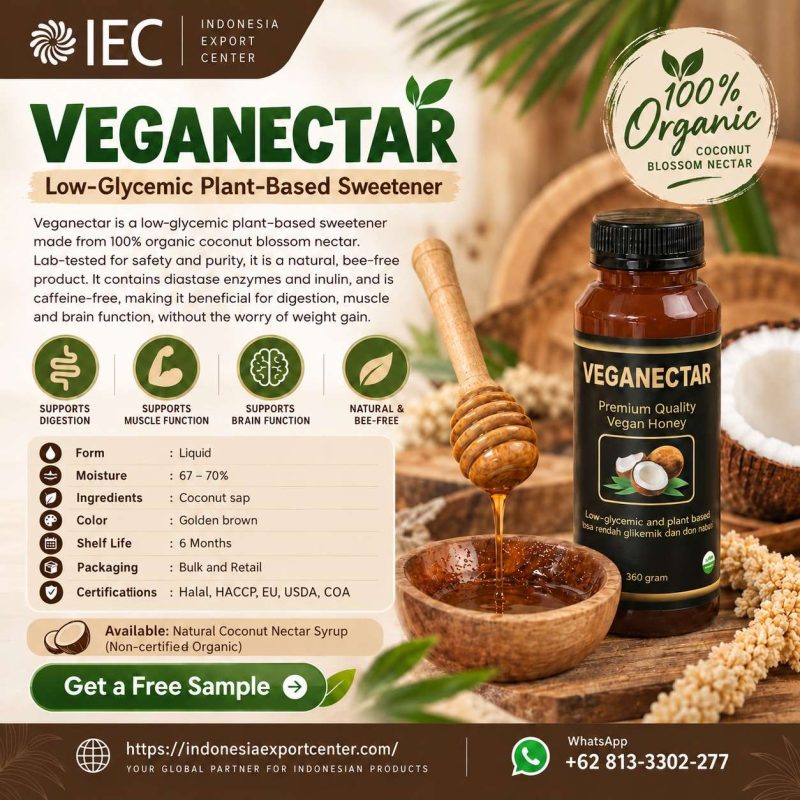
Indonesia Export Center (IEC) facilitates sourcing inquiries for Indonesian coconut blossom nectar syrup, including VEGANECTAR.
The promotional material describes VEGANECTAR as a golden-brown liquid sweetener derived from coconut sap and positioned for bulk and retail applications.
Bakery manufacturers should evaluate the ingredient under actual recipe and processing conditions before commercial use.
What Is Coconut Blossom Nectar Syrup?
Coconut blossom nectar syrup is a liquid sweetening ingredient made from coconut palm sap.
Its liquid format differs from dry granulated sugar, which can affect dough handling, batter consistency, product moisture, and finished texture.
A bakery should not assume coconut nectar can replace granulated sugar or honey at the same weight without adjustments.
VEGANECTAR Reference Product Profile
| Parameter | Promotional Information |
|---|---|
| Product | VEGANECTAR |
| Source | Coconut Sap |
| Ingredient Claim | 100% Organic Coconut Blossom Nectar |
| Form | Liquid |
| Colour | Golden Brown |
| Moisture | 67–70% |
| Shelf Life | 6 Months |
| Packaging | Bulk and Retail |
| Certification References | Halal, HACCP, EU, USDA |
| Alternative | Natural Coconut Nectar Syrup |
The information requires verification.
Potential Bakery Applications
Cakes and Batters
Bakeries may test coconut nectar for sweetness and flavour in selected cake formulations.
The ingredient’s water contribution may require changes to the liquid ingredients.
Bakery Fillings
Coconut nectar may be evaluated in sweet fillings where its flavour and consistency are suitable.
Glazes
A liquid sweetener may be investigated for selected bakery glaze formulations.
Pastry Applications
Manufacturers may evaluate coconut nectar in pastry fillings, toppings, or specialty products.
Dessert Sauces
Coconut nectar may be tested in bakery-related dessert sauces.
Plant-Based Bakery Products
Vegan bakery brands may consider coconut nectar as a plant-derived sweetening ingredient, subject to ingredient verification.
Moisture Balance in Bakery Formulations
The VEGANECTAR flyer reports moisture of 67–70%.
This is particularly relevant when replacing dry sugar.
If a bakery adds a liquid sweetener, it may need to adjust:
- Added water.
- Milk or plant-based liquids.
- Flour hydration.
- Mixing time.
- Batter viscosity.
- Baking time.
- Finished-product moisture.
The actual adjustment depends on the recipe and measured ingredient composition.
Browning and Colour Development
Coconut nectar is described as golden brown.
In bakery production, manufacturers should evaluate its effect on:
- Crust colour.
- Crumb colour.
- Surface appearance.
- Heating behaviour.
- Flavour development.
Browning behaviour cannot be predicted from the flyer alone.
Sweetness Replacement Trials
A controlled trial should compare the current sweetener with coconut nectar.
The bakery may evaluate:
- Sweetness intensity.
- Ingredient dosage.
- Moisture contribution.
- Batter or dough handling.
- Product volume.
- Colour.
- Texture.
- Flavour.
- Shelf life.
- Production cost.
A direct one-to-one replacement should not be assumed.
Texture and Product Structure
Sweeteners can influence bakery structure.
When coconut nectar is introduced, manufacturers should assess:
- Crumb softness.
- Moisture retention.
- Stickiness.
- Spread.
- Product volume.
- Surface characteristics.
- Texture during storage.
The actual effect must be determined through application testing.
Shelf-Life Evaluation
A new sweetening ingredient can influence finished-product stability.
Bakery manufacturers should evaluate appropriate microbiological and physical shelf-life parameters.
The six-month shelf life stated for VEGANECTAR refers to the ingredient’s promotional description, not the finished bakery product.
Organic Bakery Applications
The flyer promotes VEGANECTAR as organic.
Organic bakery manufacturers should verify the relevant certification and supply-chain requirements before using the ingredient in certified organic products.
Food Safety and Quality Documentation
Bakery buyers may request:
- Ingredient declaration.
- Product specification.
- COA.
- Moisture analysis.
- Brix.
- Microbiological results.
- Shelf-life evidence.
- Organic certification where claimed.
- Halal documentation where required.
- Packaging specification.
Bakery Sample Evaluation Checklist
| Test Area | Evaluation |
|---|---|
| Ingredient Appearance | Colour and uniformity |
| Sweetness | Sensory comparison |
| Moisture | Recipe water balance |
| Mixing | Batter or dough behaviour |
| Baking | Time and temperature response |
| Colour | Crust and crumb |
| Texture | Softness, firmness, stickiness |
| Flavour | Aroma and aftertaste |
| Stability | Finished-product shelf life |
| Cost | Ingredient cost per finished unit |
Recommended Trial Sequence
Trial 1 – Bench Evaluation: Test a small formulation and document observations.
Trial 2 – Recipe Adjustment: Modify liquid and dry ingredient proportions as needed.
Trial 3 – Pilot Production: Evaluate production-scale handling.
Trial 4 – Shelf-Life Assessment: Test the finished product under appropriate conditions.
Trial 5 – Commercial Approval: Confirm specifications and acceptable performance.
Packaging for Bakery Manufacturers
The flyer references bulk and retail packaging.
Bakery manufacturers should request information about available industrial formats, food-contact suitability, storage, MOQ, and delivery schedules.
Bakery Ingredient RFQ Template
Subject: Coconut Nectar Syrup for Bakery Manufacturing
Company: [Name]
Country: [Country]
Bakery Product: [Details]
Product: VEGANECTAR Coconut Blossom Nectar
Variant: [Organic / Natural]
Initial Quantity: [KG or MT]
Monthly Consumption: [Quantity]
Required Specifications: [Details]
Packaging: [Details]
Certification Requirements: [Details]
Destination: [Port]
Please provide current specifications, COA, sample feasibility, storage instructions, MOQ, lead time, and quotation.
Frequently Asked Questions
Can coconut nectar be used in cakes?
It may be evaluated through recipe trials.
Can coconut nectar replace granulated sugar directly?
Not without testing and formulation adjustments.
Does coconut nectar affect browning?
Its effect should be evaluated in the specific baking process.
What moisture content is reported?
67–70%.
Can coconut nectar be used in glazes?
It may be tested in suitable glaze formulations.
Is VEGANECTAR organic-certified?
Current certification evidence is required.
Can industrial bakeries request samples?
Sample feasibility must be confirmed.
Is bulk supply available?
Bulk packaging is referenced, subject to supplier confirmation.
Request Coconut Nectar Bakery Application Samples
Contact IEC with your bakery product category, formulation requirements, and expected purchasing volume.
REQUEST BAKERY APPLICATION SAMPLE INFORMATION
INDONESIA EXPORT CENTER (IEC)
Website: https://indonesiaexportcenter.com/
WhatsApp: +62 813-3302-277
Bakery performance, samples, certifications, specifications, packaging, MOQ, and prices require verification.
Related Resources
Coconut Nectar for Food Manufacturers
Coconut Nectar for Cookies and Biscuits
Bulk Coconut Nectar Syrup Supplier
