

Palm Fatty Acid Distillate (PFAD) Supplier Indonesia – Bulk Industrial Raw Material and Export Sourcing
INDONESIA EXPORT CENTER (IEC)
Your Trusted Partner for Indonesian Industrial Commodities and International Sourcing
Premium Palm Fatty Acid Distillate (PFAD) from Indonesia for Global Industrial Buyers
Are you looking for a Palm Fatty Acid Distillate (PFAD) supplier in Indonesia for industrial manufacturing, oleochemical processing, biodiesel feedstock evaluation, or international commodity trading?
Indonesia Export Center (IEC) facilitates business-to-business sourcing inquiries for Indonesian industrial commodities, including Palm Fatty Acid Distillate (PFAD).
PFAD is a palm oil refining by-product widely considered as a raw material for various industrial applications. Its fatty acid content and other chemical characteristics make it relevant to manufacturers seeking palm-derived industrial feedstocks.
As one of the world’s major palm oil-producing countries, Indonesia represents an important potential sourcing origin for PFAD and other palm oil derivatives.
IEC supports international buyers in exploring Indonesian PFAD supply opportunities, reviewing available product information, communicating technical requirements, and requesting commercial export quotations.
Our objective is to help global buyers identify suitable sourcing opportunities while encouraging transparent product specifications, supplier verification, and appropriate quality documentation.
Contact Indonesia Export Center to request PFAD specifications, supplier information, availability, and an export quotation.
What Is Palm Fatty Acid Distillate (PFAD)?
Palm Fatty Acid Distillate, commonly known as PFAD, is a by-product generated during the physical refining process of crude palm oil (CPO).
During palm oil refining, certain components, including free fatty acids, are separated from the oil through processing operations.
The resulting fatty acid-rich distillate is known as Palm Fatty Acid Distillate.
PFAD is different from refined palm oil because it contains a substantially higher concentration of free fatty acids.
Its properties make it relevant for selected industrial manufacturing processes.
Depending on the application and product quality, PFAD may be evaluated for use in:
- Oleochemical manufacturing.
- Industrial fatty acid processing.
- Soap manufacturing.
- Biodiesel feedstock applications.
- Fatty acid derivative production.
- Selected industrial chemical processes.
- Other technically compatible manufacturing applications.
Suitability depends on the buyer’s process, applicable regulations, and the actual batch specification.
Indonesian PFAD Product Overview
The Indonesia Export Center product material identifies the following commodity:
| Product Information | Description |
|---|---|
| Product Name | Palm Fatty Acid Distillate |
| Abbreviation | PFAD |
| Country of Origin | Indonesia |
| Source Material | Crude Palm Oil |
| Production Origin | Physical Palm Oil Refining |
| Product Category | Palm Oil Refining By-Product |
| Appearance | Reddish-Orange to Brownish-Yellow |
| Physical Form | Semi-Solid or Liquid, Depending on Temperature |
| Intended Market | Industrial B2B Buyers |
PFAD’s physical appearance and handling characteristics can vary depending on composition and temperature.
Buyers should evaluate the product against their required technical specifications rather than relying on appearance alone.
PFAD Technical Specifications and Quality Analysis Results
Product quality is an essential consideration when sourcing Palm Fatty Acid Distillate internationally.
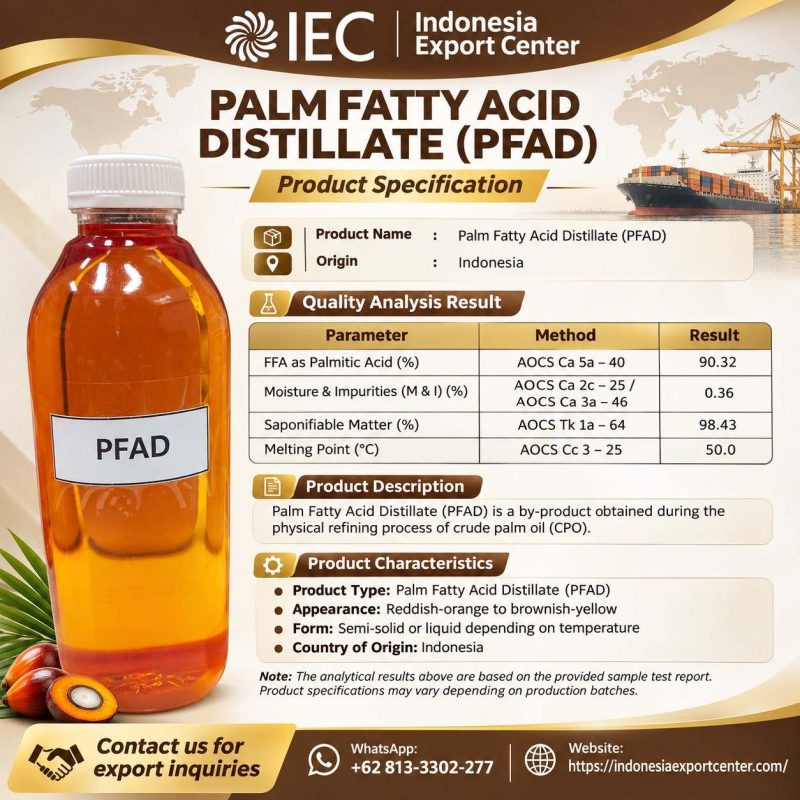
The IEC promotional image includes specific analytical results and their associated testing methods.
Reported Laboratory Analysis
| Quality Parameter | Testing Method | Reported Result |
|---|---|---|
| Free Fatty Acid (FFA), as Palmitic Acid | AOCS Ca 5a-40 | 90.32% |
| Moisture & Impurities (M & I) | AOCS Ca 2c-25 / AOCS Ca 3a-46 | 0.36% |
| Saponifiable Matter | AOCS Tk 1a-64 | 98.43% |
| Melting Point | AOCS Cc 3-25 | 50.0°C |
Important quality note: These results are reproduced from the sample test information displayed in the supplied IEC product image. They are not independently verified by IEC within this article and should not be interpreted as guaranteed specifications for every shipment.
Product characteristics may vary between production batches. Buyers should request the original laboratory report, representative sampling information, and a current Certificate of Analysis (COA) for the offered lot.
Understanding the PFAD Quality Parameters
1. Free Fatty Acid (FFA) Content – 90.32%
Free Fatty Acid content is one of the most important analytical characteristics of PFAD.
The supplied sample report states an FFA result of 90.32%, expressed as palmitic acid.
This reporting basis is important because FFA percentages expressed as palmitic acid should not automatically be treated as numerically interchangeable with values expressed as oleic acid.
A high FFA content may make PFAD relevant for processes designed to handle fatty acid-rich raw materials.
However, a buyer should determine whether the fatty acid composition and overall material quality are compatible with the intended manufacturing process.
For industrial procurement, the FFA specification should identify:
- Minimum acceptable FFA percentage.
- Calculation basis.
- Analytical method.
- Sampling procedure.
- Lot identification.
- Acceptance tolerance.
2. Moisture and Impurities – 0.36%
The reported combined Moisture and Impurities (M & I) result is 0.36%.
Moisture and impurities are important because unwanted water and foreign substances can affect industrial processing, storage, handling, and product consistency.
Depending on the application, buyers may need to assess whether additional purification or pretreatment is required.
The sample result should not be treated as a guaranteed maximum for all available PFAD.
Buyers should request confirmation of the actual shipment’s moisture and impurities specification.
3. Saponifiable Matter – 98.43%
The IEC sample analysis reports 98.43% saponifiable matter.
Saponifiable matter is relevant when assessing materials for processes involving reactions of saponifiable lipid components, including certain soap and oleochemical manufacturing applications.
However, the analytical value alone does not establish suitability for a particular production line.
Manufacturers should evaluate the full chemical composition, processing requirements, and finished-product quality targets.
4. Melting Point – 50.0°C
The supplied analysis reports a melting point of 50.0°C.
This result is important for handling and logistics planning because PFAD may become semi-solid or solid at lower temperatures.
Industrial buyers should consider:
- Storage tank design.
- Heating systems.
- Transfer pumps.
- Loading and unloading arrangements.
- Temperature monitoring.
- Transport equipment.
- Material handling safety.
The reported melting point is not a recommended pumping, storage, or transportation temperature.
Operating temperatures should be determined using the actual material properties, supplier guidance, equipment specifications, and appropriate safety assessment.
PFAD Appearance and Physical Characteristics
According to the IEC product image, PFAD has a reddish-orange to brownish-yellow appearance.
Its physical form may be semi-solid or liquid depending on temperature.
Colour and physical condition can vary with processing conditions and composition.
Visual inspection may provide useful preliminary information, but it cannot replace laboratory testing.
Buyers should not approve a PFAD shipment solely based on colour or appearance.
Industrial Applications of Palm Fatty Acid Distillate
PFAD for Oleochemical Manufacturing
The oleochemical industry processes oils, fats, fatty acids, and related materials into chemical products used across multiple manufacturing sectors.
PFAD may be evaluated as a feedstock for suitable oleochemical processes because of its fatty acid-rich composition.
Potential downstream applications include the production of certain fatty acid derivatives and other industrial intermediates.
The actual processing route depends on the manufacturer’s technology and raw material acceptance criteria.
PFAD for Biodiesel Feedstock
PFAD may be considered for biodiesel production routes capable of processing high-free-fatty-acid feedstocks.
However, PFAD cannot automatically be treated as a direct substitute for refined vegetable oil in every biodiesel production system.
High-FFA feedstocks may require specific pretreatment, esterification, or other appropriate processing steps.
Biodiesel producers should assess:
- FFA content.
- Moisture.
- Impurities.
- Fatty acid composition.
- Feedstock handling.
- Process compatibility.
- Regulatory eligibility.
- Sustainability documentation.
The classification and sustainability treatment of PFAD may vary by jurisdiction and regulatory scheme.
PFAD for Soap Manufacturing
PFAD may be evaluated as a raw material in certain soap manufacturing processes.
Its fatty acid and saponifiable components can be relevant to suitable formulations.
Manufacturers should confirm the required:
- Fatty acid profile.
- Colour.
- Odour.
- Moisture.
- Impurity limits.
- Processing conditions.
- Finished-product specifications.
Not every PFAD grade will be appropriate for every soap formulation.
PFAD for Fatty Acid Derivatives
Industrial chemical manufacturers may evaluate PFAD as an input for processes that convert fatty acids into other chemical intermediates.
Potential suitability depends on the specific reaction pathway and required purity.
PFAD for Industrial Raw Material Trading
Commodity traders may purchase and distribute PFAD to qualified industrial end users.
Trading companies should maintain clear specifications, reliable documentation, and traceability to reduce commercial disputes.
Why Source PFAD from Indonesia?
Established Palm Oil Industry
Indonesia has a major palm oil production and processing sector, providing a potential industrial base for palm oil refining by-products.
Industrial Feedstock Opportunities
PFAD may be relevant to manufacturers seeking fatty acid-rich feedstocks.
International Sourcing Potential
Indonesian PFAD can be evaluated by buyers in different international markets, subject to actual supplier capability and trade requirements.
Product Specification-Based Procurement
Industrial buyers can establish technical acceptance criteria and request supporting laboratory documentation before purchasing.
Supply Chain Development
Qualified suppliers may support commercial procurement arrangements where production capacity, quality, and logistics are confirmed.
These considerations do not establish a guaranteed supply volume or price from IEC.
PFAD Supplier Verification and Quality Assurance
Before selecting a supplier, buyers should conduct appropriate due diligence.
Supplier Identity Verification
Confirm:
- Registered company name.
- Business address.
- Manufacturing or trading role.
- Relevant business licences.
- Exporter identity.
- Authorized representatives.
Product Quality Verification
Request:
- Product specification sheet.
- Current COA.
- Laboratory test methods.
- Sample identification.
- Batch information.
- Applicable impurity limits.
- Additional testing where necessary.
Supply Capacity Verification
Determine:
- Available commercial quantity.
- Monthly supply capability.
- Loading location.
- Production or procurement lead time.
- Shipment frequency.
- Storage arrangements.
Commercial Verification
Confirm:
- Quoted price.
- Currency.
- Minimum order quantity.
- Incoterm.
- Payment terms.
- Shipment period.
- Inspection arrangements.
- Required documentation.
PFAD Certificate of Analysis (COA)
A Certificate of Analysis is an important document for industrial buyers.
Depending on the transaction, a COA may include:
| Parameter | Purpose |
|---|---|
| FFA Content | Evaluate fatty acid concentration |
| Moisture & Impurities | Assess unwanted water and materials |
| Saponifiable Matter | Evaluate relevant chemical characteristics |
| Melting Point | Support handling and process planning |
| Product Appearance | Record physical characteristics |
| Sample Identification | Link results to tested material |
| Test Methods | Establish analytical basis |
| Test Date | Identify testing period |
The COA should be linked to the relevant batch or representative material.
The reported IEC sample values should not be substituted for a current shipment-specific COA.
PFAD Packaging and International Logistics
PFAD may require specialized handling because its physical condition changes with temperature.
Depending on the supplier, shipment quantity, and logistics feasibility, buyers may investigate suitable bulk transport or other approved arrangements.
Potential logistics considerations include:
- Storage tank compatibility.
- Cargo heating requirements.
- Loading equipment.
- Pumping systems.
- Transport equipment suitability.
- Cleaning requirements.
- Cargo contamination prevention.
- Temperature monitoring.
- Unloading capability.
Packaging and transport options must be confirmed for the actual proposed shipment.
FOB, CFR, and CIF PFAD Export Quotations
International buyers may request quotations using applicable Incoterms rules.
FOB – Free on Board
Under FOB, the seller delivers the goods on board the vessel at the named port of shipment, with responsibilities allocated according to the agreed rule.
CFR – Cost and Freight
Under CFR, the seller arranges and pays for carriage to the named destination port, while risk generally transfers when the goods are on board at the shipment port.
CIF – Cost, Insurance and Freight
Under CIF, the seller arranges carriage and the insurance required under the rule.
Risk generally transfers when the goods are on board at the shipment port, not when the cargo arrives at the destination.
Buyers should confirm the named ports, exact Incoterms version, insurance requirements, and all additional charges.
Export Documentation for PFAD
Depending on the destination and transaction, documents may include:
- Commercial invoice.
- Packing list or cargo quantity documentation.
- Bill of lading or other transport document.
- Certificate of origin where applicable.
- Certificate of Analysis.
- Inspection certificate where required.
- Relevant safety or technical documentation.
- Applicable export permits or declarations.
- Other destination-specific customs documents.
Requirements must be verified for the actual product classification and importing country.
How to Request a Bulk PFAD Quotation
A complete Request for Quotation (RFQ) helps potential suppliers evaluate your requirements accurately.
PFAD Export RFQ Template
Subject: Palm Fatty Acid Distillate (PFAD) Bulk Supply Inquiry – Indonesia
Dear Indonesia Export Center Team,
We are interested in sourcing Palm Fatty Acid Distillate (PFAD) from Indonesia for industrial use.
Please review our purchasing requirements below.
Buyer Information
Company Name: [Company Name]
Country: [Country]
Business Type: [Manufacturer / Importer / Trader]
Contact Person: [Name]
Email: [Email]
WhatsApp: [Number]
Product Requirements
Product: Palm Fatty Acid Distillate (PFAD)
Origin: Indonesia
Required FFA (as Palmitic Acid): [Minimum %]
Maximum Moisture & Impurities: [%]
Required Saponifiable Matter: [Specification]
Required Melting Point: [Specification]
Additional Quality Requirements: [Details]
Commercial Requirements
Required Quantity: [Metric Tons]
Monthly Demand: [Metric Tons]
Destination Country: [Country]
Destination Port: [Port]
Preferred Incoterm: [FOB / CFR / CIF / Other]
Target Shipment Period: [Dates]
Preferred Payment Terms: [Details]
Documents Requested
- Current product specification.
- Latest COA.
- Available quantity.
- Minimum order quantity.
- Loading port.
- Packaging
