

IEC | INDONESIA EXPORT CENTER
Natural Goodness from Indonesia to the World
Packaging Indonesian Edible Swiftlet Bird’s Nest for International Trade
Export packaging is an important part of edible bird’s nest procurement. A suitable packaging system should protect the material from physical damage, contamination, and unsuitable environmental exposure throughout handling, storage, and transportation.
Whole edible bird’s nests may require particular attention to shape preservation, while broken pieces and fragments may have different handling priorities.
Indonesia Export Center (IEC) facilitates inquiries involving potential Indonesian edible bird’s nest suppliers.
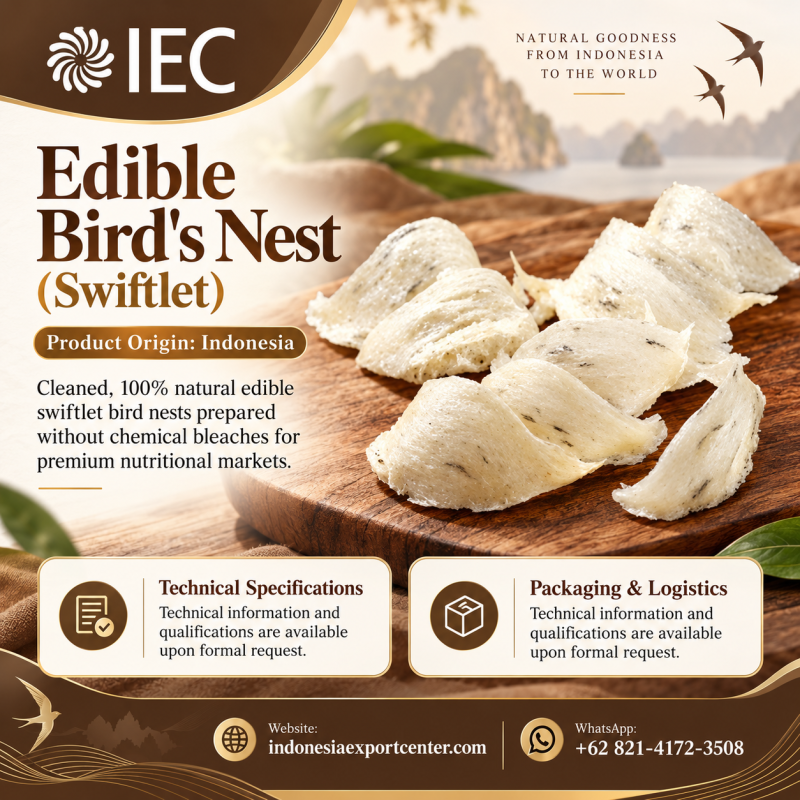
The IEC brochure describes cleaned, natural edible swiftlet nests originating from Indonesia and prepared without chemical bleaches.
Specific packaging formats, materials, package weights, labelling arrangements, and shipping capabilities are subject to supplier confirmation.
Why Packaging Matters
A packaging specification helps buyers address:
- Product integrity.
- Breakage.
- Moisture exposure.
- Foreign matter contamination.
- Food-contact material suitability.
- Lot identification.
- Inventory handling.
- Customs inspection.
- Retail or wholesale presentation.
Packaging should be selected for the actual product form and destination requirements.
Primary Packaging
Primary packaging is the material in direct contact with the product.
Buyers should request information about:
- Packaging material.
- Food-contact suitability.
- Closure method.
- Product protection.
- Net weight.
- Lot identification.
- Opening and resealing requirements.
- Applicable destination-country rules.
Possible packaging concepts may include food-compatible containers or protective inner packs, but IEC does not confirm that any particular format is available.
Secondary Packaging
Secondary packaging groups or protects individual packs.
It may support:
- Physical protection.
- Order consolidation.
- Handling.
- Identification.
- Distribution.
The buyer should verify the dimensions, strength, and suitability of the proposed format.
Outer Shipping Cartons
Outer cartons should be evaluated for the planned shipment conditions.
Important considerations include:
- Carton strength.
- Stacking.
- Handling.
- Moisture protection.
- Closure.
- Shipping marks.
- Palletization, if applicable.
- Package count.
Whole Nest Packaging
Whole nests may be particularly sensitive to damage affecting their commercial appearance.
Buyers may request a packaging proposal addressing:
- Individual separation.
- Movement inside packs.
- Compression.
- Vibration.
- Shock protection.
- Representative packing trials.
A packaging design should be validated rather than assumed to eliminate breakage.
Broken Pieces and Fragments
For broken material, buyers may prioritize:
- Product cleanliness.
- Containment.
- Particle-size consistency.
- Protection from additional crushing.
- Ease of handling.
- Manufacturing suitability.
The packaging specification should reflect the intended application.
Moisture Protection
Moisture control should consider:
- Product moisture specification.
- Water activity where relevant.
- Packaging barrier characteristics.
- Warehouse environment.
- Condensation risk.
- Transport conditions.
The appropriate solution should be based on product-specific evidence.
Packaging Labelling
Labels may need to identify:
| Field | Purpose |
|---|---|
| Product Name | Identification |
| Product Form | Commercial description |
| Country of Origin | Origin information |
| Net Weight | Quantity |
| Lot Number | Traceability |
| Packing Date | Where applicable |
| Supplier/Processor | Required identification |
| Storage Instructions | Product handling |
| Destination Language | Regulatory compliance |
| Other Mandatory Information | Market-specific |
Not every label field is universally required in the same format.
Packaging and Food Safety
Packaging should not introduce unacceptable contamination risks.
Buyers should evaluate food-contact materials and any relevant supplier declarations.
Where destination-country rules require specific documentation, the importer should verify it before ordering.
Export Packaging Approval Process
A practical approval workflow is:
- Define the product form.
- Specify package quantity.
- Request packaging material details.
- Review food-contact suitability.
- Evaluate protection requirements.
- Request representative packaging photographs.
- Consider a packing sample.
- Confirm label content.
- Review transport suitability.
- Approve the final packaging specification.
Packaging Specification Template
| Attribute | Buyer Requirement |
|---|---|
| Product Form | [Specify] |
| Primary Material | [Specify] |
| Net Weight per Pack | [Specify] |
| Secondary Pack | [Specify] |
| Outer Carton | [Specify] |
| Protective Features | [Specify] |
| Lot Label | [Specify] |
| Storage Instructions | [Specify] |
| Destination Labelling | [Specify] |
| Inspection Criteria | [Specify] |
Common Packaging Problems
- Insufficient protection against breakage.
- Unverified food-contact materials.
- Missing lot numbers.
- Incorrect net weights.
- Unclear storage instructions.
- Poor carton strength.
- Inconsistent packing lists.
- Unapproved packaging substitutions.
- Failure to account for destination labelling rules.
Packaging Inspection Before Shipment
Buyers may request an inspection covering:
- Package count.
- Carton condition.
- Seals.
- Labels.
- Product form.
- Representative breakage.
- Net weight.
- Lot numbers.
- Shipping marks.
Inspection arrangements must be agreed with the supplier.
Export Packaging RFQ Template
Subject: Indonesian Edible Bird’s Nest Export Packaging Inquiry
Company: [Name]
Destination Country: [Country]
Product Form: [Whole / Broken / Strips / Other]
Commercial Quantity: [KG]
Preferred Primary Packaging: [Details]
Net Weight per Pack: [Details]
Required Breakage Protection: [Details]
Required Labelling: [Details]
Food-Contact Documentation: [Details]
Preferred Shipment Method: [Details]
Destination Port: [Port]
Please provide available packaging specifications, photographs, minimum packaging quantities, sample feasibility, and quotation details.
Frequently Asked Questions
Does IEC offer a confirmed standard packaging format?
The brochure does not specify one.
Can buyers request custom packaging?
Requests may be discussed, subject to supplier feasibility.
Can packaging prevent all breakage?
No packaging system should be assumed to guarantee zero breakage.
Is food-contact documentation important?
Yes, where applicable to the materials and destination.
Can whole nests and fragments use the same packaging?
Their requirements may differ.
Can IEC guarantee private-label packaging?
No. Availability must be verified.
Request Edible Bird’s Nest Export Packaging Information
Need Indonesian edible bird’s nest with specific packaging, protection, or labelling requirements?
Contact IEC with your preferred product form, quantity, destination, and packaging specification.
REQUEST EXPORT PACKAGING SPECIFICATIONS & QUOTATION
IEC | INDONESIA EXPORT CENTER
Website: https://indonesiaexportcenter.com/
WhatsApp: +62 821-4172-3508
Related Resources
Whole Edible Bird’s Nest Indonesia
Bird’s Nest Moisture Content and Storage
Bird’s Nest Shipping from Indonesia
