

IEC | INDONESIA EXPORT CENTER
Natural Goodness from Indonesia to the World
Microbiological Testing for Indonesian Edible Bird’s Nest
Microbiological testing is an important part of food safety verification for edible swiftlet bird’s nest.
International importers, food manufacturers, and quality assurance teams may require laboratory evidence that the product meets applicable microbiological criteria before approving a supplier or releasing a shipment.
Indonesia Export Center (IEC) facilitates inquiries involving potential Indonesian edible bird’s nest suppliers.
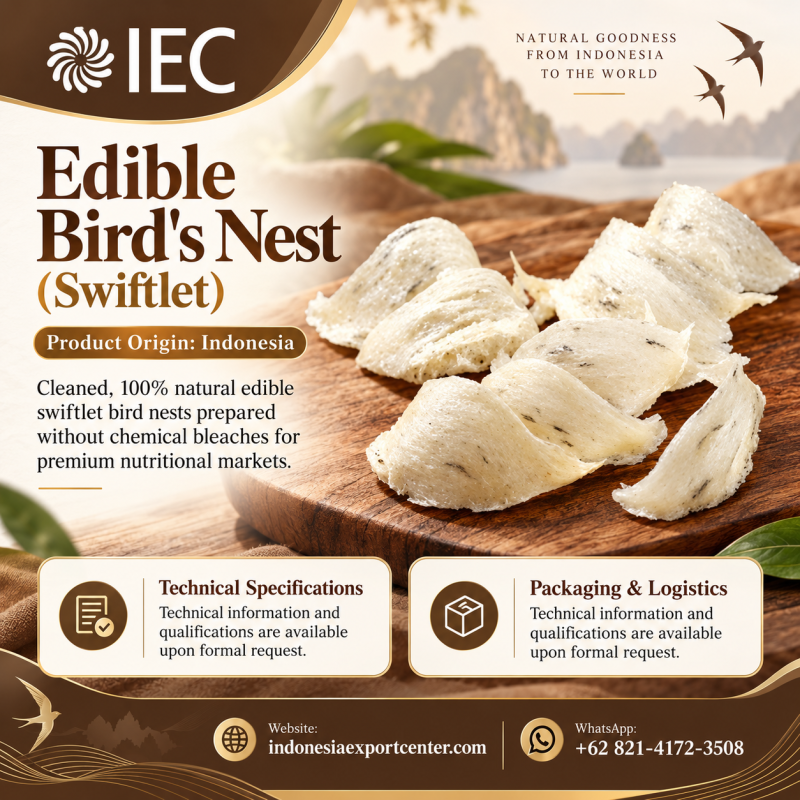
The IEC brochure describes cleaned, natural edible swiftlet bird’s nest originating from Indonesia and prepared without chemical bleaches.
The brochure does not provide microbiological test results, laboratory accreditation details, or confirmed compliance with a particular national food safety standard.
Why Microbiological Testing Matters
Edible bird’s nest is a food material that may undergo collection, handling, cleaning, drying, packing, storage, and transportation.
Microbiological risks depend on the actual source, processing methods, hygiene controls, storage, and intended use.
Testing can help evaluate selected hazards and verify aspects of supplier quality control.
However, laboratory testing alone does not guarantee the absence of all hazards.
Understanding Microbiological Quality
Microbiological quality may be assessed using different types of tests.
These can include:
- General microbial indicators.
- Hygiene indicators.
- Specific foodborne pathogens.
- Yeasts and moulds where relevant.
- Other microorganisms identified through a product-specific hazard assessment.
The appropriate testing panel must be selected according to the actual product and applicable regulations.
Common Microbiological Test Categories
Aerobic Plate Count
This may be used as a general indicator of microbial load under defined testing conditions.
Interpretation depends on the product and applicable criteria.
Coliforms or Other Hygiene Indicators
These may provide information relevant to processing hygiene.
The significance of a result depends on the test method and product.
Escherichia coli
Testing may be relevant to certain food safety assessments.
Salmonella
Testing may be required or appropriate depending on the product and jurisdiction.
Staphylococcus aureus
This may be considered where relevant to the product’s hazard assessment.
Yeasts and Moulds
Testing may help assess selected aspects of microbial quality and storage-related concerns.
This list is illustrative. It is not a claim that every test is legally required for every edible bird’s nest shipment.
Microbiological Testing and Product Form
Different product forms may require different assessments.
For example:
- Raw material.
- Cleaned material.
- Whole nests.
- Broken pieces.
- Ingredients intended for further processing.
- Finished food products.
The buyer should determine which microbiological criteria apply to the actual material.
Step 1 – Review Destination-Country Requirements
Importers should identify:
- Applicable food category.
- Microbiological standards.
- Required organisms.
- Test methods.
- Sampling plans.
- Acceptance criteria.
- Required laboratory qualifications.
- Documentation requirements.
Regulatory requirements vary by destination.
Step 2 – Assess Supplier Food Safety Controls
Microbiological testing should be considered alongside preventive controls.
Relevant questions include:
- How are source materials handled?
- What cleaning procedures are used?
- How is water quality controlled?
- Are workers trained in hygiene?
- How is equipment cleaned?
- How is cross-contamination prevented?
- How is drying managed?
- What storage controls apply?
- Are lots traceable?
- How are nonconforming results handled?
Step 3 – Select Appropriate Tests
A qualified food safety professional should determine the relevant test panel based on:
- Product characteristics.
- Processing status.
- Intended use.
- Supplier history.
- Destination regulations.
- Identified hazards.
Step 4 – Choose a Competent Laboratory
The buyer should verify:
- Laboratory identity.
- Relevant accreditation.
- Scope of accreditation.
- Method suitability.
- Sample handling procedures.
- Reporting format.
- Report authenticity.
Accreditation should not be assumed from a laboratory’s name or marketing materials.
Step 5 – Establish Sampling Procedures
A microbiological sampling plan may specify:
- Lot identification.
- Number of sample units.
- Sampling locations.
- Sample size.
- Aseptic sampling procedures.
- Sample containers.
- Transport conditions.
- Testing timeframe.
- Chain of custody.
Poor sampling or handling can compromise the usefulness of results.
Step 6 – Review Laboratory Reports
| Report Field | Buyer Review |
|---|---|
| Product Name | Match offered product |
| Lot Number | Match commercial lot |
| Sample Identification | Confirm |
| Test Organism | Identify |
| Test Method | Review |
| Result | Evaluate |
| Reporting Unit | Confirm |
| Acceptance Criterion | Verify |
| Laboratory | Authenticate |
| Test Date | Review |
| Accreditation Scope | Check if required |
Step 7 – Interpret Results
Microbiological results should be evaluated according to:
- Test method.
- Sampling plan.
- Reporting unit.
- Applicable limit.
- Product category.
- Intended use.
For example, a quantitative result and a presence/absence result are not interchangeable.
Likewise, testing one sample does not establish that every unit in a shipment is free from contamination.
Step 8 – Address Nonconforming Results
If testing identifies a nonconformity:
- Hold the affected material.
- Verify sample and lot identity.
- Review laboratory findings.
- Investigate processing and storage conditions.
- Assess the scope of affected material.
- Determine appropriate corrective actions.
- Follow applicable regulatory requirements.
- Document the disposition decision.
A failed result should not be dismissed solely because the product appears clean.
Step 9 – Link Testing to Lot Traceability
Microbiological documentation should ideally connect:
Supplier → Source Lot → Processing Lot → Finished Lot → Laboratory Sample → Shipment
This supports quality investigations and recall readiness.
Step 10 – Evaluate Ongoing Supplier Performance
Repeat buyers may review:
- Testing frequency.
- Historical results.
- Nonconformity trends.
- Corrective actions.
- Process changes.
- Supplier audits.
- Lot consistency.
A single satisfactory report does not guarantee all future shipments.
Microbiological Testing vs Nitrite Testing
These address different quality questions.
| Test Category | Main Purpose |
|---|---|
| Microbiological Testing | Assess selected microorganisms |
| Nitrite Testing | Measure nitrite concentration |
| Moisture Testing | Assess moisture content |
| Heavy Metal Testing | Assess selected chemical contaminants |
| Foreign Matter Inspection | Evaluate physical contamination |
A comprehensive food safety program may require several categories.
Microbiological Testing Request Checklist
- Product identified.
- Destination market identified.
- Relevant microorganisms selected.
- Test methods specified.
- Sampling plan agreed.
- Laboratory verified.
- Lot number recorded.
- Acceptance criteria established.
- Reports authenticated.
- Nonconformity procedure defined.
Microbiological Testing RFQ Template
Subject: Indonesian Edible Bird’s Nest Microbiological Testing Inquiry
Company: [Name]
Country: [Country]
Product: Edible Swiftlet Bird’s Nest
Product Form: [Details]
Processing Status: [Details]
Destination Market: [Country]
Required Microbiological Tests: [List]
Required Methods: [Details]
Required Sampling Plan: [Details]
Applicable Acceptance Criteria: [Details]
Required Laboratory Accreditation: [Details]
Sample Quantity: [KG]
Commercial Quantity: [KG]
Required Documentation: [Details]
Please provide available microbiological testing information, laboratory reports, lot traceability records, and supplier quotation feasibility.
Frequently Asked Questions
Does cleaned edible bird’s nest automatically pass microbiological testing?
No.
Are all microbiological tests required in every country?
No. Requirements vary.
Can I request a microbiological laboratory report?
Yes, subject to availability.
Does a laboratory report guarantee that every package is safe?
No.
Is a visually clean nest necessarily microbiologically safe?
No.
Can independent testing be requested?
Yes, subject to agreement and laboratory arrangements.
Does IEC guarantee compliance with my country’s food safety rules?
No.
Request Bird’s Nest Microbiological Testing Information
Need microbiological test documentation for Indonesian edible bird’s nest sourcing, manufacturing, or import compliance?
Contact IEC with your product requirements, destination country, required laboratory tests, and purchasing quantity.
REQUEST BIRD’S NEST MICROBIOLOGICAL TEST INFORMATION
IEC | INDONESIA EXPORT CENTER
Natural Goodness from Indonesia to the World
Website: https://indonesiaexportcenter.com/
WhatsApp: +62 821-4172-3508
Related Resources
Edible Bird’s Nest Quality Specifications
Bird’s Nest Certificate of Analysis Guide
Edible Bird’s Nest Nitrite Testing
Cleaned Swiftlet Bird’s Nest Supplier
