

IEC | INDONESIA EXPORT CENTER
Natural Goodness from Indonesia to the World
Import Edible Bird’s Nest from Indonesia with a Structured Procurement Plan
Importing edible bird’s nest requires careful preparation because the product is intended for human consumption and originates from an animal species.
International buyers should establish the product’s identity, legal import eligibility, food safety status, supplier qualifications, documentation requirements, and shipment arrangements before making a purchase commitment.
Indonesia Export Center (IEC) facilitates B2B sourcing inquiries involving potential Indonesian edible swiftlet bird’s nest suppliers.
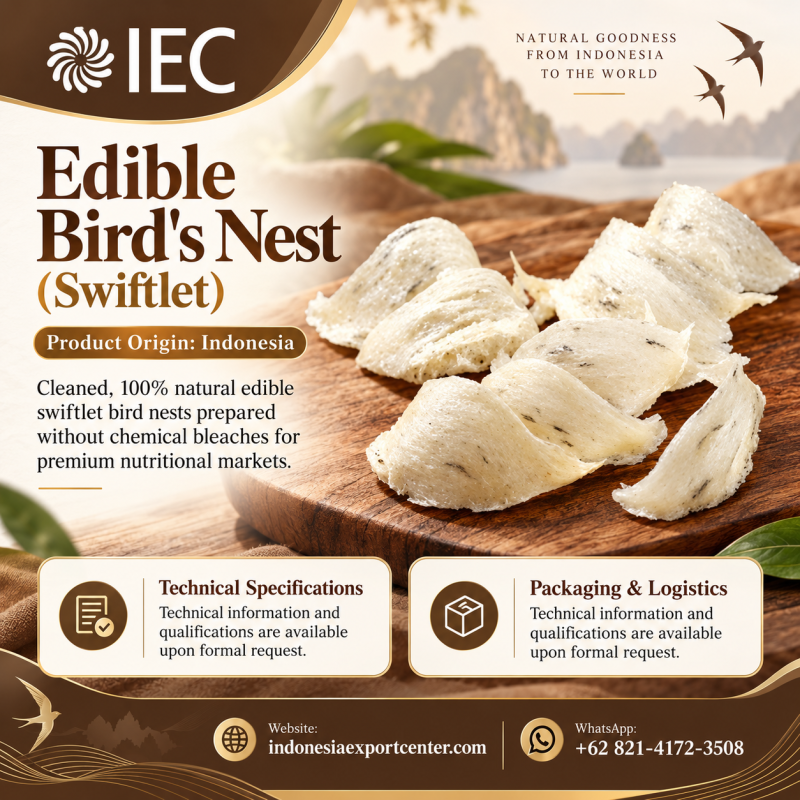
The IEC brochure identifies the product as Indonesian-origin cleaned edible swiftlet bird’s nest, described as prepared without chemical bleaches.
This brochure does not establish destination-country import approval, establishment registration, laboratory compliance, or guaranteed export availability.
Why Import Planning Matters
A supplier may offer a commercially attractive product, but the shipment may still be unsuitable if the destination country requires approvals or documents that cannot be provided.
Import planning should therefore begin before quotation acceptance.
The buyer should determine:
- Whether edible bird’s nest imports are permitted.
- Whether Indonesia is an eligible origin.
- Whether the source or processing establishment must be approved.
- Whether the importer requires registration or permits.
- What sanitary documentation is required.
- Which laboratory tests apply.
- How the product must be labelled.
- Which customs procedures apply.
Step 1 – Identify the Exact Product
Confirm:
- Edible swiftlet bird’s nest.
- Source and species information, where available.
- Cleaned or other processing status.
- Whole, broken, strips, or other form.
- Intended use.
- Packaging.
- Whether any additional ingredients are present.
A processed or formulated food product may face different requirements from unprepared nest material.
Step 2 – Verify Destination Import Eligibility
Edible bird’s nest can be subject to veterinary, sanitary, or animal-origin food import controls.
Requirements vary by market.
For example, a destination may require an approved exporting country, an eligible establishment, a specific certificate, or prior import authorization.
The importer should verify these requirements with the relevant competent authority.
Do not assume that an Indonesian supplier eligible for one market is eligible for every market.
Step 3 – Confirm Customs Classification
The correct customs code depends on the actual product and applicable national tariff schedule.
The importer should verify classification with customs authorities or a qualified customs specialist.
No specific HS code is assigned here.
Step 4 – Verify Supplier and Facility Information
Relevant questions include:
- Who is the legal seller?
- Who collected the nests?
- Who cleaned or processed them?
- Where is the processing facility?
- Is the facility registered or approved where required?
- What hygiene controls are used?
- Are source records maintained?
- Is the product traceable by lot?
- What documents can be supplied?
Step 5 – Establish Product Specifications
| Parameter | Importer Requirement |
|---|---|
| Product Identity | Confirm |
| Country of Origin | Verify |
| Product Form | Specify |
| Grade | Define |
| Cleaning Status | Document |
| Moisture | Establish criteria |
| Foreign Matter | Establish criteria |
| Microbiological Quality | Apply relevant requirements |
| Nitrite | Evaluate applicable limits |
| Heavy Metals | Assess relevant standards |
| Other Residues | Risk-based testing |
| Packaging | Approve |
| Shelf Life | Verify |
| Lot Identification | Require where applicable |
Step 6 – Request Laboratory Reports
Buyers should assess whether laboratory reports:
- Identify the product.
- Identify the tested lot.
- State the test method.
- Include the result and units.
- Identify the laboratory.
- State the test date.
- Address applicable acceptance criteria.
A generic certificate should not be assumed to cover a particular shipment.
Step 7 – Review Import Documents
Depending on destination requirements, documents may include:
- Commercial invoice.
- Packing list.
- Transport document.
- Certificate of origin, where applicable.
- Health or sanitary certificate.
- Veterinary documentation, where applicable.
- Import permit.
- Product specification.
- Laboratory reports.
- Establishment approval evidence.
- Other customs or regulatory records.
This is a planning checklist, not a universal mandatory document list.
Step 8 – Request Samples Where Permitted
Even samples may be subject to import restrictions.
Before requesting samples, confirm:
- Import eligibility.
- Permit requirements.
- Labelling.
- Quantity restrictions.
- Courier acceptance.
- Required documentation.
Sample approval does not automatically authorize commercial import.
Step 9 – Request a Commercial Quotation
The quotation should clearly state:
- Product.
- Grade.
- Quantity.
- Price.
- Currency.
- Packaging.
- Delivery term.
- Named destination.
- Shipment period.
- Payment terms.
- Documentation.
- Inspection arrangements.
Step 10 – Evaluate Total Landed Cost
Consider:
- Product cost.
- Packaging.
- Laboratory testing.
- Export documentation.
- Freight.
- Insurance.
- Customs duties.
- Taxes.
- Inspection.
- Clearance.
- Storage.
- Inland delivery.
Step 11 – Review the Purchase Contract
The contract should define:
- Product identity.
- Grade and specifications.
- Quantity.
- Price.
- Delivery terms.
- Payment.
- Required documents.
- Inspection.
- Acceptance and rejection.
- Claims.
- Responsibilities for regulatory compliance.
Step 12 – Prepare Receiving Quality Control
At arrival, the importer should review:
- Package condition.
- Product identification.
- Lot numbers.
- Quantity.
- Transport records.
- Required certificates.
- Product appearance.
- Testing results.
- Any evidence of damage or contamination.
Material should not be released for sale or manufacturing until required checks are complete.
Common Import Mistakes
Ordering Before Checking Eligibility
A commercially available product may not be legally importable.
Assuming Every Supplier Is Export-Approved
Approvals may be market-specific.
Accepting Unsupported Quality Claims
Product descriptions should be supported by appropriate evidence.
Ignoring Lot Traceability
Traceability is important for food safety and product recalls.
Confusing Samples with Commercial Approval
Sample import permission may differ from commercial shipment requirements.
Using an Unverified Customs Code
Incorrect classification may create clearance problems.
Importer RFQ Template
Subject: Indonesian Edible Bird’s Nest Import Inquiry
Company: [Name]
Destination Country: [Country]
Importer Registration Details: [If Relevant]
Product: Edible Swiftlet Bird’s Nest
Required Form: [Details]
Required Grade: [Details]
Technical Specifications: [Details]
Food Safety Tests: [Details]
Trial Quantity: [KG]
Commercial Quantity: [KG]
Destination Port: [Port]
Preferred Incoterm: [Term]
Required Health or Sanitary Documents: [Details]
Required Establishment Approvals: [Details]
Required Shipment Period: [Dates]
Please provide supplier information, product specifications, available quality documents, and confirmation of export feasibility for the destination market.
Frequently Asked Questions
Can I import edible bird’s nest from Indonesia into any country?
No. Import eligibility is destination-specific.
Is a health certificate required?
It depends on the destination’s current requirements.
Are all Indonesian processing facilities eligible for export?
No such general claim can be made.
Can I request an import sample?
Only where applicable regulations and supplier arrangements permit.
Does IEC handle customs clearance automatically?
No customs clearance service is confirmed.
Can IEC guarantee successful import?
No.
Request Edible Bird’s Nest Import Information
Preparing to import Indonesian edible swiftlet bird’s nest?
Contact IEC with your destination country, required product specifications, quantity, and documentation checklist.
REQUEST BIRD’S NEST IMPORT SPECIFICATIONS & QUOTATION
IEC | INDONESIA EXPORT CENTER
Website: https://indonesiaexportcenter.com/
WhatsApp: +62 821-4172-3508
Related Resources
Edible Bird’s Nest Supplier Indonesia
Indonesian Swiftlet Bird’s Nest Sourcing
Bulk Edible Bird’s Nest Supplier Indonesia
