

IEC | INDONESIA EXPORT CENTER
Your Global Sourcing Partner
Understanding Gum Copal in Traditional Varnish Applications
Natural resins have a long history in varnish making and decorative surface finishing.
Before the widespread availability of many modern synthetic resin systems, various natural resins were used in coatings and finishing materials.
Copal is among the commercial resin categories associated with historical varnish applications.
Today, specialty varnish manufacturers, craft producers, and materials researchers may investigate natural Gum Copal for formulations inspired by traditional finishing practices.
However, historical use does not establish that every modern Gum Copal grade will behave identically or that a traditional formulation can be reproduced without testing.
Indonesia Export Center (IEC) facilitates inquiries involving potential Indonesian Gum Copal suppliers.
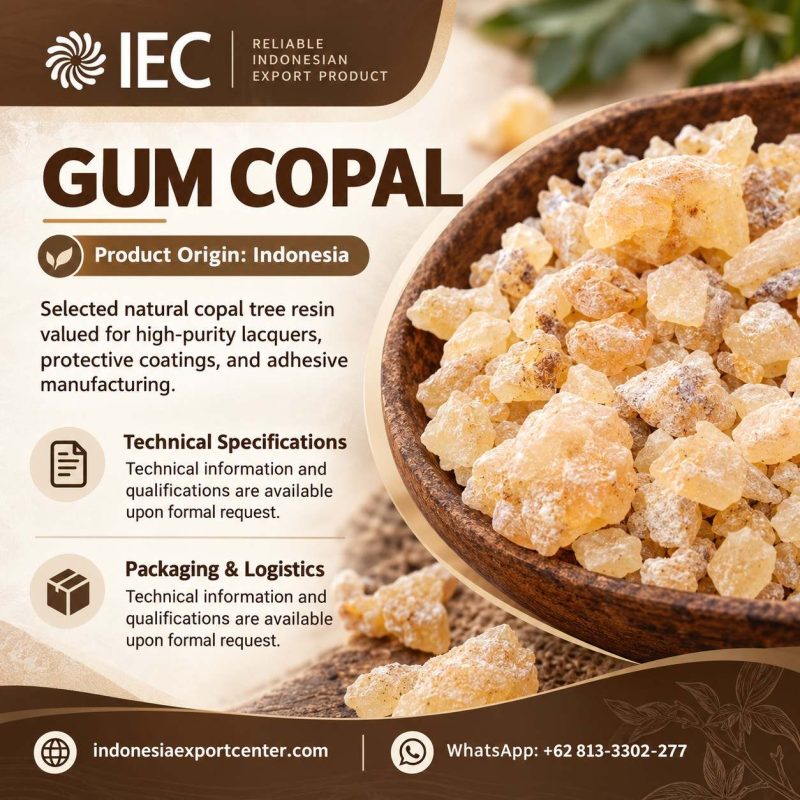
The IEC brochure identifies the product as selected natural copal tree resin originating from Indonesia.
What Is a Traditional Varnish?
A traditional varnish generally refers to a finishing formulation associated with historical materials or preparation practices.
Different traditions used different combinations of resins, oils, solvents, and processing methods.
Therefore, the phrase “traditional varnish” does not identify one universal recipe.
The specific historical context, intended substrate, and performance objectives should be defined.
Why Gum Copal Is Associated with Varnish Making
Certain copal resins have historically been used in varnish-related applications.
Their use depended on the available resin, processing methods, and desired coating characteristics.
However, the broad term copal encompasses materials with potentially different properties.
For modern procurement, the buyer must identify the actual resin grade.
Traditional Context vs Modern Manufacturing
Traditional materials may be studied for:
- Historical formulation research.
- Specialty finishes.
- Craft manufacturing.
- Decorative applications.
- Material comparison.
- Restoration research.
Modern production also requires attention to:
- Workplace safety.
- Product consistency.
- Technical testing.
- Applicable regulations.
- Documented quality control.
Resin Identification for Traditional Varnishes
Before selecting Gum Copal, investigate:
- Resin identity.
- Botanical source, where available.
- Geographic origin.
- Grade.
- Appearance.
- Processing history.
- Solubility.
- Thermal behavior.
- Relevant chemical properties.
The IEC brochure does not establish a particular historical copal variety.
Physical Preparation Considerations
Natural resin preparation may involve inspection, sorting, and other appropriate operations.
The actual procedure should be based on:
- Material condition.
- Manufacturing requirements.
- Equipment.
- Safety assessment.
- Technical testing.
This guide does not provide a varnish recipe or recommend uncontrolled heating or solvent processing.
Solubility and Compatibility
Traditional varnish research may involve evaluating resin behavior in particular formulation systems.
However, compatibility cannot be assumed.
Laboratory screening should examine:
- Dissolution behavior.
- Residue.
- Colour.
- Stability.
- Interactions with other ingredients.
- Finished-film characteristics.
Appearance and Colour
Natural resin colour may influence varnish appearance.
Buyers should evaluate:
- Raw resin colour.
- Colour after processing.
- Film colour.
- Clarity.
- Aging behavior.
No fixed colour performance is guaranteed.
Film Formation and Performance
A varnish manufacturer may assess:
- Application characteristics.
- Drying or curing.
- Adhesion.
- Hardness.
- Flexibility.
- Gloss.
- Resistance to relevant exposure.
- Aging.
The finished formulation should be tested on the intended substrate.
Quality Control for Natural Resin Varnishes
| Quality Area | Recommended Evaluation |
|---|---|
| Resin Identity | Confirm |
| Grade | Define |
| Appearance | Inspect |
| Foreign Matter | Evaluate |
| Moisture | Test if relevant |
| Solubility | Screen |
| Thermal Behavior | Characterize |
| Formulation Stability | Test |
| Film Appearance | Evaluate |
| Adhesion | Test |
| Aging | Assess |
| Batch Consistency | Monitor |
Sample Qualification Workflow
Identify Resin → Request Sample → Review Technical Data → Conduct Laboratory Screening → Prepare Controlled Trial → Test Finished Varnish → Approve Material
A successful sample trial does not guarantee that future lots will perform identically.
Historical Research and Conservation Considerations
For conservation or restoration work, material selection can involve additional requirements.
These may include:
- Compatibility with existing materials.
- Long-term aging.
- Reversibility.
- Visual matching.
- Historical authenticity.
- Specialist conservation standards.
Such decisions should be made by appropriately qualified professionals.
Supplier Questions for Traditional Varnish Manufacturers
- What Gum Copal grade is offered?
- What is the material’s identified origin?
- Is botanical information available?
- Can representative samples be supplied?
- Are technical reports available?
- Is the resin sorted or otherwise prepared?
- Can lot consistency be evaluated?
- What packaging is available?
- What commercial quantities can be discussed?
- What shipment arrangements are possible?
Traditional Varnish Gum Copal RFQ
Subject: Indonesian Gum Copal for Traditional Varnish Development
Company: [Name]
Country: [Country]
Product: Natural Gum Copal
Application: Traditional or Specialty Varnish
Required Grade: [Details]
Historical Material Reference: [If Applicable]
Required Appearance: [Details]
Required Testing: [Details]
Sample Quantity: [KG]
Commercial Quantity: [KG / MT]
Destination: [Port, Country]
Please provide available Gum Copal identity information, grade descriptions, representative samples, and technical documentation.
Frequently Asked Questions
Was copal historically used in varnishes?
Certain copal resins have historical associations with varnish making.
Is every Gum Copal grade suitable for traditional varnish?
No.
Does IEC provide a traditional varnish formula?
No. This page is a material sourcing and qualification guide.
Can Gum Copal be used in conservation work?
Any conservation application requires specialist evaluation.
Does a historical recipe guarantee modern performance?
No.
Can buyers request resin samples?
Yes, subject to supplier availability.
Request Indonesian Gum Copal for Traditional Varnish Development
Researching natural resins for specialty varnishes, decorative finishes, or historical formulation studies?
Contact IEC with your required resin characteristics, sample quantity, and commercial needs.
IEC | INDONESIA EXPORT CENTER
Website: https://indonesiaexportcenter.com/
WhatsApp: +62 813-3302-277
Related Resources
Gum Copal for Varnish Manufacturing
Natural Copal Resin for Specialty Finishes
