

IEC | INDONESIA EXPORT CENTER
Your Global Sourcing Partner
Understanding Gum Copal Grades for Industrial Procurement
Natural resin buyers often encounter commercial descriptions such as selected Gum Copal, sorted copal, or other supplier-specific grade names.
However, these descriptions do not necessarily correspond to a single internationally standardized grading system.
For industrial manufacturers and importers, the correct approach is to establish the actual material identity, understand the supplier’s grading criteria, and evaluate the resin against the intended application.
Indonesia Export Center (IEC) facilitates inquiries involving potential Indonesian Gum Copal suppliers.
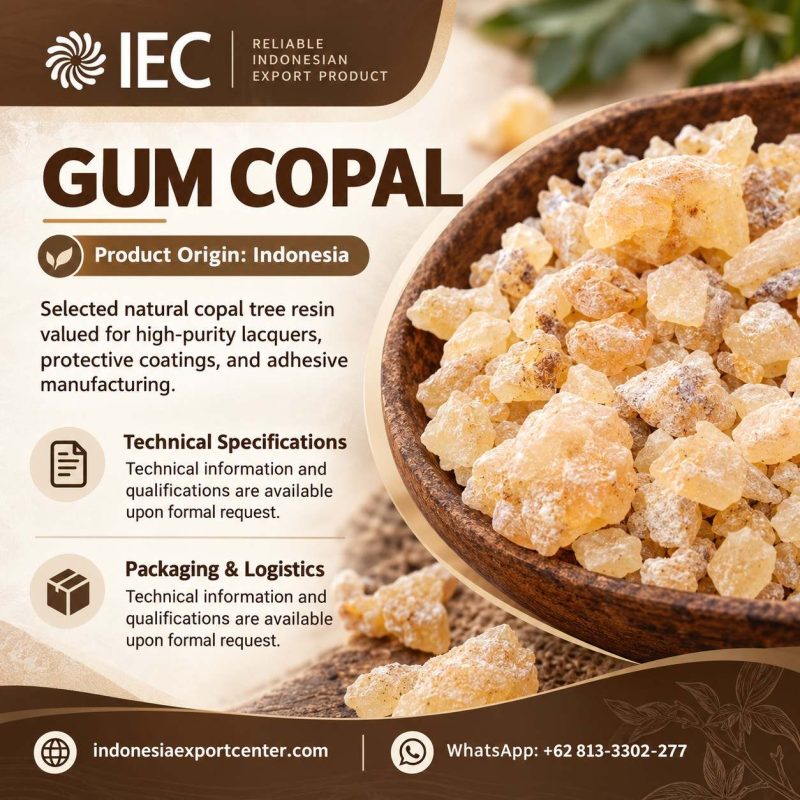
The IEC brochure identifies the product as selected natural copal tree resin originating from Indonesia. It does not provide a verified grade classification table or numerical grading limits.
What Is a Gum Copal Grade?
A commercial grade is a category used to distinguish material according to defined characteristics.
Depending on the supplier, grading may consider:
- Resin identity.
- Origin.
- Appearance.
- Colour.
- Lump size.
- Cleanliness.
- Foreign matter.
- Processing history.
- Other technical characteristics.
The buyer should ask the supplier to explain the criteria used for each offered grade.
Why Gum Copal Classification Matters
Grade identification helps buyers:
- Compare supplier offers.
- Define quality requirements.
- Evaluate samples.
- Plan manufacturing processes.
- Maintain consistency.
- Establish contract specifications.
- Reduce disputes.
A grade name without measurable criteria provides limited technical assurance.
Resin Identity vs Commercial Grade
These are different concepts.
Resin Identity describes what the material is.
Commercial Grade describes how a supplier classifies that material.
Buyer Specification establishes the characteristics the purchasing company requires.
All three should be considered during procurement.
Factors Used in Gum Copal Classification
Botanical Source
Different natural resin sources may produce materials with different characteristics.
Botanical identity should be requested where available and relevant.
Geographic Origin
The IEC brochure identifies Indonesia as the product origin.
For specific shipments, buyers may request supporting origin information.
Colour
Natural copal can exhibit visual variation.
Colour may be useful for grading, but it does not independently establish purity or processing suitability.
Lump Size
Suppliers may sort material according to physical size.
Buyers should define acceptable size ranges if relevant.
Cleanliness
Visible foreign matter may influence the grade and the amount of preparation needed before industrial use.
Moisture
Moisture may be relevant to storage and processing.
Processing History
Sorting, cleaning, or other processing may affect the commercial material.
Application Suitability
A grade may be suitable for one industrial formulation but unsuitable for another.
Gum Copal Grade Evaluation Matrix
| Classification Factor | Buyer Verification |
|---|---|
| Resin Identity | Confirm |
| Botanical Source | Request if available |
| Geographic Origin | Verify as required |
| Supplier Grade Name | Obtain definition |
| Colour | Compare under controlled conditions |
| Appearance | Inspect representative sample |
| Lump Size | Measure |
| Foreign Matter | Test or inspect |
| Moisture | Test if relevant |
| Thermal Properties | Evaluate |
| Solubility | Application-specific testing |
| Batch Consistency | Compare multiple lots |
This matrix is not an official grading standard.
Avoiding Invented Grade Categories
Buyers should not assume that labels such as premium, superior, export quality, or high purity have a universally accepted meaning.
A supplier may use these terms commercially, but the buyer should request measurable definitions.
For example, rather than specifying only “premium Gum Copal,” a buyer can define:
- Required appearance.
- Maximum acceptable foreign matter.
- Acceptable colour.
- Required physical form.
- Relevant analytical results.
- Application performance criteria.
How to Compare Two Gum Copal Grades
A structured comparison should evaluate:
- Product identity.
- Supplier’s grade definition.
- Representative samples.
- Relevant laboratory results.
- Processing behavior.
- Application performance.
- Commercial availability.
- Total cost.
Classification for Varnish Manufacturers
Varnish formulators may prioritize:
- Processing characteristics.
- Colour.
- Solubility.
- Film appearance.
- Formulation compatibility.
Classification for Protective Coatings
Coating manufacturers may prioritize:
- Batch consistency.
- Processing compatibility.
- Film performance.
- Application-specific durability.
Classification for Lacquer Manufacturers
Lacquer producers may prioritize:
- Solubility under defined conditions.
- Colour.
- Clarity.
- Processing behavior.
- Film properties.
Classification for Adhesive Manufacturers
Adhesive formulators may prioritize:
- Compatibility.
- Tack.
- Adhesion.
- Processing characteristics.
- Storage stability.
These are application-dependent evaluation criteria, not universal grade definitions.
Sample Qualification Process
A buyer can use the following workflow:
Supplier Grade Description → Representative Sample → Laboratory Evaluation → Application Trial → Approved Specification → Commercial Purchase
The process should be documented.
Gum Copal Grade Inquiry Template
Subject: Indonesian Gum Copal Grade and Classification Inquiry
Company: [Name]
Country: [Country]
Product: Natural Gum Copal
Application: [Details]
Required Grade: [If Known]
Required Appearance: [Details]
Colour Requirements: [Details]
Size Requirements: [Details]
Foreign Matter Requirements: [Details]
Technical Testing Requirements: [Details]
Sample Quantity: [KG]
Commercial Quantity: [KG / MT]
Destination: [Country / Port]
Please provide available commercial grades, grading criteria, representative samples, and supporting technical information.
Frequently Asked Questions
Are all Gum Copal grades the same?
No.
Does IEC provide an official grade classification?
No verified classification table is provided in the supplied brochure.
Does darker Gum Copal always mean lower quality?
No. Colour alone cannot establish overall quality.
Is a larger lump automatically better?
No. Size suitability depends on the intended application.
Can buyers specify their own quality requirements?
Yes, subject to supplier capability and agreement.
Can two suppliers use the same grade name differently?
Yes. Buyers should compare measurable characteristics.
Request Indonesian Gum Copal Grade Information
Looking for the right natural copal resin grade for your manufacturing or distribution requirements?
Contact IEC with your application, preferred grade, quality requirements, and quantity.
REQUEST GUM COPAL GRADE INFORMATION
IEC | INDONESIA EXPORT CENTER
Website: https://indonesiaexportcenter.com/
WhatsApp: +62 813-3302-277
Related Resources
Natural Copal Resin Supplier Indonesia
Gum Copal Technical Specifications Guide
