

IEC | INDONESIA EXPORT CENTER
Your Global Sourcing Partner
Planning a Large-Volume PFAD Purchase from Indonesia
Bulk purchasing of Palm Fatty Acid Distillate requires coordination between procurement, technical quality, finance, production, logistics, and legal teams.
A large-volume order may offer operational advantages, but it can also create significant exposure if specifications, shipment schedules, storage arrangements, or payment obligations are not properly defined.
For industrial buyers, the purchasing process should begin with a realistic demand forecast and end with a documented cargo acceptance and claims procedure.
Indonesia Export Center (IEC) facilitates sourcing inquiries involving potential Indonesian PFAD suppliers.
IEC does not guarantee bulk inventory, vessel availability, monthly production capacity, or any particular commercial price.
Why Bulk PFAD Planning Matters
Bulk procurement decisions affect:
- Manufacturing continuity.
- Working capital.
- Storage utilization.
- Shipping costs.
- Product quality.
- Delivery scheduling.
- Supplier exposure.
- Insurance.
- Customs clearance.
- Contractual risk.
The lowest quoted unit price is not necessarily the lowest total procurement cost.
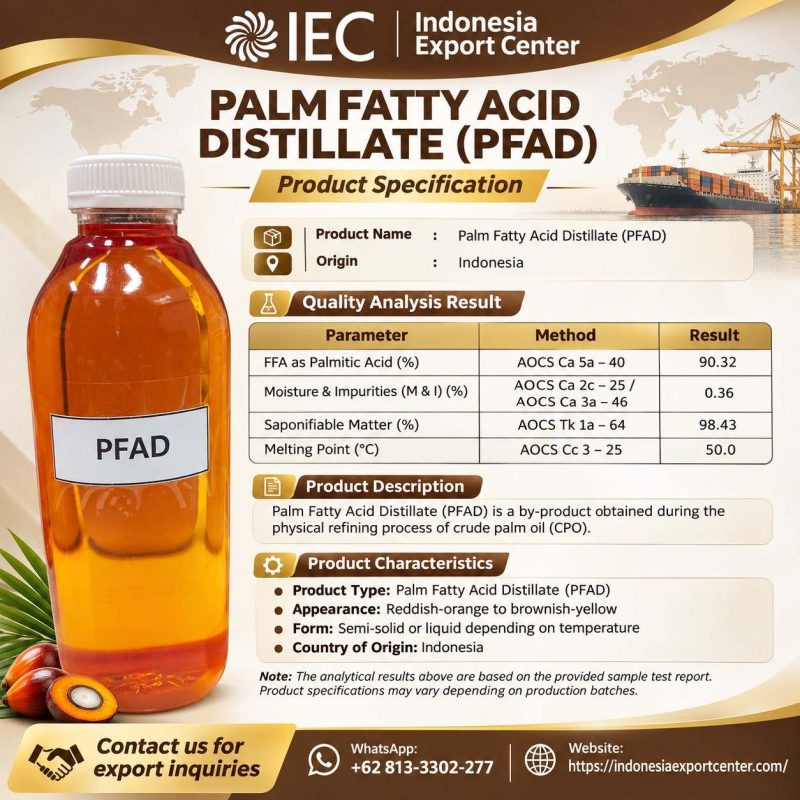
IEC PFAD Reference Specifications
| Parameter | Reference |
|---|---|
| FFA, as Palmitic | Minimum 90% |
| Moisture & Impurities | Maximum 1.0% |
| Iodine Value | Maximum 50 |
| Melting Point | 36–46°C |
| Gardner Colour | Maximum 7 |
| Appearance | White / Off White Solid |
Packaging concepts include bulk tanks and flexibags, subject to suitability confirmation.
Phase 1 – Forecast Industrial Demand
Before requesting supplier quotations, determine:
- Average monthly consumption.
- Expected production changes.
- Existing inventory.
- Minimum safety stock.
- Procurement lead time.
- Storage limitations.
- Planned maintenance shutdowns.
- Seasonal or project-specific demand.
The demand forecast should be reviewed by the relevant production team.
Phase 2 – Calculate the Purchase Requirement
A basic planning relationship is:
Planned Purchase Quantity = Forecast Consumption + Target Closing Inventory − Opening Inventory − Confirmed Incoming Supply
Adjustments may be necessary for process losses, inventory restrictions, or other operational factors.
This is a planning formula, not a guarantee of required purchase volume.
Phase 3 – Define Technical Specifications
The buyer should establish:
- Product identity.
- Minimum FFA.
- Moisture limit.
- Impurity limit.
- Iodine value.
- Melting characteristics.
- Additional analytical requirements.
- Sampling methods.
- Acceptance procedures.
The buyer should distinguish between mandatory specifications and preferred characteristics.
Phase 4 – Qualify Potential Suppliers
Review:
- Legal registration.
- Contracting entity.
- Product source.
- Selling authority.
- Available capacity.
- Current COA.
- Commercial references, where verifiable.
- Export arrangements.
- Payment beneficiary.
Do not treat an indicative offer as proof of physical inventory.
Phase 5 – Arrange Samples and Quality Testing
Where required, obtain representative samples.
Laboratory testing may assess whether the proposed material meets the buyer’s process requirements.
A trial should not automatically approve all future batches.
Phase 6 – Confirm Storage Capacity
Bulk PFAD storage planning should address:
- Available tank capacity.
- Tank compatibility.
- Cleaning.
- Heating equipment.
- Transfer lines.
- Pumping capability.
- Temperature monitoring.
- Sampling access.
- Contamination prevention.
- Inventory control.
The melting range stated in the brochure does not establish a universal operating temperature.
Phase 7 – Evaluate Shipping Options
Potential arrangements may involve:
- Suitable bulk liquid shipping.
- Approved tank containers.
- Approved flexibag systems.
- Other technically suitable methods.
Actual feasibility depends on the cargo, quantity, equipment, carrier, route, and receiving facilities.
Phase 8 – Plan Freight and Chartering
For a bulk vessel arrangement, the parties may need to address:
- Vessel suitability.
- Loading port.
- Discharge port.
- Loading window.
- Terminal capacity.
- Cargo quantity.
- Tank cleanliness.
- Heating requirements.
- Laytime.
- Demurrage.
- Surveyor arrangements.
These terms require careful contractual review.
Phase 9 – Calculate the Total Procurement Cost
A useful comparison should consider:
| Cost Component | Planning Question |
|---|---|
| Product | What is the confirmed quotation? |
| Freight | Which party arranges and pays? |
| Insurance | What coverage applies? |
| Loading | What is included? |
| Discharge | Who pays? |
| Customs | What requirements apply? |
| Storage | What capacity and cost are needed? |
| Heating | Is it required? |
| Testing | What inspection is planned? |
| Finance | What are the payment costs? |
| Delays | What exposure exists? |
Phase 10 – Establish Payment and Contract Controls
The purchase agreement should address:
- Legal parties.
- Product.
- Quantity.
- Quality specification.
- Price.
- Currency.
- Incoterm.
- Delivery schedule.
- Payment.
- Inspection.
- Documents.
- Claims.
- Dispute resolution.
For substantial transactions, qualified legal and trade professionals should review the contract.
Phase 11 – Define Quality and Quantity Claims
Before shipment, agree on:
- Sampling location.
- Inspection timing.
- Laboratory methods.
- Quantity measurement.
- Retained samples.
- Claims notification deadlines.
- Retesting procedures.
- Applicable remedies.
Claim limits should be expressly negotiated rather than assumed.
Phase 12 – Prepare for Receiving and Acceptance
The receiving team should confirm:
- Storage readiness.
- Cargo identification.
- Shipping documentation.
- Receiving equipment.
- Safety procedures.
- Quantity measurement.
- Sampling arrangements.
- Laboratory testing.
- Acceptance authorization.
- Inventory recording.
Complete Bulk PFAD Purchase Checklist
| Stage | Requirement | Status |
|---|---|---|
| Demand | Forecast monthly consumption | Pending |
| Inventory | Establish safety stock | Pending |
| Quality | Approve specification | Pending |
| Supplier | Verify legal entity | Pending |
| Source | Verify product availability | Pending |
| Sample | Complete qualification | Pending |
| COA | Review current results | Pending |
| Storage | Confirm tank capacity | Pending |
| Handling | Approve operating procedures | Pending |
| Freight | Confirm shipping feasibility | Pending |
| Customs | Verify requirements | Pending |
| Payment | Agree and verify | Pending |
| Contract | Complete legal review | Pending |
| Inspection | Define scope | Pending |
| Receiving | Prepare facilities | Pending |
| Claims | Agree on procedures | Pending |
Monthly PFAD Procurement Planning Template
| Planning Period | Forecast Consumption | Available Inventory | Planned Purchase | Confirmed Supply |
|---|---|---|---|---|
| Month 1 | [MT] | [MT] | [MT] | [MT] |
| Month 2 | [MT] | [MT] | [MT] | [MT] |
| Month 3 | [MT] | [MT] | [MT] | [MT] |
| Month 4 | [MT] | [MT] | [MT] | [MT] |
This table is for buyer planning and does not represent IEC supplier inventory.
Bulk PFAD RFQ Template
Subject: Bulk Indonesian PFAD Purchase Inquiry
Company: [Name]
Country: [Country]
Product: Palm Fatty Acid Distillate
Industrial Application: [Details]
Initial Quantity: [MT]
Monthly Demand: [MT]
Annual Estimated Demand: [MT]
Required Specifications: [Details]
Packaging: [Bulk Tank / Approved Alternative]
Loading Port: [If Specified]
Destination Port: [Port]
Incoterm: [Term]
Shipment Schedule: [Dates]
Inspection Requirements: [Details]
Payment Preference: [Details]
Please provide potential supplier information, relevant technical documents, and confirmed commercial quotation requirements.
Frequently Asked Questions
Can buyers request large-volume PFAD quotations?
Yes. Quantity and supplier capability must be confirmed.
Is bulk purchasing always cheaper?
Not necessarily. Total costs and quality requirements must be considered.
Can IEC guarantee monthly quantities?
No.
Should buyers inspect bulk cargo before shipment?
Independent inspection may be appropriate depending on the transaction.
Does PFAD require heated storage?
Requirements depend on actual product properties and equipment.
Can buyers request a long-term supply contract?
Yes, subject to supplier capability and negotiated terms.
Request Bulk PFAD Supplier Information
Planning a substantial PFAD purchase or recurring industrial feedstock requirement?
Share your demand forecast, technical specification, delivery destination, and purchasing schedule with IEC.
REQUEST BULK PFAD SUPPLIER INFORMATION
IEC | INDONESIA EXPORT CENTER
Website: https://indonesiaexportcenter.com/
WhatsApp: +62 813-3302-277
Related Resources
PFAD Long Term Supply Contract Guide
