

IEC | INDONESIA EXPORT CENTER
Your Global Sourcing Partner
Requesting PFAD Samples Before Industrial Procurement
Requesting a representative sample is an important step when evaluating Palm Fatty Acid Distillate (PFAD) from a potential Indonesian supplier.
For research and development teams, chemical laboratories, industrial manufacturers, and procurement departments, a sample can support preliminary assessment of the material’s chemical composition, physical characteristics, and suitability for a particular production process.
However, obtaining a sample does not automatically establish the quality of a future commercial shipment.
A sample should be traceable to its source, accompanied by appropriate technical documentation, and evaluated using suitable analytical methods.
Indonesia Export Center (IEC) facilitates inquiries involving potential Indonesian PFAD suppliers. Sample availability, quantity, preparation, shipping, and cost must be confirmed with the relevant supplier.
Why Request a PFAD Sample?
International buyers may request samples for several purposes.
Technical Qualification
A laboratory can assess whether the material meets the buyer’s raw material acceptance criteria.
Product Development
Manufacturers may evaluate PFAD in suitable laboratory or pilot-scale formulations.
Supplier Comparison
Samples from different suppliers can be evaluated using consistent test methods.
Quality Verification
A sample provides an opportunity to compare independently measured results with the supplier’s documentation.
Procurement Risk Management
Sample testing may help identify technical concerns before committing to larger purchases.
A successful sample evaluation does not eliminate the need for commercial due diligence or shipment-specific quality control.
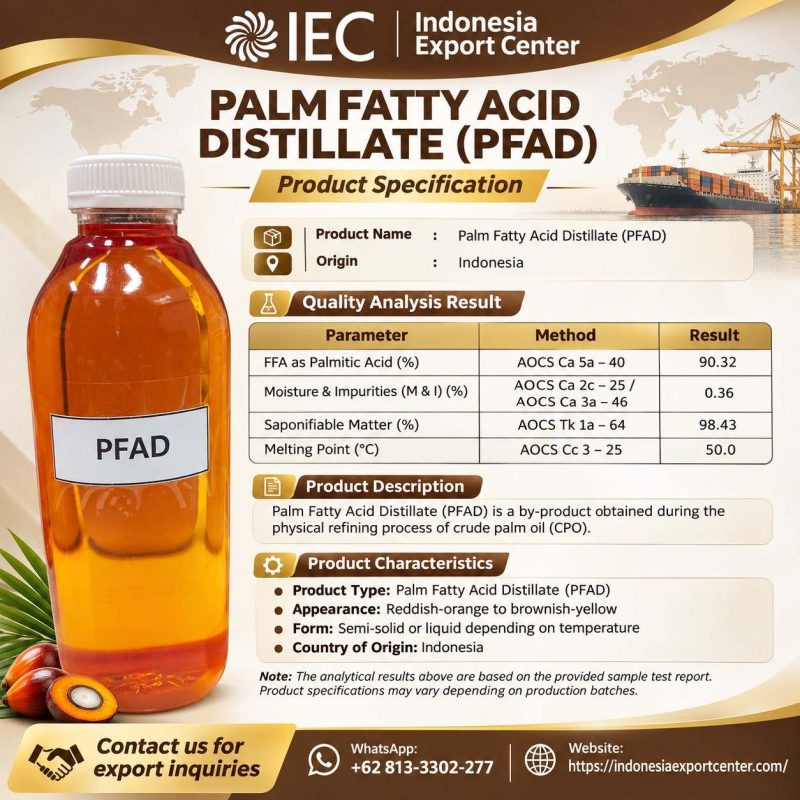
IEC PFAD Reference Specifications
| Parameter | Reference Target |
|---|---|
| FFA, as Palmitic | Minimum 90% |
| Moisture & Impurities | Maximum 1.0% |
| Iodine Value | Maximum 50 |
| Melting Point | 36–46°C |
| Colour (Gardner) | Maximum 7 |
| Appearance | White / Off White Solid |
These are brochure references. Actual samples must be evaluated against the buyer’s agreed specifications.
Step 1 – Define the Purpose of the Sample
Before contacting a supplier, explain how the sample will be used.
Possible purposes include:
- Laboratory chemical analysis.
- Biodiesel feedstock screening.
- Oleochemical processing evaluation.
- Fatty acid ester development.
- Industrial soap formulation trials.
- Material compatibility testing.
- Comparison with an existing approved feedstock.
The intended application helps determine the appropriate sample quantity and analytical requirements.
Step 2 – Establish Sample Specifications
A buyer should identify its critical acceptance criteria.
For example:
| Parameter | Buyer Requirement |
|---|---|
| Product | Palm Fatty Acid Distillate |
| FFA | [Minimum, as Palmitic] |
| Moisture | [Maximum] |
| Impurities | [Maximum] |
| Iodine Value | [Required Limit] |
| Melting Characteristics | [Requirement] |
| Colour | [Requirement] |
| Additional Analysis | [List] |
If the buyer requires a particular analytical method, it should be specified before the sample is prepared.
Step 3 – Determine Sample Quantity
The required sample amount depends on the testing program.
A basic analytical assessment may require a different quantity from a pilot-scale processing trial.
The buyer should ask its laboratory or technical team to calculate the required amount, including any material needed for repeat testing.
IEC does not publish a guaranteed standard sample size.
Step 4 – Confirm Sample Availability
The potential supplier should confirm whether a sample can be provided.
The response should clarify:
- Available quantity.
- Sample origin.
- Preparation method.
- Estimated preparation period.
- Sample cost, if any.
- Shipping cost.
- Required documentation.
Free samples should not be assumed.
Step 5 – Verify Sample Representativeness
A sample should be identified clearly.
Important information may include:
- Supplier name.
- Product name.
- Sample identification number.
- Source tank or batch.
- Collection date.
- Sampling method.
- Storage conditions.
- Relationship to the proposed commercial cargo.
A generic promotional sample may not represent future production.
Step 6 – Request Supporting Documents
Useful documents include:
- Product specification sheet.
- Relevant COA.
- Safety Data Sheet, where available and applicable.
- Sample identification.
- Analytical methods.
- Available product-origin information.
- Shipping documents required for the sample.
Documentation should accurately describe the material.
Step 7 – Establish Packaging and Shipping Requirements
Sample packaging should be compatible with PFAD and suitable for the shipping conditions.
Because PFAD may be solid or semi-solid at certain temperatures, the parties should consider:
- Container compatibility.
- Leakage prevention.
- Closure integrity.
- Temperature exposure.
- Labelling.
- Handling.
- Carrier acceptance.
International sample shipments may be subject to customs and transport requirements.
The responsible shipper should verify these before dispatch.
Step 8 – Conduct Laboratory Testing
Upon receipt, the laboratory should record:
- Package condition.
- Sample identity.
- Receipt date.
- Storage conditions.
- Test methods.
- Analytical results.
- Any visible abnormalities.
- Deviations from the test procedure.
The laboratory should use methods appropriate for the material.
Step 9 – Compare Results with the Supplier COA
Differences between the buyer’s results and the supplier’s COA should be investigated.
Possible factors include:
- Sampling variation.
- Different analytical methods.
- Sample preparation.
- Product heterogeneity.
- Storage conditions.
- Laboratory measurement uncertainty.
A disagreement should not be resolved solely by selecting the more favorable result.
Step 10 – Conduct Application Trials
Where appropriate, the buyer may test the material in its intended process.
The technical team should evaluate:
- Process compatibility.
- Pretreatment requirements.
- Product performance.
- Operating conditions.
- Quality consistency.
- Manufacturing economics.
No particular conversion yield or finished product quality is guaranteed.
Step 11 – Retain Reference Samples
For significant procurement decisions, buyers may retain appropriately labelled samples under controlled conditions.
Retained samples can support future comparisons or investigations.
Retention conditions and duration should be established by the relevant laboratory or quality management system.
Step 12 – Proceed to Commercial Qualification
After satisfactory technical evaluation, the buyer may proceed with:
- Supplier due diligence.
- Commercial quotation.
- Quantity confirmation.
- Contract negotiation.
- Pre-shipment inspection.
- Logistics planning.
A sample approval should not automatically approve every future shipment.
PFAD Sample Request Checklist
| Item | Status |
|---|---|
| Application Defined | To Confirm |
| Required Quantity | To Confirm |
| Product Specification | To Confirm |
| Sample Source | To Verify |
| Sample Identification | To Verify |
| COA | To Request |
| Test Methods | To Agree |
| Packaging | To Confirm |
| Shipping Cost | To Confirm |
| Customs Requirements | To Verify |
| Laboratory Testing | To Arrange |
| Commercial Qualification | Pending |
Complete PFAD Sample Request Template
Subject: Request for PFAD Sample and Technical Documentation – Indonesia
Dear IEC Team,
We are interested in evaluating Palm Fatty Acid Distillate from Indonesia for an industrial application.
Please review our sample request.
Buyer Information
Company: [Company Name]
Country: [Country]
Contact Person: [Name]
Email: [Email]
WhatsApp: [Number]
Sample Requirements
Product: Palm Fatty Acid Distillate
Application: [Details]
Required Sample Quantity: [Amount]
FFA Requirement: [Minimum, as Palmitic]
Moisture & Impurities: [Maximum]
Iodine Value: [Limit]
Additional Tests: [Details]
Shipping Information
Recipient: [Company / Laboratory]
Destination Country: [Country]
Destination City: [City]
Shipping Address: [Provided through an appropriate secure channel]
Preferred Shipping Method: [If Any]
Documents Requested
Product specification, available COA, sample identification, and relevant shipping documentation.
Please confirm sample availability, preparation time, applicable charges, and shipment feasibility.
Thank you.
Frequently Asked Questions
Can I request a PFAD sample from Indonesia?
You can submit an inquiry. Availability must be confirmed with a potential supplier.
Are PFAD samples free?
Not necessarily. Sample and shipping costs depend on the supplier’s terms.
Can I request a COA with the sample?
Yes. Buyers should request relevant analytical documentation.
Does sample approval guarantee commercial cargo quality?
No. Shipment-specific verification may still be necessary.
Can a sample be sent internationally?
Potentially, subject to packaging, carrier, customs, and other applicable requirements.
Can IEC guarantee sample delivery?
No. IEC facilitates inquiries, and shipment arrangements require confirmation.
Request a PFAD Sample Through IEC
Evaluate Indonesian PFAD using representative samples, relevant analytical documentation, and your own industrial acceptance criteria.
REQUEST PFAD SAMPLE INFORMATION
IEC | INDONESIA EXPORT CENTER
Website: https://indonesiaexportcenter.com/
WhatsApp: +62 813-3302-277
Related Resources
PFAD COA and Quality Verification
