

IEC | INDONESIA EXPORT CENTER
Your Global Sourcing Partner
Understanding Moisture and Impurities in Palm Fatty Acid Distillate
Moisture and impurities are important quality parameters when evaluating Palm Fatty Acid Distillate (PFAD) for industrial applications. For international importers, laboratory chemists, quality assurance teams, and industrial manufacturers, understanding these parameters can help improve feedstock qualification and reduce procurement-related quality risks.
PFAD is a fatty acid-rich by-product generated during certain palm oil refining operations. It is used as a potential feedstock in oleochemical manufacturing, biodiesel production, fatty acid ester processing, and other industrial applications.
Although free fatty acid content is often the first parameter reviewed by buyers, moisture and impurities also deserve careful attention. Excessive water or unwanted materials may affect storage, transportation, processing operations, and downstream product quality.
Indonesia Export Center (IEC) facilitates business-to-business sourcing inquiries involving potential Indonesian PFAD suppliers. IEC does not automatically manufacture, own, inspect, or certify the offered cargo.
What Are Moisture and Impurities in PFAD?
Moisture refers to water present in the material. Depending on the product and handling conditions, water may be present in different physical forms.
Impurities refer to unwanted substances that may be present in the material, including certain insoluble solids or process-related residues.
Moisture and impurities are different analytical characteristics and may require separate test methods.
For commercial procurement, buyers should clarify whether a specification represents:
- A combined maximum for moisture and impurities.
- Separate maximum values for moisture and insoluble impurities.
- A specific analytical definition established in the contract.
This distinction is important because laboratory results cannot always be compared directly when different methods or reporting conventions are used.
IEC PFAD Reference Specifications
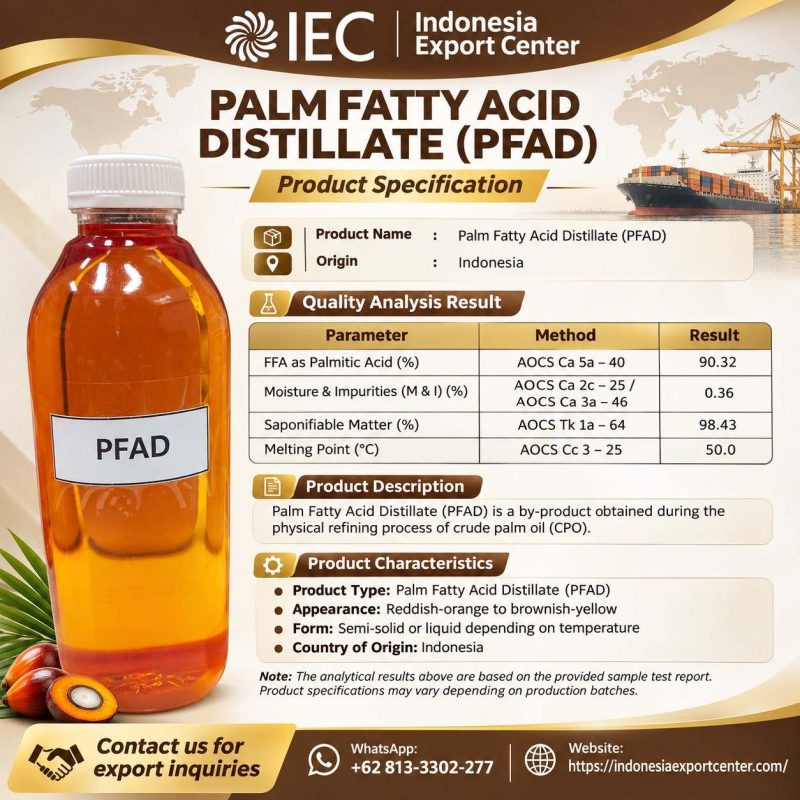
The IEC product brochure identifies the following reference parameters:
| Quality Parameter | Reference Specification |
|---|---|
| Free Fatty Acids (as Palmitic) | Minimum 90% |
| Moisture & Impurities | Maximum 1.0% |
| Iodine Value | Maximum 50 |
| Melting Point | 36–46°C |
| Colour (Gardner) | Maximum 7 |
| Appearance | White / Off White Solid |
The maximum 1.0% moisture and impurities figure is a brochure reference, not a verified result for a particular shipment.
Actual cargo acceptance should be based on an agreed specification and representative laboratory testing.
Why Moisture Control Matters
1. Feedstock Processing
Water can influence certain industrial processing operations. The significance depends on the chemical process, operating conditions, and feedstock acceptance criteria.
2. Storage and Handling
Moisture may affect the physical condition of stored material and should be monitored according to the facility’s quality management procedures.
3. Product Consistency
Manufacturers often require consistent feedstock characteristics to support stable production.
4. Commercial Quality Acceptance
If moisture is a contractual quality parameter, a clearly defined limit helps reduce disagreements between buyers and sellers.
5. Laboratory Interpretation
Moisture testing requires suitable sample preparation and analytical methods. Inconsistent procedures may affect comparability.
Why Impurities Matter
Impurities may create operational challenges depending on their identity and concentration.
Potential concerns include:
- Equipment fouling.
- Filtration requirements.
- Processing residues.
- Material transfer difficulties.
- Additional pretreatment.
- Product quality variability.
- Unplanned operating costs.
The term “impurities” should be defined precisely when a manufacturing process has specific contaminant sensitivities.
Common Sources of Moisture and Impurities
Possible sources include:
- Incoming refinery feedstock.
- Processing conditions.
- Storage tank contamination.
- Inadequate tank cleaning.
- Transfer equipment.
- Condensation or water ingress.
- Product handling practices.
- Cross-contamination during loading.
The presence of a particular contaminant cannot be inferred without testing or supporting evidence.
How Is PFAD Moisture Tested?
The appropriate laboratory method should be selected based on the product matrix, required detection range, and applicable standard.
Possible analytical approaches for fatty materials include recognized moisture determination procedures, such as suitable Karl Fischer methods or other validated methods where appropriate.
The buyer and laboratory should agree on:
- Analytical method.
- Sample preparation.
- Test temperature, where relevant.
- Units of reporting.
- Detection or quantification limits.
- Acceptance criteria.
No single method should be assumed suitable for every PFAD sample without technical review.
How Are Insoluble Impurities Tested?
Insoluble impurities may be determined through an appropriate validated method involving sample preparation and separation of insoluble material.
The method should specify the solvent or medium, filtration conditions, sample mass, and reporting basis where applicable.
Laboratory procedures should be performed by qualified personnel.
Representative PFAD Sampling
A laboratory result is only useful when the sample accurately represents the material being evaluated.
For bulk cargo, buyers should consider:
- Tank identification.
- Sample location.
- Material temperature.
- Product homogeneity.
- Sampling equipment.
- Sample container compatibility.
- Sample sealing.
- Sample identification.
- Chain of custody.
- Retained reference samples.
Sampling plans should be established before testing.
Pre-Shipment and Destination Testing
| Inspection Stage | Main Objective |
|---|---|
| Supplier Sample | Preliminary technical screening |
| Pre-Shipment | Assess the proposed cargo |
| Loading | Verify agreed loading-stage characteristics |
| Destination | Evaluate received material |
| Retained Sample | Support quality investigations |
The contract should specify which results govern acceptance.
How to Interpret a Maximum 1.0% Reference
The IEC brochure states moisture and impurities maximum 1.0%.
This should not be interpreted as confirmation that moisture alone may reach 1.0% while impurities are unlimited.
The buyer should establish the precise contractual definition and test methods.
For example, a purchasing specification might require a combined limit and separately reported test results. Such arrangements must be agreed by the contracting parties.
PFAD Quality Verification Checklist
| Verification Item | Buyer Action |
|---|---|
| Product Identity | Confirm PFAD |
| Moisture Requirement | Define limit and method |
| Impurity Requirement | Define limit and method |
| Combined Limit | Clarify reporting convention |
| COA | Request current document |
| Sample Identification | Verify cargo relevance |
| Laboratory | Review competence |
| Inspection | Agree on scope |
| Retesting | Establish procedure |
| Acceptance | Define contractual rules |
Questions to Ask Potential PFAD Suppliers
- Is the product confirmed as Palm Fatty Acid Distillate?
- What is the actual moisture content?
- What is the insoluble impurity content?
- Are results reported separately or together?
- Which analytical methods are used?
- Is a recent COA available?
- Does the sample represent the proposed shipment?
- Can independent laboratory testing be arranged?
- What storage and loading controls are used?
- What quantity and delivery terms can be confirmed?
PFAD Moisture and Impurities RFQ Template
Subject: PFAD Moisture and Impurities Specification – Indonesian Supplier Inquiry
Company: [Company Name]
Country: [Country]
Product: Palm Fatty Acid Distillate
Application: [Industrial Application]
Required Quantity: [Metric Tons]
FFA Requirement: [Minimum, as Palmitic]
Moisture Requirement: [Maximum]
Insoluble Impurities Requirement: [Maximum]
Combined M&I Requirement: [If Applicable]
Required Test Methods: [Details]
Additional Tests: [Details]
Destination Port: [Port and Country]
Preferred Incoterm: [FOB / CFR / CIF / Other]
Shipment Period: [Dates]
Please provide the current product specification, relevant COA, sampling information, and potential supplier quotation details.
Frequently Asked Questions
What does M&I mean in PFAD?
M&I commonly refers to moisture and impurities.
What is the IEC PFAD moisture and impurities reference?
Maximum 1.0%, as presented in the product brochure.
Does maximum 1.0% mean the actual cargo has passed testing?
No. The actual shipment must be tested.
Are moisture and impurities the same thing?
No. They describe different characteristics.
Can buyers request independent testing?
Yes, subject to agreement with the supplier and laboratory.
Does lower moisture always guarantee better industrial performance?
No. Performance depends on the complete feedstock specification and process.
Can IEC issue a laboratory certificate?
IEC acts as a sourcing intermediary and does not automatically issue or guarantee laboratory certifications.
Request PFAD Quality and Supplier Information
Looking for Indonesian PFAD with defined moisture and impurity requirements?
Share your required analytical limits, quantity, destination, and intended application with IEC.
REQUEST PFAD SUPPLIER INFORMATION
IEC | INDONESIA EXPORT CENTER
Website: https://indonesiaexportcenter.com/
WhatsApp: +62 813-3302-277
Related Resources
PFAD COA and Quality Verification
