

IEC | INDONESIA EXPORT CENTER
Your Global Sourcing Partner
Prepare the Right Documents for Importing Crude Palm Oil
Importing crude palm oil requires coordination between the overseas buyer, Indonesian seller, exporter, shipping provider, customs broker, and relevant regulatory authorities.
Documentation requirements vary according to destination country, product classification, shipment method, and intended application.
Indonesia Export Center (IEC) facilitates B2B sourcing inquiries for potential Indonesian CPO supply.
IEC does not guarantee import approval or provide a universal document package applicable to every destination.
Why Import Documentation Matters
Complete and consistent documentation helps support:
- Customs clearance.
- Product identification.
- Customs valuation.
- Origin verification.
- Shipping arrangements.
- Quality assessment.
- Payment processing.
- Regulatory compliance.
- Cargo delivery.
Importers should confirm the required documents before the seller ships the goods.
1. Commercial Invoice
The invoice identifies the transaction and its commercial value.
Important information may include:
- Seller.
- Buyer.
- Product description.
- Quantity.
- Unit price.
- Currency.
- Incoterm.
- Invoice date.
- Contract reference.
2. Bill of Lading
The bill of lading contains essential marine shipment information.
Buyers should check the shipper, consignee, vessel, ports, cargo description, and document arrangements.
The type of bill of lading and release procedure should match the contract and payment terms.
3. Certificate of Origin
Origin documentation may be required for customs treatment or buyer verification.
The correct document depends on the destination and applicable trade arrangements.
An origin certificate does not automatically prove sustainability or complete upstream traceability.
4. Certificate of Analysis
A COA supports evaluation of product quality.
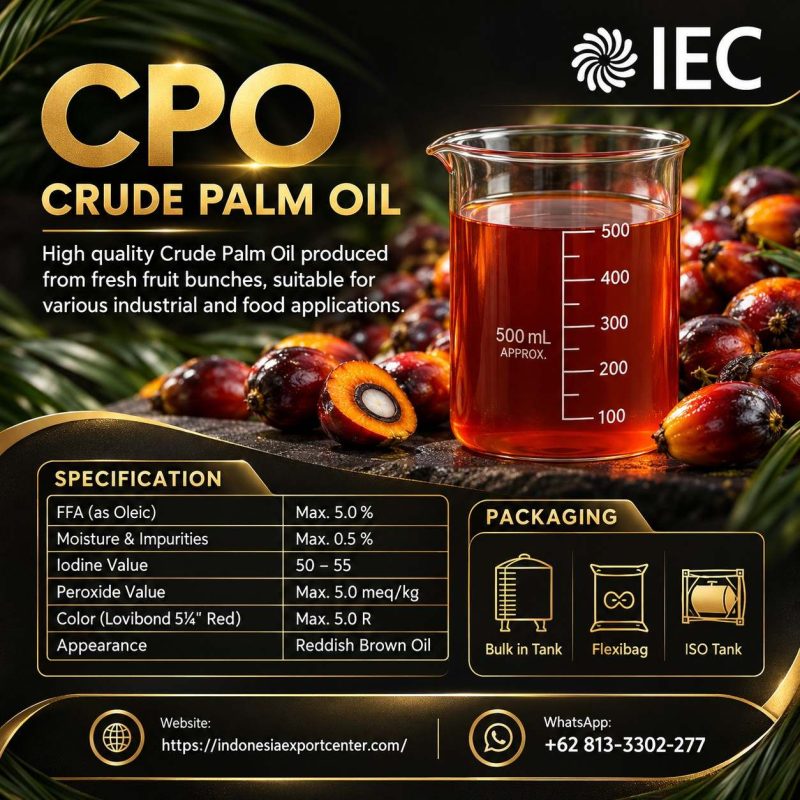
The IEC reference specification includes:
| Parameter | Reference Target |
|---|---|
| FFA, as Oleic | Maximum 5.0% |
| Moisture & Impurities | Maximum 0.5% |
| Iodine Value | 50–55 |
| Peroxide Value | Maximum 5.0 meq/kg |
| Lovibond Color, 5¼-inch Red | Maximum 5.0 R |
| Appearance | Reddish Brown Oil |
These figures are reference targets only.
The buyer should obtain cargo-specific laboratory results where required.
5. Import Licenses or Registrations
Depending on the importing jurisdiction, a company may need relevant import registration, permits, or other authorizations.
The importer should consult local authorities or a qualified customs broker.
6. Customs Classification
Crude palm oil is generally associated with HS 1511.10 at the international six-digit level.
The destination country’s full tariff code must be verified.
Incorrect classification may affect duties, taxes, regulatory treatment, and customs clearance.
7. Inspection Documentation
A buyer may request:
- Pre-shipment inspection.
- Quality certificate.
- Quantity certificate.
- Loading survey.
- Sampling report.
- Independent laboratory results.
The scope should be defined contractually.
8. Insurance Documents
Insurance documentation depends on the Incoterm and agreed arrangements.
For CIF transactions, review the insurance procured by the seller and determine whether broader coverage is necessary.
9. Sustainability and Origin Evidence
Depending on the buyer’s market, relevant requirements may involve:
- Traceability records.
- Supplier declarations.
- Certification documents.
- Deforestation due diligence.
- Chain-of-custody evidence.
- Geolocation data.
The buyer must verify which requirements apply.
10. Customs Valuation
Customs authorities may require evidence supporting the declared import value.
Documents may include the commercial invoice, contract, freight information, insurance records, and other relevant materials.
The importer should follow the destination country’s customs valuation rules.
11. Duties and Taxes
The total import cost may include:
- Customs duty.
- Value-added or equivalent taxes.
- Other applicable charges.
- Customs brokerage.
- Port and terminal costs.
- Storage.
- Inland transportation.
Rates and obligations must be verified for the destination and import date.
12. Destination Port Requirements
The importer should confirm:
- Port acceptance.
- Bulk liquid discharge capability.
- Terminal arrangements.
- Tank availability.
- Heating or pumping requirements.
- Customs procedures.
- Inspection requirements.
- Local transportation.
13. Import Documentation Checklist
| Document or Requirement | Verification |
|---|---|
| Commercial Invoice | Seller, buyer, value and goods |
| Bill of Lading | Vessel, ports and cargo |
| Certificate of Origin | Required origin evidence |
| Certificate of Analysis | Quality results |
| Import Authorization | Applicable local approval |
| Customs Classification | National tariff code |
| Inspection Certificate | Where required or agreed |
| Insurance | Appropriate coverage |
| Sustainability Records | Applicable buyer or legal requirements |
| Customs Declaration | Destination clearance |
| Tax and Duty Records | Applicable payment obligations |
14. Common Import Documentation Errors
- Incorrect consignee details.
- Inconsistent product descriptions.
- Different quantities across documents.
- Incorrect tariff code.
- Missing certificates.
- Expired approvals.
- Incorrect port names.
- Missing insurance evidence.
- Unsupported origin claims.
- Late document submission.
15. Import Documentation Workflow
Buyer Requirements → Customs Broker Review → Supplier Documentation Agreement → Shipment → Document Verification → Customs Declaration → Inspection if Required → Duty and Tax Processing → Cargo Release
Import Documentation RFQ Template
Subject: Indonesian CPO Import Documentation and Supplier Inquiry
Company: [Name]
Country: [Country]
Product: Crude Palm Oil
Quantity: [MT]
Destination Port: [Port]
Product Application: [Details]
Incoterm: [Term]
Required Import Documents: [List]
Origin Requirements: [Details]
Quality Specifications: [Details]
Inspection Requirements: [Details]
Shipment Period: [Dates]
Please advise on potential suppliers and their ability to provide the documentation required for the proposed import transaction.
Frequently Asked Questions
Are import requirements the same in every country?
No. Each destination has its own legal and customs requirements.
Is a commercial invoice enough to import CPO?
Generally, additional documentation and procedures may apply.
Can IEC guarantee customs clearance?
No. Clearance is subject to the destination country’s authorities.
Is a COA always mandatory?
Requirements depend on the transaction and destination.
Does CIF include import customs clearance?
Under CIF Incoterms 2020, import clearance is generally the buyer’s responsibility.
Should buyers consult a customs broker before shipment?
Yes. Early verification can help prevent avoidable delays.
Request Indonesian CPO Import Documentation Information
Prepare your import operation with the correct product classification, shipping records, quality evidence, and destination compliance requirements.
REQUEST CPO IMPORT SOURCING INFORMATION
IEC | INDONESIA EXPORT CENTER
Website: https://indonesiaexportcenter.com/
WhatsApp Inquiry: +62 821-4172-3508
Related Resources
CPO Export Documentation Checklist Indonesia
Crude Palm Oil HS Code Classification Guide
