

IEC | INDONESIA EXPORT CENTER
Your Global Sourcing Partner
CRUDE PALM OIL SOURCING FROM INDONESIA
International Importers | Bulk Commodity Buyers | Refinery Procurement | Global Trading Companies
How to Buy Crude Palm Oil from Indonesia
Indonesia is an important international sourcing market for crude palm oil (CPO), a vegetable oil produced from the fleshy portion of oil palm fruit and widely used as a feedstock for refining, food manufacturing, and industrial applications.
For first-time international importers, however, purchasing bulk CPO requires careful preparation. Buyers must evaluate product specifications, supplier legitimacy, export eligibility, commercial terms, quality assurance, shipping arrangements, import regulations, and payment security.
Indonesia Export Center (IEC) helps international buyers explore sourcing opportunities by facilitating inquiries and introductions to potential Indonesian suppliers and trading partners.
IEC acts as a sourcing intermediary. Actual product availability, pricing, exporter identity, documentation, and shipment capability must be confirmed by the responsible supplier or exporter.
This guide explains the Indonesian CPO buying process, from the first request for quotation to cargo delivery.
1. Define Your Crude Palm Oil Purchasing Requirements
The first step is to prepare a clear procurement specification.
Buyers should identify the intended application, whether the product will be used as refinery feedstock, industrial processing material, or another permitted application.
Essential information includes:
- Product: Crude Palm Oil (CPO).
- Required quantity in metric tons.
- Quality specifications.
- Intended application.
- Destination country and port.
- Preferred Incoterm.
- Shipment period.
- Spot or recurring purchase.
- Inspection requirements.
- Preferred payment terms.
Clear requirements help potential suppliers assess whether they can submit a relevant commercial offer.
2. Understand CPO Technical Specifications
Crude palm oil is evaluated using several physical and chemical quality parameters.
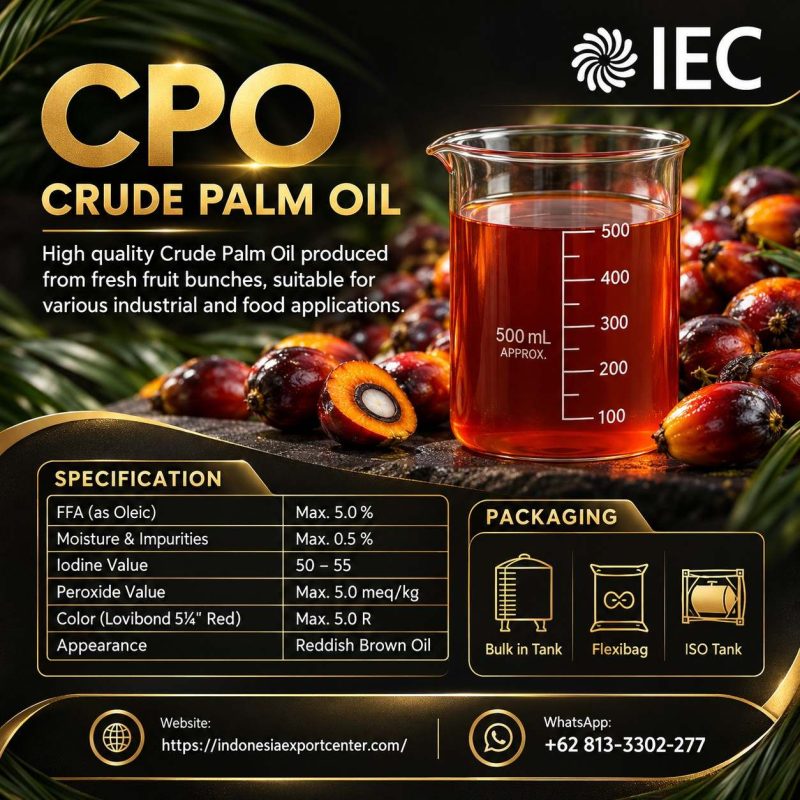
The following table reflects the reference product description supplied for IEC.
| Quality Parameter | Reference Specification |
|---|---|
| Free Fatty Acid (FFA), as Oleic | Maximum 5.0% |
| Moisture & Impurities | Maximum 0.5% |
| Iodine Value | 50–55 |
| Peroxide Value | Maximum 5.0 meq/kg |
| Color, Lovibond 5¼-inch Red | Maximum 5.0 R |
| Appearance | Reddish Brown Oil |
These are proposed reference targets, not verified results for a specific shipment.
Before contracting, request a current Certificate of Analysis (COA), confirm the testing methods, and agree on the contractual quality limits. In particular, the FFA reporting basis and Lovibond measurement conditions must be explicitly defined.
3. Identify Potential Indonesian CPO Suppliers
Potential counterparties may include:
- Producers or mill-linked commercial entities.
- Commodity trading companies.
- Export-capable suppliers.
- Authorized marketing or sales representatives.
- Other legitimate commercial intermediaries.
Different counterparties perform different roles.
A company advertising CPO does not automatically own the cargo or possess the legal authority to export it.
IEC can help facilitate initial sourcing communications, but the buyer should verify the actual seller and exporter independently.
4. Conduct Supplier Due Diligence
Supplier verification is one of the most important stages in bulk commodity procurement.
A basic due diligence review should cover:
Legal identity: Confirm the registered company name, business address, and relevant registration information.
Commercial authority: Establish whether the counterparty owns the cargo, has authority to sell it, or represents another company.
Export capability: Confirm the legal exporter of record and applicable export eligibility.
Product evidence: Request lot-specific or tank-specific documentation.
Operational capability: Review loading arrangements, storage facilities, and previous performance where verifiable.
Banking details: Verify that payment instructions correspond to the authorized contracting party.
Compliance: Review sanctions, anti-bribery, applicable trade rules, and origin or sustainability requirements.
Do not rely solely on brochures, photographs, informal statements, or unverified certificates.
5. Submit a Detailed Request for Quotation
A professional RFQ should provide enough information for the seller to evaluate the transaction.
Include the product, specification, quantity, destination, Incoterm, delivery window, inspection scope, and payment preference.
The seller should then provide a dated quotation identifying the actual contracting entity and the proposed commercial terms.
6. Review the Supplier’s Commercial Offer
A CPO quotation should identify:
- Legal seller.
- Product specification.
- Quantity and tolerance.
- Unit price and currency.
- Delivery term and named port.
- Shipment window.
- Payment conditions.
- Inspection arrangements.
- Required documents.
- Offer validity.
An indicative price is not the same as a binding commercial offer.
7. Choose the Appropriate Incoterm
Common maritime trade terms include:
| Incoterm | Main Carriage Arrangement | Key Buyer Consideration |
|---|---|---|
| FOB | Buyer arranges main ocean carriage | Vessel nomination and freight management |
| CFR | Seller contracts and pays for main carriage | Buyer should arrange appropriate cargo insurance |
| CIF | Seller contracts and pays for freight and required insurance | Review insurance scope and destination costs |
Under these Incoterms 2020 rules, risk generally transfers when the goods are delivered on board at the shipment port.
The contract must state the named port and applicable Incoterms version.
8. Establish the Purchase Contract
A written contract should address:
- Seller and buyer identity.
- Product description.
- Technical specification.
- Quantity and tolerance.
- Price and currency.
- Incoterm.
- Loading and delivery arrangements.
- Shipment period.
- Payment.
- Inspection and sampling.
- Quality and quantity claims.
- Force majeure.
- Default and remedies.
- Governing law and dispute resolution.
Qualified legal and trade professionals should review material transactions.
9. Arrange Quality Inspection
Bulk CPO quality should be assessed using an agreed sampling and testing process.
Potential inspection activities include:
- Cargo identification.
- Storage tank verification.
- Representative sampling.
- Laboratory analysis.
- Quantity survey.
- Tank cleanliness review.
- Loading supervision.
The contract should define the inspection company, test methods, acceptance criteria, and dispute procedures.
10. Confirm Indonesian Export Requirements
CPO exports may be subject to licensing, customs, duties, levies, reporting, and other conditions that can change.
The exporter and customs professionals must verify currently effective Indonesian requirements for the actual product classification and shipment date.
Do not assume that a previous shipment establishes eligibility for a new transaction.
11. Prepare Import Documentation
Typical documents may include:
- Commercial invoice.
- Bill of lading.
- Certificate of Analysis.
- Certificate of origin, when required.
- Inspection documents, when agreed.
- Export declarations or permits, as applicable.
- Insurance documents, where applicable.
- Other destination-specific records.
The buyer should consult its customs broker before shipment.
12. Confirm Freight and Cargo Handling
CPO is a bulk liquid product whose handling requirements depend on its characteristics and operating conditions.
Shipping planning may involve:
- Vessel suitability.
- Tank compatibility.
- Heating and pumping arrangements.
- Loading terminal capability.
- Destination discharge facilities.
- Storage availability.
- Cargo insurance.
- Port restrictions.
Bulk vessel transportation, ISO tanks, and flexibags are not interchangeable without technical assessment. ISO tank or flexibag feasibility requires specific approval.
13. Complete Import Customs Clearance
The importer or appointed customs broker must verify:
- Correct tariff classification.
- Import permissions.
- Duties and taxes.
- Customs valuation.
- Origin requirements.
- Food or industrial product rules.
- Applicable sustainability or traceability obligations.
- Required declarations and supporting documents.
Requirements differ by destination country.
14. Receive and Inspect the Cargo
At destination, the responsible parties should follow the agreed discharge, quantity measurement, and quality verification procedures.
Any discrepancy should be documented promptly and handled under the contract.
Common Mistakes First-Time CPO Importers Should Avoid
- Accepting an unverified seller identity.
- Treating a marketing brochure as proof of available stock.
- Paying an unrelated bank account without verification.
- Requesting a price without specifying a destination or Incoterm.
- Failing to agree on analytical methods.
- Assuming all transport equipment is suitable for CPO.
- Ignoring destination import requirements.
- Overlooking independent inspection.
- Using outdated export compliance information.
- Signing incomplete commercial contracts.
Indonesian CPO Buying Process Checklist
| Procurement Stage | Key Requirement |
|---|---|
| Buyer Preparation | Quantity, specifications, destination |
| Supplier Discovery | Potential counterparty identification |
| Due Diligence | Identity, authority, export capability |
| Quality Review | COA, sampling, test methods |
| Quotation | Dated supplier offer |
| Contract | Price, Incoterms, quality, payment |
| Export Compliance | Current Indonesian requirements |
| Logistics | Vessel, tank, port and handling feasibility |
| Shipment | Documents, loading and inspection |
| Import Clearance | Destination customs compliance |
| Delivery | Quantity, quality and contractual acceptance |
Request for Quotation: Indonesian Crude Palm Oil
Subject: Indonesian Crude Palm Oil Import Sourcing Inquiry
Company Name: [Company]
Country: [Country]
Business Type: [Importer / Refinery / Trader]
Product: Crude Palm Oil
Required Quantity: [MT]
Purchase Type: [Spot / Monthly / Long-Term]
FFA Requirement: [Maximum and Reporting Basis]
Moisture & Impurities: [Limit]
Iodine Value: [Range]
Peroxide Value: [Limit]
Other Specifications: [Details]
Destination Port: [Port, Country]
Preferred Incoterm: [FOB / CFR / CIF]
Shipment Period: [Dates]
Inspection Requirements: [Details]
Required Documents: [Details]
Preferred Payment Terms: [Details]
Please advise on potential Indonesian suppliers, current cargo availability, verified product specifications, export eligibility, and a dated commercial quotation.
Frequently Asked Questions
Can foreign companies buy crude palm oil from Indonesia?
International companies may explore CPO procurement, subject to applicable export and import requirements.
Does IEC manufacture crude palm oil?
IEC is presented here as a sourcing intermediary, not the manufacturer.
Is a fixed CPO price available?
No fixed or live price is established. The actual seller must provide a dated quotation.
Can buyers request a Certificate of Analysis?
Yes. Availability and validity must be confirmed with the supplier.
Is independent inspection recommended?
It can be an important contractual risk-management measure for bulk commodity purchases.
Can buyers request monthly shipments?
Yes, but recurring availability and scheduling must be confirmed through an actual supply agreement.
Are CIF and FOB prices directly comparable?
Not without accounting for the different freight, insurance, and cost responsibilities.
Does IEC guarantee export permits?
No. The responsible exporter must verify eligibility and obtain applicable approvals.
Start Your Indonesian CPO Sourcing Inquiry
Looking for a potential Indonesian crude palm oil supplier?
Indonesia Export Center helps international buyers communicate their technical, commercial, and logistical requirements to potential sourcing partners.
REQUEST INDONESIAN CPO QUOTATION
IEC | INDONESIA EXPORT CENTER
Website: https://indonesiaexportcenter.com/
WhatsApp Inquiry: +62 821-4172-3508
Related Resources
CPO Request for Quotation Checklist
Crude Palm Oil Supplier Due Diligence Indonesia
CPO Export Documentation Checklist Indonesia
CPO Payment Terms and Letter of Credit Guide
