

IEC | INDONESIA EXPORT CENTER
Your Global Sourcing Partner
CRUDE PALM OIL LOVIBOND COLOR TESTING
Color Measurement | 5¼-Inch Cell | Red Scale | Laboratory Reporting | CPO Quality Control
Understanding Lovibond Color Measurement in Crude Palm Oil
Color is one of the physical characteristics considered during crude palm oil quality evaluation.
Crude palm oil naturally contains pigments that contribute to its reddish-orange or reddish-brown appearance.
However, visual appearance alone is not a reliable substitute for a standardized color measurement.
For international buyers, a clearly defined Lovibond color specification can help establish consistent testing and reporting requirements.
Indonesia Export Center (IEC) facilitates CPO sourcing inquiries and helps buyers communicate technical specifications to potential Indonesian suppliers.
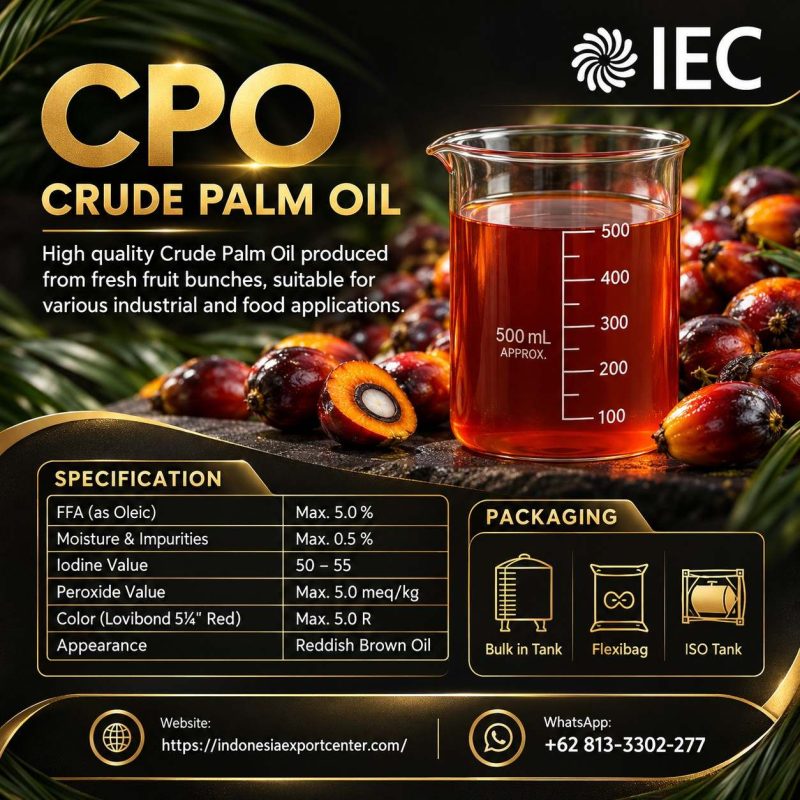
The reference marketing material supplied for IEC identifies:
Color (Lovibond 5¼-inch Red): Maximum 5.0 R
This statement must be interpreted carefully because Lovibond color results depend on the test method, optical path length, sample preparation, and reporting scale.
The figure should not be treated as a verified product result without a suitable laboratory report.
What Is Lovibond Color Measurement?
Lovibond is a color measurement system used in certain oil and fat quality applications.
Depending on the instrument and method, color may be evaluated using defined red, yellow, and other color scales.
The measured result depends on the instrument configuration and test conditions.
For contractual purposes, buyers should specify the applicable method rather than relying only on a short numerical statement.
Why Color Matters in CPO Procurement
Product Characterization
Color provides information about the visible characteristics of the oil.
Refinery Evaluation
Color may be relevant to a refinery’s raw material assessment and processing requirements.
Quality Consistency
Standardized measurements may help compare different samples.
Contractual Acceptance
Buyers may include color requirements in their purchase specifications.
Laboratory Documentation
A properly reported result provides more useful information than an informal visual description.
IEC Reference Color Specification
The supplied reference states:
Color (Lovibond 5¼” Red): Max. 5.0 R
Before including this limit in a binding purchase contract, buyers should confirm:
- The exact test method.
- The instrument or color system.
- The optical path length.
- The meaning of the red-scale value.
- Whether other color components must be reported.
- Sample preparation conditions.
- Test temperature, if specified by the method.
- The laboratory’s ability to perform the measurement.
- Whether the proposed limit is appropriate for the actual CPO product.
The supplied reference does not establish all these details.
What Does 5¼-Inch Mean?
The 5¼-inch designation refers to the optical path length or cell length used in the specified measurement configuration.
Path length is important because measured color can depend on the distance light travels through the sample.
A result obtained using a different cell length should not automatically be treated as equivalent.
Understanding the Red Scale
The notation R generally refers to the red component in the relevant Lovibond color reporting system.
However, a complete measurement may require additional information.
A buyer should not assume that a single red-scale value fully describes the color characteristics of crude palm oil.
Reference CPO Technical Specifications
| Parameter | Reference Target |
|---|---|
| Color, Lovibond 5¼-inch Red | Max. 5.0 R |
| Appearance | Reddish Brown Oil |
| FFA, as Oleic | Max. 5.0% |
| Moisture & Impurities | Max. 0.5% |
| Iodine Value | 50–55 |
| Peroxide Value | Max. 5.0 meq/kg |
These are marketing reference targets, not laboratory-certified results.
Visual Appearance Versus Instrumental Color
| Visual Inspection | Instrumental Color Measurement |
|---|---|
| Based on observed appearance | Based on a defined measurement method |
| Can be affected by lighting | Uses specified equipment and conditions |
| Useful for preliminary observation | Supports standardized reporting |
| Does not produce a complete analytical specification | Produces results within the method’s scope |
| Cannot replace laboratory testing | Still requires correct sampling and interpretation |
Both may contribute to quality assessment, but they serve different purposes.
Factors That Can Affect Color Measurement
Relevant factors may include:
- Sample temperature.
- Sample homogeneity.
- Suspended particles.
- Moisture.
- Optical path length.
- Instrument condition.
- Calibration.
- Sample preparation.
- Testing procedure.
The laboratory should follow the specified method.
Laboratory Testing Procedure
A suitable color testing workflow may include:
Step 1 – Sample Identification
Record the cargo or lot reference.
Step 2 – Sample Preparation
Prepare the sample according to the selected method.
Step 3 – Instrument Verification
Confirm that the instrument is suitable and appropriately maintained or calibrated.
Step 4 – Measurement
Perform the color measurement using the agreed cell and method.
Step 5 – Result Recording
Record all required color components, units, and measurement conditions.
Step 6 – Report Review
Verify that the report matches the buyer’s contractual specification.
What Should a Lovibond Color Report Include?
Buyers may request:
- Product name.
- Sample identification.
- Laboratory.
- Testing date.
- Instrument or method.
- Cell path length.
- Red-scale result.
- Other required color components.
- Sample preparation conditions.
- Authorized report identification.
Color and CPO Refining
Crude palm oil may undergo refining and bleaching processes to achieve desired downstream product characteristics.
The relationship between raw material color and final refined product performance depends on the actual oil, process, and operating conditions.
A Lovibond color result alone cannot predict the complete refining outcome.
Why Color Should Not Be Evaluated Alone
A CPO sample may satisfy a stated color requirement while failing another important quality parameter.
For this reason, buyers should review color alongside:
- FFA.
- Moisture and impurities.
- Iodine value.
- Peroxide value.
- Additional refinery-specific parameters.
Common Color Specification Mistakes
Missing Cell Length
A color value without the optical path length may be ambiguous.
Missing Test Method
Different methods or instruments may not provide directly comparable results.
Incomplete Color Reporting
A red-scale number may not represent the complete result required by the method.
Comparing Different Sample Conditions
Testing conditions should be consistent.
Treating a Marketing Brochure as a COA
A brochure specification is not evidence that an actual cargo meets the stated limit.
Buyer Quality Verification Checklist
- Confirm the actual supplier.
- Request the current cargo specification.
- Confirm the Lovibond method.
- Verify the 5¼-inch cell designation.
- Establish the required color components.
- Review the laboratory report.
- Confirm sample identity.
- Review the testing date.
- Agree on acceptance criteria.
- Establish a retesting procedure where needed.
Lovibond Color RFQ Template
Subject: Indonesian CPO Lovibond Color Specification and COA Inquiry
Company: [Name]
Country: [Country]
Product: Crude Palm Oil
Required Color Specification: [Details]
Lovibond Cell Length: [Required Length]
Red Scale Requirement: [Limit]
Additional Color Components: [If Applicable]
Required Testing Method: [Details]
FFA Requirement: [Limit and Basis]
Moisture & Impurities: [Limit]
Iodine Value: [Range]
Peroxide Value: [Limit]
Quantity: [MT]
COA Requirement: [Details]
Independent Inspection: [Required / Not Required]
Destination Port: [Port]
Shipment Period: [Dates]
Please advise on potential suppliers, laboratory color measurement records, cargo availability, and commercial quotation.
Frequently Asked Questions
What is Lovibond color measurement?
It is a color assessment system used in certain oil and fat testing applications.
What does the IEC reference specify?
The supplied material states a maximum red-scale value of 5.0 R using a 5¼-inch Lovibond cell designation.
Is this color specification guaranteed?
No. Actual cargo compliance requires appropriate laboratory verification.
Why is the cell length important?
Measured color depends on the optical path and test configuration.
Can different Lovibond cell lengths be compared directly?
Not without appropriate technical validation or an established method.
Is color enough to determine CPO quality?
No. Other chemical and physical parameters must also be reviewed.
Can IEC issue a Lovibond laboratory report?
IEC can facilitate requests for documentation from potential suppliers; it does not claim to operate the testing laboratory.
Should buyers verify the color standard before contracting?
Yes. The method, cell path, reporting components, and acceptance limits should be agreed in advance.
Request CPO Lovibond Color Documentation
Looking for Indonesian CPO with clearly defined color and technical quality requirements?
Submit your laboratory specifications, quantity, and destination to investigate potential sourcing opportunities.
REQUEST CPO LOVIBOND COLOR INFORMATION
IEC | INDONESIA EXPORT CENTER
Your Global Sourcing Partner
Website: https://indonesiaexportcenter.com/
WhatsApp Inquiry: +62 821-4172-3508
Related Resources
CPO Technical Specifications and Quality Parameters
CPO Certificate of Analysis and Laboratory Testing
CPO Quality Inspection Before Shipment
Crude Palm Oil (CPO) Supplier Indonesia
