

INDONESIA EXPORT CENTER
PREMIUM INDONESIAN SEAFOOD
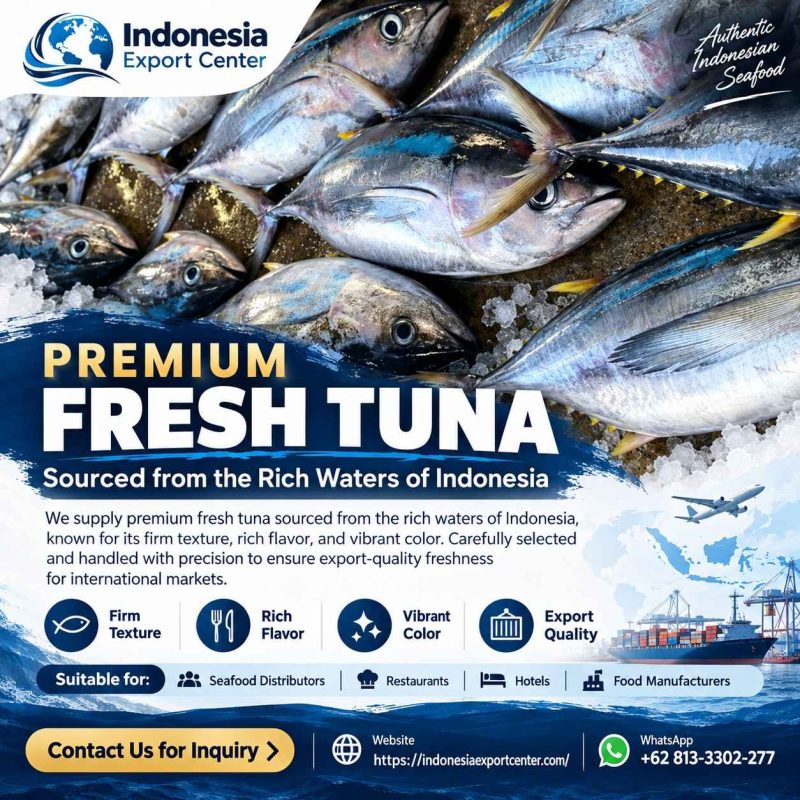
FRESH TUNA FOR JAPAN IMPORTERS
Yellowfin Tuna | Bigeye Tuna | Whole Fish | Fresh Loins | Japanese Market Procurement
Fresh Tuna Supplier for Japan Importers
Japan’s seafood market places significant importance on product identity, handling, grading, traceability, and precise commercial specifications.
Indonesia Export Center helps Japanese tuna importers and seafood purchasing teams communicate with potential Indonesian suppliers of fresh yellowfin and bigeye tuna.
Products may be requested in whole-fish or loin formats, subject to supplier availability and processing capabilities.
For importers serving Japanese seafood wholesalers, restaurants, and specialized distributors, detailed product requirements are essential.
1. Fresh Tuna Product Specifications
| Parameter | Description |
|---|---|
| Species | Yellowfin / Bigeye |
| Scientific Names | Thunnus albacares / Thunnus obesus |
| Origin | Indonesia, lot-specific verification |
| Condition | Fresh / Chilled |
| Forms | Whole / Loin |
| Grade | Buyer-defined |
| Weight Range | Buyer-specified |
| Packaging | Supplier-confirmed |
| Destination | Japan |
| Shipment | Subject to logistics confirmation |
2. Yellowfin Tuna for Japanese Buyers
Yellowfin tuna may be evaluated for:
- Wholesale seafood distribution
- Restaurant supply
- Tuna processing
- Specialized foodservice
- Further portioning
The actual product must meet the buyer’s specifications.
3. Bigeye Tuna for Japanese Buyers
Bigeye tuna may be considered for buyers seeking particular fat characteristics, flesh qualities, or commercial grades.
These characteristics vary by fish and lot.
Availability and grading must be verified.
4. Whole Fish vs. Loin Procurement
Whole Fish
Whole-fish buyers should define:
- Fish weight
- Processing condition
- Physical defects
- Handling history
- Grade
- Packaging
Tuna Loins
Loin buyers should define:
- Skin status
- Bloodline trim
- Dark muscle tolerance
- Weight range
- Surface condition
- Packaging
5. Japanese Market Grading Requirements
There is no single universal grading system that applies to every Japanese tuna transaction.
Buyers should establish written criteria covering:
- Species
- Appearance
- Texture
- Fat characteristics
- Size
- Handling records
- Temperature
- Acceptable defects
6. Import Procedures in Japan
Japanese importers should verify requirements administered by the relevant Japanese authorities, including applicable food sanitation, customs, and fisheries-related rules.
Potential requirements may include:
- Food import notification
- Import inspection where applicable
- Customs declaration
- Product documentation
- Traceability
- Fisheries-related import controls
Requirements vary by species, origin, and transaction.
7. Food Safety and Raw Consumption
Fresh tuna is not automatically suitable for raw consumption.
Importers should evaluate:
- Histamine controls
- Processing hygiene
- Microbiological hazards
- Parasite risk where relevant
- Handling records
- Applicable Japanese food safety requirements
8. Traceability
Potential records include:
- Vessel information
- Catch area
- Catch date
- Landing details
- Processing facility
- Lot number
- Shipment reference
9. Air Freight to Japan
Buyers may consider Japanese airports such as:
- Narita International Airport
- Haneda Airport
- Kansai International Airport
Actual routing and airline acceptance must be confirmed.
10. Temperature Management
Appropriate temperature control should be maintained throughout:
- Initial handling
- Processing
- Storage
- Packing
- Airport transfer
- International transport
- Customs clearance
- Receiving
11. Supplier Documentation
Buyers may request:
- Company registration
- Facility information
- Product specification
- Traceability records
- Temperature records
- Applicable health documentation
- Laboratory reports where required
12. Commercial Terms
A quotation should clearly state:
- Species
- Form
- Grade
- Weight
- Quantity
- Unit price
- Currency
- Packaging
- Incoterm
- Delivery schedule
- Payment conditions
13. Japan Importer RFQ Checklist
| Field | Buyer Requirement |
|---|---|
| Species | Yellowfin / Bigeye |
| Form | Whole / Loin |
| Grade | |
| Weight Range | |
| Quantity (kg) | |
| Destination Airport | |
| Required Delivery Date | |
| Packaging | |
| Documentation | |
| Preferred Incoterm |
14. IEC’s Role in Japan Tuna Procurement
IEC facilitates initial communication with potential suppliers, helps clarify technical requirements, and coordinates requests for seller-issued commercial offers.
Supplier approval and import compliance remain the responsibility of the relevant parties.
Frequently Asked Questions
Can I request both yellowfin and bigeye tuna?
Yes. Each species should be identified separately in the RFQ.
Can Indonesian tuna be sourced for Japanese wholesalers?
IEC can coordinate inquiries, subject to supplier and import eligibility verification.
Does IEC guarantee sashimi quality?
No. Raw-consumption suitability and quality must be established for the actual product lot.
Can I request delivery to Narita or Haneda?
These airports may be specified as proposed destinations, subject to logistics confirmation.
Request Fresh Tuna for Japan Importers
INDONESIA EXPORT CENTER
Indonesian Yellowfin and Bigeye Tuna | Japanese Seafood Procurement
WhatsApp: +62 813-3302-277
Website: https://indonesiaexportcenter.com/
Page: https://indonesiaexportcenter.com/fresh-tuna-supplier-for-japan-importers/
Send your species, product form, grade, kilograms, destination airport, and required delivery date.
Disclaimer: IEC is a sourcing intermediary, not a direct tuna producer or exporter. Availability, product quality, regulatory eligibility, documentation, pricing, and delivery must be confirmed with the responsible parties.
