

INDONESIA EXPORT CENTER
AUTHENTIC INDONESIAN SEAFOOD
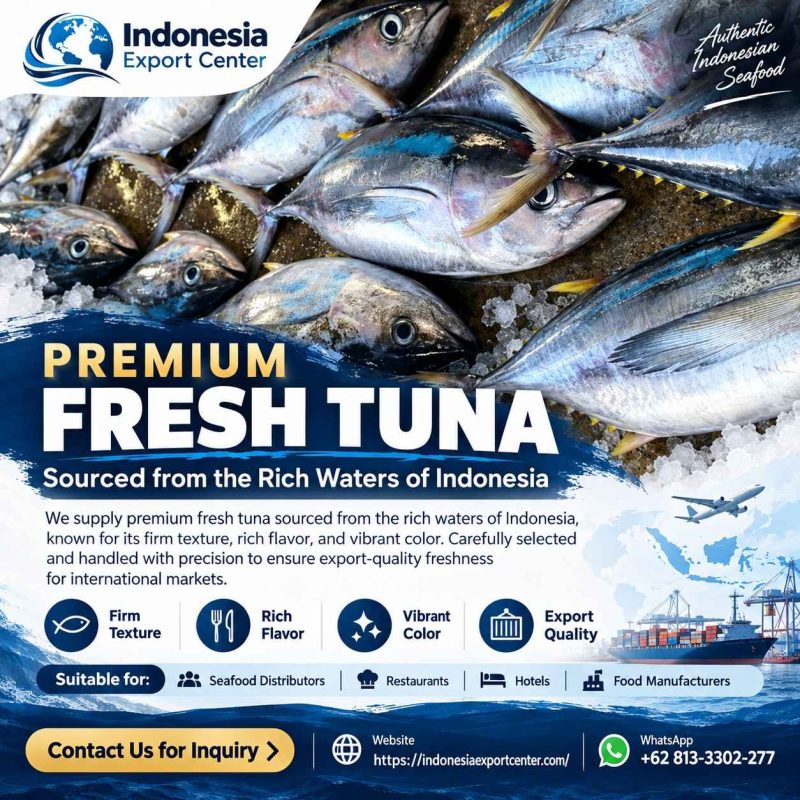
PREMIUM FRESH TUNA FROM INDONESIA
Yellowfin Tuna | Bigeye Tuna | Fresh Tuna Loins | Whole Fish | USA Seafood Import Procurement
Fresh Tuna Supplier for USA Importers – Source Indonesian Tuna with Clear Specifications and Compliance Planning
Are you searching for a fresh tuna supplier for USA importers to support your seafood distribution, wholesale operations, restaurant supply chain, or processing business?
Indonesia Export Center (IEC) helps American seafood importers identify and communicate with potential Indonesian suppliers of fresh yellowfin and bigeye tuna.
Indonesia is an important source of tuna for international seafood trade. However, successful fresh tuna procurement requires more than identifying a product. Buyers must evaluate species, product grade, processing specifications, traceability, food safety controls, air cargo arrangements, and applicable United States import requirements.
IEC supports initial sourcing communication, supplier introductions, documentation requests, and commercial RFQ coordination.
Our role is to help buyers and potential suppliers establish clear expectations before a commercial transaction.
1. Indonesian Fresh Tuna Product Overview
| Specification | Description |
|---|---|
| Product | Fresh Tuna |
| Species | Yellowfin / Bigeye |
| Scientific Names | Thunnus albacares / Thunnus obesus |
| Country of Origin | Indonesia, subject to lot verification |
| Product Forms | Whole Fish / Tuna Loin |
| Condition | Fresh / Chilled |
| Grade | Buyer-defined |
| Size Range | Buyer-specified |
| Packaging | Supplier-confirmed |
| Minimum Order | Subject to supplier confirmation |
| Destination | United States |
| Transportation | Chilled air freight where feasible |
Product forms and availability must be verified with the selected supplier.
2. Why USA Seafood Importers Consider Indonesian Tuna
Indonesian tuna may be considered by buyers seeking additional sourcing options for their international seafood procurement programs.
Potential purchasing applications include:
- Seafood import distribution
- Wholesale seafood markets
- Restaurant supply chains
- Hotel foodservice
- Seafood processing
- Specialized Japanese food distribution
- Retail seafood programs
Each application may require different specifications, safety documentation, and commercial terms.
3. Yellowfin Tuna for the USA Market
Yellowfin tuna, scientifically known as Thunnus albacares, is widely traded in international seafood markets.
Importers may request:
- Whole yellowfin tuna
- Fresh yellowfin tuna loins
- Skin-on or skinless loin specifications
- Buyer-defined grade
- Specific fish or loin weight ranges
The supplier must confirm its actual processing capabilities.
4. Bigeye Tuna for USA Importers
Bigeye tuna, Thunnus obesus, may be considered for buyers seeking particular commercial characteristics.
Potential evaluation criteria include:
- Species identity
- Flesh characteristics
- Fat distribution
- Product form
- Grade
- Temperature history
- Traceability
Bigeye availability may differ from yellowfin availability.
5. USA Import Requirements and FDA Oversight
Seafood imported into the United States is subject to applicable requirements administered by the U.S. Food and Drug Administration (FDA), among other authorities.
Importers should review requirements relating to:
- Seafood safety
- Facility registration where applicable
- Prior Notice
- Seafood HACCP
- Product labeling
- Traceability
- Customs entry
- Importer responsibilities
The specific obligations depend on the transaction and the parties involved.
6. FDA Seafood HACCP and Importer Verification
Seafood products are subject to FDA seafood HACCP requirements under 21 CFR Part 123.
U.S. importers should determine their obligations for verifying that imported fish and fishery products have been processed in accordance with applicable seafood HACCP requirements.
Potential verification activities may include:
- Reviewing supplier HACCP documentation
- Obtaining appropriate certificates or records
- Reviewing relevant inspection information
- Evaluating processing controls
- Maintaining required importer verification records
A supplier’s marketing claim of HACCP compliance is not sufficient evidence by itself.
7. FSVP Applicability for Seafood Imports
The FDA Foreign Supplier Verification Program (FSVP) has exemptions for certain fish and fishery products that are subject to and compliant with the seafood HACCP framework.
Importers should not assume that all seafood shipments are automatically covered by the general FSVP requirements.
The applicability of seafood HACCP importer verification and any FSVP exemption should be assessed for the specific product and transaction.
8. Histamine Prevention
Tuna is a histamine-forming fish.
Histamine risk must be addressed through appropriate handling, chilling, processing, and monitoring.
Importers may request:
- Receiving records
- Processing temperature records
- Histamine control procedures
- Relevant testing results
- Corrective action records
Histamine cannot reliably be eliminated by cooking or freezing once it has formed.
9. Cold Chain Management for USA Shipments
Fresh tuna requires suitable temperature control throughout the supply chain.
Important stages include:
- Harvest and initial handling
- Landing and receiving
- Processing and grading
- Packing
- Transport to the airport
- Airline cargo handling
- International transportation
- U.S. import clearance
- Final delivery
Buyers should agree on monitoring and acceptance procedures before shipment.
10. USA Destination Airports
Potential destination airports for fresh tuna inquiries include:
- John F. Kennedy International Airport (JFK), New York
- Los Angeles International Airport (LAX)
- Miami International Airport (MIA)
- Other U.S. airports with suitable cargo arrangements
These are potential destinations, not confirmed routes or available bookings.
11. Packaging for International Air Cargo
Buyers should clarify:
- Insulated packaging
- Refrigerant type
- Food-contact materials
- Leakage prevention
- Net and gross weight
- Temperature monitoring
- Airline acceptance
Packaging must be suitable for the actual route and transit conditions.
12. Supplier Verification Before Ordering
Recommended checks include:
- Legal supplier identity
- Processing establishment details
- Relevant facility registration
- HACCP procedures
- Traceability
- Export eligibility
- Product specifications
- Commercial references where available
13. Import Documentation
Depending on the shipment, documentation may include:
- Commercial invoice
- Packing list
- Air Waybill
- Applicable health certificates
- Catch documentation
- Product traceability
- FDA-related submissions
- Customs entry documentation
The importer and its licensed customs broker should confirm the exact requirements.
14. Fresh Tuna Pricing for USA Importers
Prices may depend on:
- Species
- Grade
- Product form
- Processing yield
- Quantity
- Packaging
- Origin airport
- Destination airport
- Air freight charges
- Delivery terms
IEC does not publish unverified fixed prices.
15. Air Freight Incoterms
For air cargo, buyers may consider:
- FCA
- CPT
- CIP
- DAP
The chosen Incoterm should identify the named place and applicable version.
FOB is intended for sea and inland waterway transport rather than air freight.
16. USA Importer RFQ Checklist
Please provide:
| RFQ Field | Buyer Information |
|---|---|
| Company Name | |
| Destination State | |
| Destination Airport | |
| Species | Yellowfin / Bigeye |
| Product Form | Whole / Loin |
| Grade | |
| Size Range | |
| Quantity (kg) | |
| Packaging | |
| Required Delivery Date | |
| Preferred Incoterm | |
| Documentation Requirements |
17. How Indonesia Export Center Supports USA Buyers
IEC may assist with:
- Initial supplier identification
- Product specification clarification
- Supplier introduction
- Documentation inquiries
- Commercial quotation coordination
- Communication follow-up
The actual seller or exporter remains responsible for its contractual commitments.
Frequently Asked Questions
Can I import fresh yellowfin tuna from Indonesia into the USA?
Potentially, subject to the applicable FDA, customs, and other regulatory requirements.
Does the USA require seafood HACCP compliance?
Applicable FDA seafood HACCP requirements must be addressed.
Is FSVP always required for tuna?
Not necessarily. Certain fish and fishery products fall under specific FSVP exemptions connected to seafood HACCP compliance.
Can IEC guarantee FDA approval?
No. Regulatory eligibility must be verified by the responsible parties.
Can fresh tuna be delivered to JFK or LAX?
An inquiry can specify these airports, but actual flight and cargo arrangements require confirmation.
Does IEC export tuna directly?
IEC operates as a sourcing intermediary and trade facilitator. The contractual exporter must be identified separately.
Request Fresh Tuna for USA Importers
INDONESIA EXPORT CENTER
Indonesian Yellowfin and Bigeye Tuna | USA Importer Sourcing Assistance
WhatsApp: +62 813-3302-277
Website: https://indonesiaexportcenter.com/
Page: https://indonesiaexportcenter.com/fresh-tuna-supplier-for-usa-importers/
Send your species, product form, grade, total kilograms, U.S. destination airport, and required delivery date to begin a supplier inquiry.
Disclaimer: IEC is an intermediary, not the manufacturer, owner of stock, or exporter of record. All product specifications, supplier approvals, FDA compliance, prices, and shipping arrangements require independent verification.
