

INDONESIA EXPORT CENTER
INTERNATIONAL SEAFOOD TRADE PROCUREMENT
FRESH TUNA PRICE FACTORS
Product Grade | Processing Yield | Freight | Incoterms | Packaging | Spoilage Risk | Landed Cost
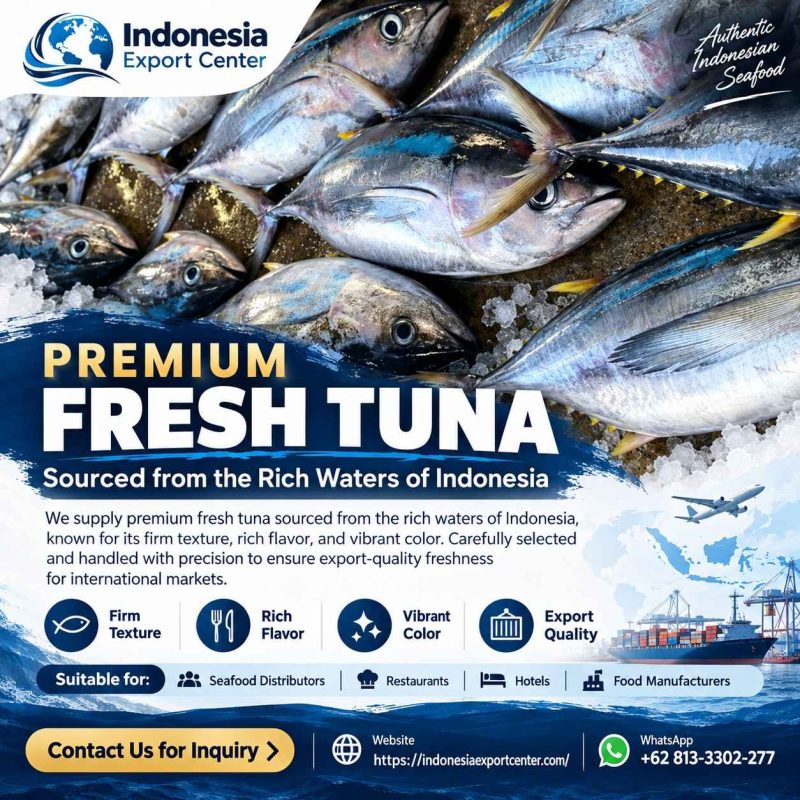
Fresh Tuna Price Factors FOB vs Air Cargo – A Guide for International Import Managers
International fresh tuna pricing involves more than the product price per kilogram.
Buyers should evaluate product grade, processing form, usable yield, packaging, freight, customs charges, and spoilage risk.
Indonesia Export Center helps international buyers communicate pricing requirements to potential Indonesian tuna suppliers.
This guide explains major pricing variables and clarifies the difference between FOB and air freight quotations.
1. Product Scope
| Parameter | Description |
|---|---|
| Species | Yellowfin |
| Scientific Name | Thunnus albacares |
| Forms | Whole / Loin |
| Condition | Fresh / Chilled |
| Origin | Indonesia |
| Grade | Buyer-defined |
| Pricing | Seller-confirmed |
| Shipping | Agreed transport mode |
2. Understanding FOB
FOB means Free On Board.
Under Incoterms 2020, FOB is intended for sea and inland waterway transport.
It is not the appropriate term for air cargo shipments.
Buyers importing fresh tuna by air should request quotations using a suitable Incoterm.
3. Suitable Incoterms for Air Freight
Potential terms include:
FCA – Free Carrier
The seller delivers the goods to the carrier or another nominated party at the agreed place.
CPT – Carriage Paid To
The seller pays carriage to the named destination, while risk transfers according to the Incoterm rules.
CIP – Carriage and Insurance Paid To
The seller arranges carriage and insurance according to the applicable rules.
DAP – Delivered at Place
The seller delivers to the named destination under the agreed Incoterm obligations.
The exact allocation of risk, cost, customs obligations, and insurance must be understood before contracting.
4. Main Tuna Pricing Variables
Fresh tuna prices may depend on:
- Species
- Grade
- Fish size
- Product form
- Processing requirements
- Quantity
- Supply conditions
- Packaging
- Delivery terms
5. Whole Fish vs. Loin Pricing
Whole fish and tuna loins may have different prices because of processing and yield.
Buyers should compare the cost per usable kilogram.
6. Processing Yield
Usable Cost per Kg = Purchased Product Cost ÷ Usable Product Weight
Example:
Purchased product: 100 kg
Purchase cost: USD 1,000
Usable yield: 80 kg
Usable cost: USD 1,000 ÷ 80 = USD 12.50/kg
This is a hypothetical example.
7. Air Freight Costs
Air freight charges may depend on:
- Chargeable weight
- Package dimensions
- Route
- Airline capacity
- Handling
- Refrigerants
- Transit requirements
8. Packaging Costs
Packaging expenses may include:
- Insulated containers
- Protective materials
- Refrigerants
- Labels
- Temperature monitoring devices
9. Customs and Import Costs
Potential expenses include:
- Import duties
- Taxes
- Customs brokerage
- Inspection charges
- Airport handling
- Local delivery
10. Spoilage and Quality Risk
Fresh tuna importers should consider potential losses from:
- Temperature excursions
- Flight delays
- Customs delays
- Product deterioration
- Packaging damage
- Rejected lots
11. Landed Cost Calculation
A simplified landed cost model is:
Landed Cost = Product Cost + Freight + Insurance + Import Charges + Local Delivery + Other Applicable Costs
Actual cost allocation depends on the agreed Incoterm.
12. Illustrative Landed Cost Example
| Cost Component | Example USD |
|---|---|
| Product | 2,000 |
| Air Freight | 900 |
| Packaging | 150 |
| Insurance | 50 |
| Import Charges | 200 |
| Local Delivery | 100 |
| Total | 3,400 |
These figures are hypothetical and are not current tuna market quotations.
13. Cost per Usable Kilogram
If a shipment costs USD 3,400 and produces 180 kg of usable product:
USD 3,400 ÷ 180 kg = USD 18.89 per usable kg.
This calculation illustrates why yield matters.
14. Supplier Quotation Comparison
| Factor | Quotation A | Quotation B |
|---|---|---|
| Species | ||
| Grade | ||
| Form | ||
| Quantity | ||
| Price/kg | ||
| Incoterm | ||
| Named Place | ||
| Packaging | ||
| Freight | ||
| Documentation | ||
| Estimated Landed Cost |
15. Pricing RFQ Checklist
Provide:
- Species
- Product form
- Grade
- Size
- Quantity
- Destination airport
- Required delivery date
- Packaging
- Preferred Incoterm
- Required documents
Frequently Asked Questions
Is FOB appropriate for fresh tuna air freight?
No. FOB is intended for sea and inland waterway transport.
Can IEC provide a fixed tuna price?
IEC does not publish a fixed price without seller confirmation.
Why can loin prices differ from whole fish prices?
Processing, trim, yield, and other factors may affect prices.
Does a lower price per kilogram always mean a better offer?
No. Buyers should compare usable yield, freight, quality, and landed cost.
Request a Fresh Tuna Price Quotation
INDONESIA EXPORT CENTER
Fresh Tuna Procurement | Price Comparison | Air Freight Cost Evaluation
WhatsApp: +62 813-3302-277
Website: https://indonesiaexportcenter.com/
Page: https://indonesiaexportcenter.com/fresh-tuna-price-factors-fob-vs-air-cargo/
Send your species, form, grade, kilograms, destination airport, and required delivery date to request a seller-issued commercial quotation.
Disclaimer: IEC acts as a sourcing intermediary. Prices, Incoterms, freight arrangements, import costs, quality specifications, and shipment availability require confirmation from the relevant commercial parties.
