

IEC | INDONESIA EXPORT CENTER
Your Reliable Export & Sourcing Partner from Indonesia
OEM COCONUT FIBER ROPE SOURCING FROM INDONESIA
Custom Product Integration | Supplier Feasibility | Technical Samples | Contract Manufacturing Inquiries
Product / Buyer Need
Coconut Coir Rope for OEM Manufacturing and Product Integration
OEM sourcing managers in the United States, the United Kingdom, and other international markets may require coconut coir rope with specific dimensions, construction, appearance, or packaging.
Unlike standard wholesale purchasing, OEM procurement often involves integrating rope into another product or manufacturing process.
The buyer may need a particular diameter, ply construction, coil length, flexibility, surface texture, or mechanical performance.
Indonesia Export Center (IEC) facilitates sourcing inquiries for Indonesian coconut coir rope and helps OEM buyers communicate technical requirements to potential suppliers.
Custom manufacturing capability must be confirmed before any OEM specification, quotation, or production commitment is accepted.
Potential OEM Applications
Garden Product Manufacturing
Coir rope may be evaluated as a component in suitable garden accessories.
Furniture and Home Decor
Manufacturers may investigate natural rope for selected decorative details.
Craft Product Manufacturing
Coir rope may be used in appropriate craft kits or finished handicrafts.
Decorative Packaging
Brands may evaluate rope as a presentation-packaging component.
Industrial Product Integration
Specialized uses require buyer-defined performance testing and manufacturing qualification.
Environmental Product Manufacturing
Coir rope may be evaluated as an input for certain manufactured products, but the final assembly requires separate technical approval.
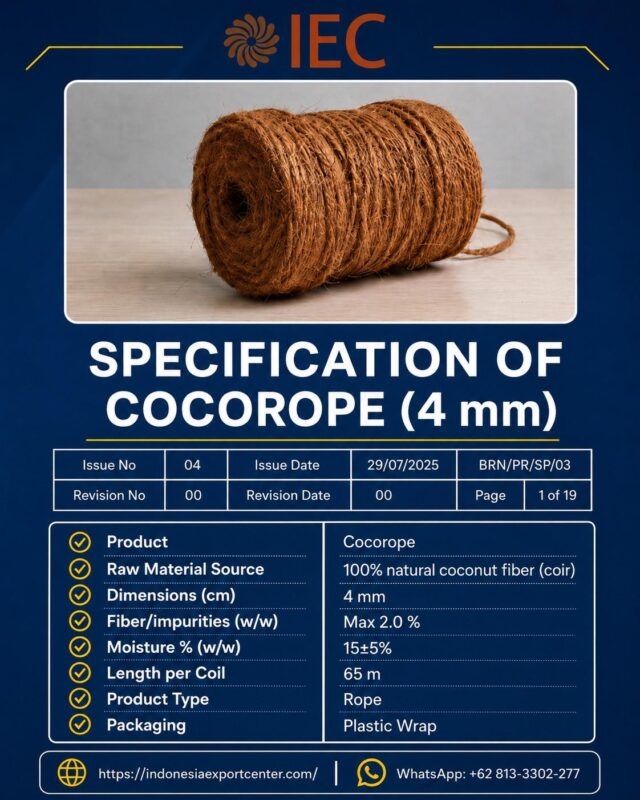
Standard Reference Product: Cocorope 4 mm
| Parameter | Documented Specification |
|---|---|
| Product | Cocorope |
| Raw Material | 100% natural coconut fiber |
| Nominal Diameter | 4 mm |
| Length per Coil | 65 m |
| Moisture | 15 ± 5% |
| Fiber/Impurities | Maximum 2.0% |
| Product Type | Rope |
| Packaging | Plastic wrap |
| Ply Construction | Not specified |
| Diameter Tolerance | Not specified |
| OEM Capability | Not confirmed |
This reference can serve as an initial discussion point but does not establish custom manufacturing capability.
OEM Product Development Requirements
Product Dimensions
The buyer should specify nominal diameter, permitted variation, length, and any relevant physical dimensions.
Ply Construction
The number of strands, twist direction, and construction should be defined where important.
Mechanical Performance
Depending on the intended application, the buyer may require breaking load, elongation, abrasion resistance, or other tests.
Surface Finish
Appearance, loose fibers, texture, and color variation may affect product integration.
Moisture and Cleanliness
The buyer should define acceptable moisture and impurity levels.
Coil or Cut Length
The OEM may require manufacturing coils, pre-cut pieces, or a different packing format.
Product Traceability
Lot identification and production records may be required for quality assurance.
OEM Technical Specification Matrix
| Parameter | Buyer Specification |
|---|---|
| Material | Coconut coir |
| Product Type | Rope / Twine |
| Nominal Diameter | [mm] |
| Diameter Tolerance | [± mm] |
| Ply Construction | [Details] |
| Twist Direction | [Requirement] |
| Linear Weight | [g/m] |
| Breaking Load | [Requirement] |
| Elongation | [Requirement] |
| Moisture | [Acceptance Range] |
| Impurities | [Maximum] |
| Color | Approved reference |
| Coil Length | [m] |
| Coil Weight | [kg] |
| Packaging | [Details] |
| Labeling | [Details] |
| Inspection | [Method] |
All custom requirements are subject to supplier feasibility.
OEM Feasibility Assessment
A potential supplier should confirm:
- Whether the requested construction can be manufactured.
- Available equipment and production processes.
- Minimum production batch.
- Material availability.
- Dimensional control capability.
- Testing and inspection capability.
- Sample development costs.
- Sample lead time.
- Commercial production lead time.
- Packaging and shipment arrangements.
IEC can facilitate these inquiries but cannot independently guarantee supplier capabilities.
Prototype and Sample Approval
OEM development should follow a controlled approval process.
Stage 1 – Technical Brief
The buyer provides drawings, dimensions, application details, and required tests.
Stage 2 – Supplier Feasibility
The proposed supplier reviews whether the product can be manufactured.
Stage 3 – Sample Development
If feasible, a representative sample is produced under agreed terms.
Stage 4 – Buyer Testing
The OEM tests the sample in the intended manufacturing process or finished product.
Stage 5 – Specification Approval
The buyer documents the approved construction and tolerances.
Stage 6 – Commercial Quotation
The supplier issues or approves a quotation for the agreed product.
Stage 7 – Production and Inspection
The contracting parties establish production controls, inspection, and acceptance procedures.
Stage 8 – Shipment
Packing, exporter responsibilities, and logistics are confirmed.
Confidentiality and Intellectual Property
OEM sourcing may involve confidential drawings, proprietary product specifications, or commercial forecasts.
Before sharing sensitive technical information, buyers should determine whether a confidentiality agreement is required.
Any nondisclosure agreement, tooling ownership, intellectual property rights, exclusivity, and permitted use of technical documents should be addressed in a written agreement between the relevant parties.
IEC’s role in facilitating communication does not automatically establish confidentiality or exclusivity obligations.
OEM Quality Assurance
Quality assurance may include:
- Approved reference sample.
- Written product specification.
- Defined dimensional tolerances.
- Agreed test methods.
- Lot identification.
- Production inspection.
- Final inspection.
- Nonconformity procedures.
- Corrective action requirements.
- Change-control arrangements.
The buyer should ensure that a supplier cannot substitute materials or change construction without the agreed approval process.
MOQ, Pricing, and Lead Time
OEM minimum order quantities may depend on equipment setup, production batch size, material procurement, testing, and packaging.
Sample costs and production costs should be quoted separately where appropriate.
No OEM MOQ, tooling cost, price, or lead time is assumed.
Logistics and Incoterms
OEM buyers should specify the required destination, delivery schedule, packaging, and preferred Incoterm.
IEC can facilitate FCA, FOB, CIF, or other appropriate quotation requests, subject to supplier and logistics confirmation.
IEC OEM Sourcing Process
IEC supports:
- Buyer requirement collection.
- Technical brief preparation.
- Potential supplier identification.
- Feasibility inquiries.
- Sample coordination.
- Commercial clarification.
- Supplier-approved quotation requests.
- Contracting party verification.
- Export communication.
OEM Coconut Fiber Rope RFQ
Subject: OEM Coconut Fiber Rope – Custom Production Feasibility Inquiry
Dear Indonesia Export Center Team,
We are seeking a potential Indonesian supplier for OEM coconut fiber rope production.
Company: [Name]
Country: [USA / UK / Other]
Product Application: [Description]
Required Product: [Rope / Twine]
Nominal Diameter: [mm]
Diameter Tolerance: [± mm]
Ply Construction: [Requirement]
Twist Requirement: [Details]
Coil Length/Weight: [Requirement]
Mechanical Requirements: [Details]
Appearance Requirements: [Details]
Quality/Test Requirements: [Details]
Prototype Quantity: [Quantity]
Initial Commercial Quantity: [Quantity]
Annual Forecast: [Quantity]
Packaging: [Details]
Confidentiality Agreement Required: [Yes / No]
Destination Port: [Port]
Incoterm: [Term]
Target Sample Date: [Date]
Target Shipment Date: [Date]
Please advise on supplier feasibility, sample development, MOQ, production lead time, and indicative commercial terms.
Best regards,
[Name] [Company]Frequently Asked Questions
Can IEC help identify OEM coconut coir rope suppliers?
Yes. IEC can facilitate potential supplier identification and technical inquiries.
Is custom rope manufacturing confirmed?
No. OEM capability requires supplier verification.
Can buyers request a diameter other than 4 mm?
Yes, as a feasibility inquiry.
Can buyers request specific ply constructions?
Yes. Manufacturing capability must be confirmed.
Are prototypes available?
Prototype feasibility, costs, and lead times depend on the supplier.
Can IEC help coordinate confidentiality discussions?
IEC can facilitate communication, but confidentiality obligations require appropriate agreements.
Can OEM buyers request private label packaging?
Yes, subject to supplier capability.
Is the supplier guaranteed to meet all tolerances?
No. The supplier must demonstrate capability and agree to measurable acceptance criteria.
Request a Sourcing Quote
Develop Your Coconut Fiber Rope Product with Indonesian Supplier Sourcing
OEM buyers can submit technical drawings, product specifications, expected quantities, and manufacturing requirements for supplier feasibility review.
REQUEST OEM COCONUT FIBER ROPE FEASIBILITY ASSESSMENT
IEC | INDONESIA EXPORT CENTER
Your Reliable Export & Sourcing Partner from Indonesia
Website: https://indonesiaexportcenter.com/
WhatsApp: +62 813-3302-277
Related Resources
Custom Cut Length Coconut Rope
Two Ply Coir Rope Supplier Matching
Three Ply Natural Coir Rope Inquiry
Private Label Coco Rope Packaging
