

IEC | INDONESIA EXPORT CENTER
DAMAR BATU FOR AGARBATTI RAW MATERIAL IMPORTERS
Indonesian Natural Resin | Agarbatti Production Trials | Grinding Evaluation | Bulk Procurement
Product / Buyer Need
Source Indonesian Damar Batu for Agarbatti Production
Agarbatti manufacturers require raw materials that can be processed consistently into their intended incense-stick formulations.
Depending on the production method, manufacturers may evaluate natural resins for particular formulation functions.
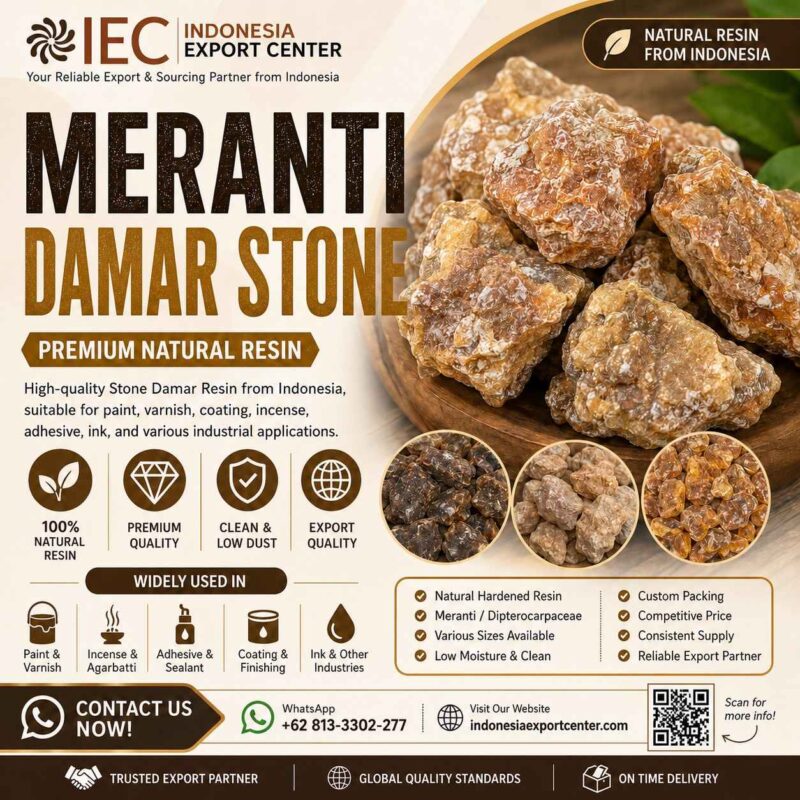
Damar batu is a natural hardened resin that may be considered for specialized agarbatti research and production trials.
However, its suitability for grinding, mixing, binding, drying, and combustion must be verified.
Indonesia Export Center (IEC) facilitates sourcing inquiries for agarbatti manufacturers, incense raw-material importers, and regional distributors interested in Indonesian damar stone.
Product Overview
| Attribute | Buyer Consideration |
|---|---|
| Product | Damar Batu / Meranti Damar Stone |
| Origin | Indonesia, subject to verification |
| Physical Form | Hardened resin lumps |
| Smaller Pieces | Supplier confirmation |
| Fines or Powder | Supplier confirmation |
| Resin Identity | Verification required |
| Moisture | Buyer-defined |
| Foreign Matter | Buyer-defined |
| Grinding Suitability | Buyer testing |
| Formulation Suitability | Buyer testing |
| Commercial Volume | Supplier confirmation |
Grinding Feasibility
Why Particle Size Matters
Agarbatti production may require ingredients in a form suitable for mixing and shaping.
If the resin is supplied as large lumps, the buyer must determine whether size reduction is practical.
Grinding Evaluation
The manufacturer’s technical team may assess:
- Lump hardness.
- Equipment compatibility.
- Grinding yield.
- Particle-size distribution.
- Dust generation.
- Material losses.
- Temperature sensitivity.
- Cleaning requirements.
Grinding should be carried out using appropriate equipment, ventilation, dust controls, and workplace safety procedures.
Combustible dust hazards should be assessed where relevant.
Binding Tests
Agarbatti formulations may use several components to achieve the desired forming and burning characteristics.
A resin’s presence does not automatically make it a suitable binder.
Manufacturers should evaluate:
- Compatibility with existing ingredients.
- Mixing behavior.
- Forming characteristics.
- Mechanical strength.
- Drying performance.
- Storage stability.
- Combustion behavior.
- Finished-product safety.
Odor and Combustion Evaluation
Raw resin odor may differ from its behavior in a finished agarbatti product.
Buyers should conduct controlled sensory and combustion tests.
Relevant safety and emissions requirements should also be reviewed.
Impurity and Moisture Requirements
Natural resin may contain foreign matter or moisture.
Agarbatti manufacturers should define acceptable limits based on their equipment and product requirements.
Buyer Sample Criteria
| Test Area | Acceptance Question |
|---|---|
| Identity | Is the correct resin supplied? |
| Lump Size | Can the material be processed? |
| Moisture | Is the material suitable for storage and grinding? |
| Impurities | Is contamination acceptable? |
| Grinding Yield | Does size reduction meet process needs? |
| Particle Size | Does the output match formulation requirements? |
| Binding Behavior | Does the material perform acceptably? |
| Odor | Does the finished product meet sensory targets? |
| Combustion | Does the finished product meet performance and safety requirements? |
Packaging
Buyers should specify packaging appropriate for lumps or fine material.
Potential considerations include net weight, dust containment, contamination protection, labeling, and warehouse handling.
Custom packaging must be confirmed with the supplier.
Supplier Verification
IEC can facilitate requests for current lot photographs, supplier identity, samples, packaging details, and export quotations.
The actual supplier must confirm the offered material and available quantity.
Procurement Process
Step 1: Define the agarbatti formulation requirement.
Step 2: Select the desired resin form.
Step 3: Request lot evidence.
Step 4: Obtain a representative sample.
Step 5: Conduct grinding and mixing trials.
Step 6: Evaluate finished-product performance.
Step 7: Approve the specification.
Step 8: Request commercial terms.
Request for Quotation
Subject: Indonesian Damar Batu for Agarbatti Manufacturing
Dear IEC Team,
We are seeking damar batu resin for agarbatti production.
Company: [Name] Country: [Country] Application: [Description] Required Resin: [Specification] Preferred Form: [Lumps / Fines / Powder] Particle Size: [Requirement] Moisture Limit: [%] Impurity Limit: [%] Grinding Requirements: [Details] Sample Quantity: [Amount] Trial Order: [MT] Monthly Requirement: [MT] Packaging: [Requirement] Destination Port: [Port] Incoterm: [Term]
Please advise on supplier availability, sample arrangements, processing options, and quotation.
Best regards,
[Name]
Frequently Asked Questions
Is damar batu suitable for every agarbatti formulation?
No. Suitability requires testing.
Can damar stone be supplied as powder?
This depends on supplier capability.
Can manufacturers grind the resin themselves?
They may evaluate this option using suitable equipment and safety controls.
Does damar batu guarantee improved binding?
No. Binding behavior must be demonstrated.
Can IEC facilitate bulk sourcing?
Yes, subject to supplier verification.
Request a Sourcing Quote
Explore Indonesian natural resin sourcing for agarbatti manufacturing.
REQUEST DAMAR BATU FOR AGARBATTI
INDONESIA EXPORT CENTER
Your Reliable Export & Sourcing Partner from Indonesia
Website: https://indonesiaexportcenter.com/
WhatsApp: +62 813-3302-277
Related Resources
Damar Batu for Incense and Dhoop Factories
Wholesale Damar Batu Resin from Indonesia
Meranti Damar Stone Export RFQ Checklist
