

Understanding Coal Quality Before Purchasing Indonesian Thermal Coal
Are you planning to purchase Indonesian thermal coal and need to understand coal quality specifications, inspection procedures, or certificate of analysis requirements?
Indonesia Export Center (IEC) supports commercial sourcing inquiries involving Indonesian thermal coal and encourages appropriate product verification before international and domestic transactions.
Coal quality is a critical consideration in industrial fuel procurement.
Two coal shipments with similar calorific values may have different moisture contents, ash characteristics, sulfur levels, volatile matter, and handling properties.
These differences can affect operational suitability, transportation economics, emissions management, and contractual compliance.
For this reason, buyers should evaluate more than a general product description or indicative GAR value.
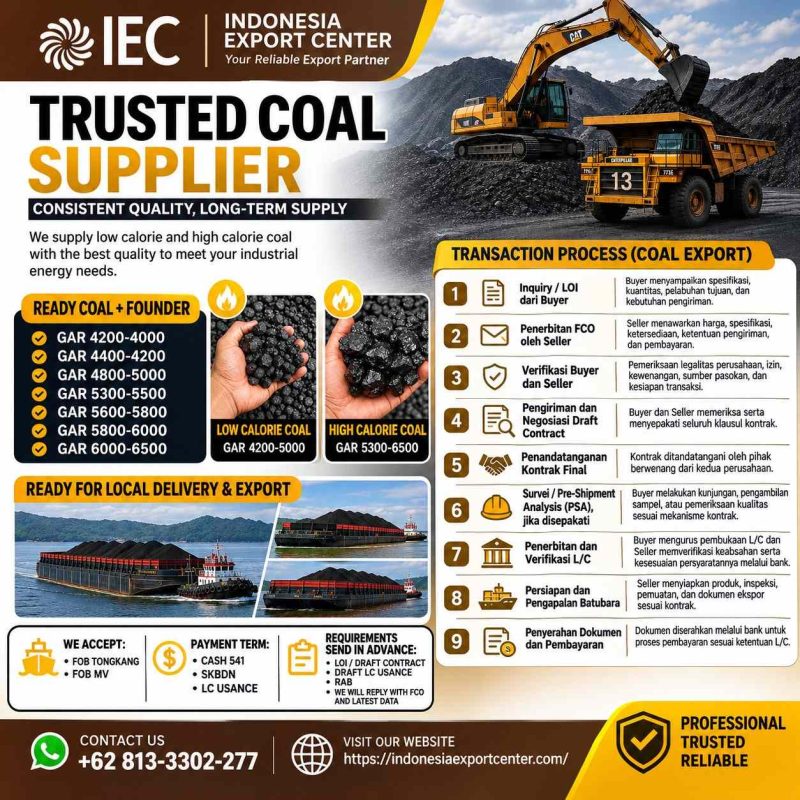
IEC welcomes inquiries involving thermal coal categories from GAR 4200 to GAR 6500, subject to actual source availability and verification.
Our commercial coordination focuses on clear buyer specifications, appropriate supplier documentation, contractual quality guarantees, and inspection arrangements where agreed.
Contact Indonesia Export Center
WhatsApp: +62 813-3302-277
Website: https://indonesiaexportcenter.com/
1. Why Coal Quality Inspection Matters
Coal is a naturally occurring material with physical and chemical characteristics that vary between sources and shipments.
Quality inspection provides information that can help buyers determine whether a product meets their intended requirements.
For industrial facilities, coal quality may influence fuel preparation, combustion efficiency, ash handling, maintenance requirements, and emissions performance.
For commodity traders, coal quality is also important because commercial contracts generally contain product specifications and acceptance conditions.
A failure to meet contractual specifications may result in price adjustments, disputes, rejection rights, or other agreed remedies.
Inspection procedures should therefore be established before shipment.
The buyer and seller should identify what will be tested, how samples will be collected, which laboratory methods will apply, and how results will be used contractually.
IEC encourages buyers to document these requirements rather than rely solely on informal assurances.
2. What Is GAR in Coal Specifications?
GAR means Gross As Received.
It refers to gross calorific value expressed on the as-received moisture basis.
The value is commonly reported in kilocalories per kilogram.
For example, GAR 5000 coal has a stated gross calorific value of approximately 5000 kcal/kg on an as-received basis.
GAR is widely used in Indonesian thermal coal trading because it provides a common commercial reference for heat energy content.
However, GAR does not describe all fuel characteristics.
Buyers must also evaluate moisture, ash, sulfur, volatile matter, and any additional parameters required by their equipment.
A coal grade should not be accepted solely because its nominal GAR matches the purchase inquiry.
The actual product analysis and contractual requirements must be reviewed.
3. Gross Calorific Value and Net Calorific Value
Gross Calorific Value, often abbreviated GCV, represents heat released during combustion under prescribed analytical conditions, including the heat associated with condensation of combustion-produced water.
Net Calorific Value, often abbreviated NCV, excludes the heat recovered from that condensation under the relevant definition.
Both measurements may be reported on different moisture bases.
NAR commonly refers to Net As Received calorific value.
GAR and NAR are therefore not interchangeable.
For example, a commercial requirement of GAR 5500 should not automatically be treated as equivalent to NAR 5500.
Buyers should specify the calorific value basis clearly in purchase documents.
Where a conversion is required, it must be based on appropriate analytical data and the relevant calculation method.
IEC encourages consistent terminology throughout inquiries, offers, contracts, and inspection certificates.
4. Total Moisture in Indonesian Thermal Coal
Total moisture is an important factor in coal quality evaluation.
Moisture affects the amount of combustible material present per unit of coal as received.
It can also influence storage, handling, transportation, and combustion efficiency.
Coal with greater moisture content may have a lower as-received calorific value than the same material measured on a dry basis.
The buyer should therefore identify the appropriate moisture limits in the purchase agreement.
A laboratory report should clearly state the relevant analytical method and moisture basis.
Moisture results may also be affected by sampling and sample-handling procedures.
Correct sampling and sample preservation are important for meaningful analysis.
IEC encourages buyers to establish appropriate moisture specifications and inspection procedures.
5. Inherent Moisture and Total Moisture
Inherent moisture and total moisture are different analytical concepts.
Inherent moisture generally describes moisture associated with the coal under the prescribed testing procedure.
Total moisture represents the total moisture determined for the coal sample under the relevant method.
The relationship between these values depends on sampling, preparation, and analytical conditions.
Buyers should avoid assuming that inherent moisture alone describes the complete moisture condition of a shipment.
For commercial transactions, both parties should agree on the moisture parameter that governs contractual acceptance.
The analytical method and reporting basis should be clearly identified.
IEC encourages precise technical terminology to reduce misunderstandings between international buyers and Indonesian suppliers.
6. Ash Content in Coal Analysis
Ash content describes the non-combustible residue measured after coal is subjected to the prescribed analytical procedure.
Ash is an important parameter because it affects the quantity of mineral residue associated with combustion.
For power plants, ash content may influence ash handling and disposal requirements.
For cement manufacturers, ash characteristics may influence process chemistry and material balance.
For industrial boilers, excessive or unsuitable ash may create operational challenges.
However, ash quantity alone does not fully describe ash behavior.
Some applications may require additional information concerning ash composition or ash fusion characteristics.
Buyers should establish appropriate ash limits according to their industrial requirements.
IEC supports inquiries containing complete ash specifications and related quality conditions.
7. Sulfur Content in Indonesian Coal
Sulfur is a key parameter in thermal coal procurement.
Coal may contain sulfur in different chemical forms.
During combustion, sulfur-containing compounds can contribute to sulfur oxide emissions.
Industrial facilities must manage emissions according to applicable environmental requirements.
The acceptable sulfur content depends on the facility’s equipment, operating permits, and emissions control systems.
A buyer should specify the maximum allowable total sulfur content in the contract.
The sulfur value should be supported by an appropriate analytical report.
IEC encourages procurement teams to request complete technical information rather than assume that every coal product from a given region has the same sulfur characteristics.
8. Volatile Matter and Fixed Carbon
Volatile matter is determined by heating coal under prescribed laboratory conditions.
It provides information that can help characterize coal behavior during thermal processing.
The significance of volatile matter depends on the intended industrial application.
Fixed carbon is generally calculated from proximate analysis results rather than measured directly as a separate elemental carbon determination.
The values should be interpreted using the relevant analytical basis.
For some industrial fuel systems, volatile matter and fixed carbon are important purchasing parameters.
Buyers should provide their required ranges when requesting a coal quotation.
IEC welcomes detailed inquiries and encourages the use of recognized analytical methods.
9. Hardgrove Grindability Index
Hardgrove Grindability Index, or HGI, is used to characterize coal grindability under a standardized testing procedure.
It can be relevant to facilities that pulverize coal before combustion.
Coal grinding equipment must operate within appropriate design conditions.
The required HGI depends on the facility’s equipment and operational requirements.
A general calorific value specification does not provide sufficient information about grindability.
Buyers operating pulverized coal systems may therefore include HGI in their procurement documentation.
IEC encourages such buyers to provide complete fuel preparation requirements.
10. Coal Size Distribution and Physical Quality
Coal particle size can influence handling, transportation, storage, and industrial fuel preparation.
Different applications may require different size distributions.
A buyer should specify whether the proposed coal must satisfy particular maximum size, minimum size, or screening requirements.
Excessive fines may create handling concerns in some systems.
Large particles may require additional crushing before use.
Sampling and inspection procedures should reflect the applicable physical quality requirements.
IEC welcomes sourcing inquiries that include coal size specifications when relevant.
The actual product characteristics must be verified against the proposed cargo.
11. Certificate of Analysis for Indonesian Coal
A Certificate of Analysis, commonly called a COA, presents laboratory findings for a particular sample or material.
In coal procurement, a COA may report calorific value, moisture, ash, sulfur, volatile matter, and other analytical parameters.
However, buyers must understand what the certificate represents.
A test report may relate to a laboratory sample, a stockpile, a production batch, or an identified shipment.
A COA from an earlier shipment does not automatically establish the quality of future deliveries.
The report should be assessed for laboratory identity, sample identification, testing methods, report date, and relationship to the proposed cargo.
IEC encourages buyers to request source-specific documentation and avoid relying on unrelated quality reports.
12. Coal Sampling and Independent Inspection
Reliable coal analysis depends on appropriate sampling.
Because coal is not necessarily uniform throughout a stockpile or shipment, collecting representative samples is important.
The contract should identify the sampling location, sampling method, and responsible inspection party.
Where appropriate, an independent surveyor may be appointed.
The surveyor’s scope may include sample collection, laboratory coordination, cargo quantity measurement, or other agreed inspection services.
The buyer and seller should establish how inspection findings affect contractual acceptance.
They should also define the procedure for resolving disputed results.
IEC supports the inclusion of clear inspection requirements in commercial negotiations.
13. Pre-Shipment Analysis and Stockpile Verification
Pre-shipment analysis may be conducted where agreed by the buyer and seller.
Depending on the transaction, the process may include a stockpile visit, material inspection, sampling, and laboratory testing.
The purpose is to evaluate whether the proposed coal meets the buyer’s requirements before shipment.
A stockpile visit may also help clarify the physical location and condition of the proposed cargo.
However, physical inspection does not independently establish legal ownership or authority to sell the material.
Separate documentary verification remains necessary.
Buyers should confirm who arranges the inspection, who bears the costs, and how results will be evaluated.
IEC encourages inspection arrangements that are transparent and mutually agreed.
14. Coal Quality Guarantees in Sales Contracts
A professional coal purchase agreement should include clear quality specifications.
The contract may identify guaranteed calorific value, maximum moisture, maximum ash, sulfur limits, and other relevant parameters.
It may also include quality adjustment provisions and rejection thresholds.
The parties should specify the sampling and testing methods that determine contractual compliance.
A quality guarantee should not be confused with a general marketing description.
Commercial terms such as “high-quality coal” are insufficient without measurable specifications.
IEC encourages buyers and sellers to define their obligations in a complete written agreement.
This approach supports more predictable procurement and reduces the risk of later disputes.
15. Indonesian Coal Quality and Export Procedures
Quality verification is one component of an international coal transaction.
Buyers and sellers must also address company verification, legal authority, shipment conditions, banking arrangements, and export documentation.
Indonesia’s coal export procedures are subject to applicable regulations.
The parties must verify the legal status of the exporter and the requirements in force at the time of shipment.
Inspection certificates and other export documents should be prepared according to the relevant legal and contractual obligations.
IEC does not represent that any single certificate automatically establishes full regulatory compliance.
Qualified buyers should conduct appropriate due diligence before entering binding transactions.
16. Frequently Asked Questions About Coal Quality
What does GAR mean in Indonesian coal?
GAR means Gross As Received and refers to gross calorific value on an as-received basis.
What is the difference between GAR and NAR?
GAR is gross calorific value on an as-received basis, while NAR refers to net calorific value on an as-received basis.
Why is moisture important?
Moisture affects the as-received energy content, handling characteristics, and combustion performance of coal.
What does a coal COA contain?
A COA may contain calorific value, moisture, ash, sulfur, volatile matter, and other laboratory findings.
Can buyers request independent coal inspection?
Yes. Inspection may be arranged where agreed by the contracting parties.
Is GAR 5500 sufficient to describe coal quality?
No. Complete specifications should also address moisture, ash, sulfur, and other relevant parameters.
Can a COA guarantee all future coal shipments?
No. A COA relates to the material tested and does not automatically establish the quality of future cargoes.
Can IEC coordinate coal sourcing inquiries with inspection requirements?
IEC welcomes sourcing inquiries that include quality verification and inspection requirements.
17. Request Indonesian Coal with Clear Quality Specifications
Are you looking for Indonesian thermal coal with defined GAR, moisture, ash, sulfur, and other technical requirements?
Indonesia Export Center welcomes formal inquiries from qualified international coal buyers.
Please provide the required calorific value, total moisture limit, ash limit, sulfur limit, coal size requirements, quantity, destination port, proposed delivery terms, and expected shipment schedule.
Where available, attach a formal Letter of Intent and the complete buyer specification sheet.
Our team will review the requirements and coordinate commercial discussions according to verified sourcing opportunities.
INDONESIA EXPORT CENTER (IEC)
Your Reliable Export Partner
WhatsApp: +62 813-3302-277
Website: https://indonesiaexportcenter.com/
Indonesian Coal Quality Inspection | GAR and GCV Specifications | Coal Certificate of Analysis | Thermal Coal Sourcing Indonesia
Professional • Trusted • Reliable
Disclaimer: IEC provides coal sourcing and commercial coordination. Laboratory testing, certification, inspection availability, cargo quality, supply quantities, and commercial terms are subject to the relevant service providers, supplier verification, applicable regulations, and final contractual agreement.
