

Thermal Coal Sourcing for Cement Plants and Industrial Kilns
Are you searching for an Indonesian coal supplier for cement factories, cement manufacturing plants, or industrial kiln operations?
Indonesia Export Center (IEC) welcomes inquiries from qualified industrial buyers seeking Indonesian thermal coal for compatible cement manufacturing applications.
Our sourcing coordination focuses on potential supply networks in South Kalimantan, East Kalimantan, and Central Kalimantan, Indonesia.
We help buyers communicate their fuel specifications, procurement quantities, shipment schedules, commercial conditions, and inspection requirements.
Cement manufacturing is an energy-intensive industrial process.
High-temperature operations require appropriate thermal energy inputs, and the selection of fuel can influence process efficiency, operating costs, and product quality.
Coal may be used in cement production where the equipment is designed and permitted to operate with that fuel.
However, the suitability of a coal product depends on more than its calorific value.
Ash characteristics, sulfur content, volatile matter, moisture, and fuel preparation requirements may all be relevant.
IEC encourages cement industry buyers to provide complete technical specifications before requesting a commercial quotation.
Contact Indonesia Export Center
WhatsApp: +62 813-3302-277
Website: https://indonesiaexportcenter.com/
1. Why Coal Is Used in Cement Manufacturing
Cement production involves several stages, including raw material preparation, thermal processing, clinker formation, and grinding.
The kiln system requires substantial thermal energy to process raw materials and produce clinker.
Coal is one of the fuels that may be used in suitable cement manufacturing operations.
Depending on the plant’s design, coal may be prepared and introduced into the combustion system to provide heat.
Fuel quality can influence combustion behavior, thermal efficiency, material balance, and operating conditions.
A cement plant must therefore select fuel according to its engineering requirements.
The choice of coal also involves cost considerations.
Procurement teams should assess delivered fuel prices, energy content, preparation requirements, ash chemistry, emissions controls, and operating reliability.
IEC supports commercial sourcing inquiries, while the cement plant’s technical personnel remain responsible for determining fuel suitability.
2. Indonesian Coal Grades for Cement Industry Inquiries
Different cement production systems may require different coal specifications.
IEC welcomes inquiries for various calorific value categories.
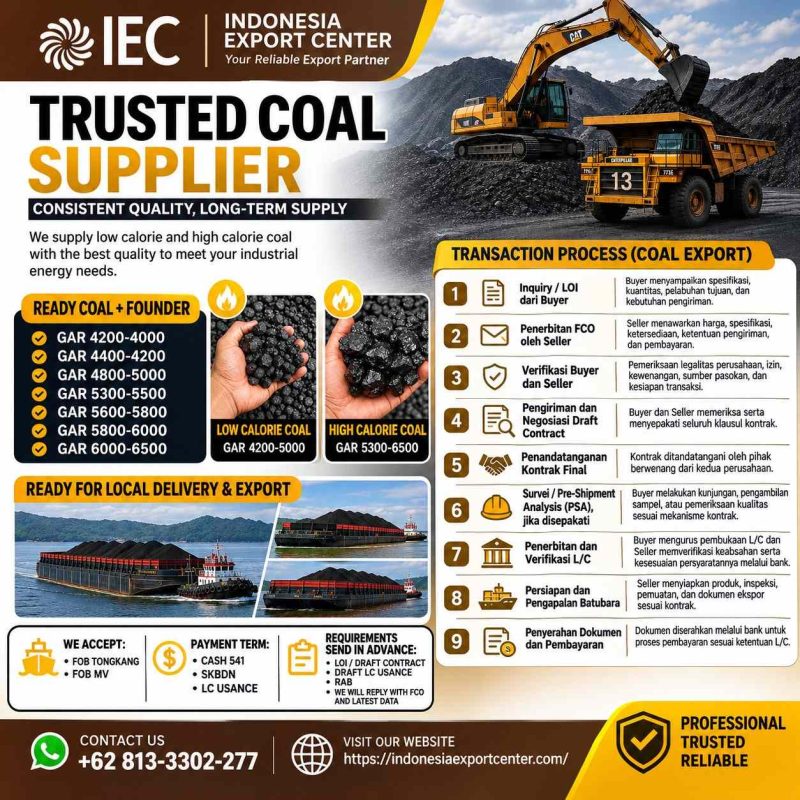
| Coal Category | Target GAR |
|---|---|
| Lower Calorie Thermal Coal | GAR 4200–4400 |
| Intermediate Thermal Coal | GAR 4800–5000 |
| Higher Calorie Thermal Coal | GAR 5300–5500 |
| Higher Calorie Thermal Coal | GAR 5600–5800 |
| Higher Calorie Thermal Coal | GAR 5800–6000 |
| High Calorie Thermal Coal | GAR 6000–6500 |
These grades represent potential sourcing categories, not recommendations for any particular kiln.
A cement plant’s technical team must evaluate the appropriate calorific value together with the complete chemical and physical characteristics of the proposed coal.
Buyers should specify whether the target GAR represents a minimum, typical, or guaranteed contractual value.
Quality tolerances should also be established before signing a purchase agreement.
3. Calorific Value and Thermal Energy Requirements
Calorific value describes the heat energy associated with combustion of a fuel.
In Indonesian coal trading, buyers frequently use Gross Calorific Value on an As-Received basis, commonly expressed as GAR kcal/kg.
A higher GAR value indicates greater gross heat energy per unit of fuel mass.
However, the cost of useful thermal energy depends on more than GAR.
Moisture content, combustion efficiency, fuel preparation, operating conditions, and total delivered cost are also relevant.
A cement plant comparing GAR 5000 and GAR 5500 coal should evaluate both the technical requirements and the commercial implications.
The plant’s engineering team may also consider how fuel quality changes affect kiln temperature stability and combustion control.
IEC encourages buyers to identify the preferred analytical basis and provide appropriate quality limits.
4. Ash Content in Cement Kiln Fuel
Ash is a particularly important consideration when selecting coal for cement manufacturing.
During combustion, the mineral components of coal contribute ash.
In a cement kiln, some fuel ash may become incorporated into the clinker material balance.
Therefore, ash characteristics can affect the chemistry of the cement manufacturing process.
Cement plants may need to evaluate both the quantity and chemical composition of coal ash.
High ash content can also affect fuel handling and operating performance.
A supplier quotation should identify the agreed ash content limit.
Where necessary, buyers may request additional information concerning ash composition.
IEC encourages cement plant buyers to include these requirements in the initial technical inquiry.
5. Sulfur Content and Cement Manufacturing
Sulfur is another important fuel parameter.
In cement manufacturing, sulfur may participate in chemical cycles within the kiln and preheater system.
The effect depends on the fuel, raw materials, equipment design, and operating conditions.
Excessive or unsuitable sulfur input can contribute to operational difficulties in some cement production systems.
Environmental compliance requirements must also be considered.
Therefore, cement plants should establish appropriate total sulfur limits for purchased coal.
The permitted value is not universal and should be determined by the facility’s technical requirements.
IEC welcomes inquiries containing buyer-defined sulfur specifications.
The actual sulfur content of any proposed cargo must be verified through appropriate source documentation and testing.
6. Volatile Matter and Combustion Performance
Volatile matter is an important parameter in coal analysis.
It can help characterize how coal behaves under specified heating conditions.
For cement kiln combustion systems, fuel ignition and flame characteristics may be relevant to process performance.
The relationship between volatile matter and combustion behavior depends on the complete fuel characteristics and equipment configuration.
A cement plant may require a particular range of volatile matter according to its burner and kiln design.
Buyers should therefore specify the applicable range in procurement documents.
IEC does not recommend a universal volatile matter value for every cement factory.
The final specification should be established by the end user’s technical specialists.
7. Moisture Content and Fuel Preparation
Moisture can influence the amount of thermal energy available from coal as received.
It may also affect fuel preparation, drying, storage, and handling systems.
For cement factories using coal grinding and drying equipment, total moisture may be an important operational consideration.
A procurement contract should identify the maximum acceptable moisture level and the applicable analytical basis.
Buyers should also consider whether a proposed coal product requires additional preparation before use.
Coal stored in open stockpiles may experience changing conditions, making appropriate sampling and quality verification important.
IEC encourages clear moisture specifications and documented inspection procedures.
8. Coal Grindability and Cement Plant Operations
Coal used in certain cement manufacturing systems may be ground to an appropriate fineness before combustion.
The characteristics of the coal can affect the performance of grinding equipment.
Hardgrove Grindability Index is one analytical parameter that may be relevant to evaluating coal grindability.
The required value depends on the plant’s fuel preparation system.
Coal size distribution may also influence unloading, conveying, and milling operations.
A cement factory should specify the physical properties necessary for its equipment.
IEC welcomes detailed inquiries that include grindability or coal size requirements where applicable.
These parameters should be supported by appropriate analytical information.
9. Indonesian Coal Sourcing from Kalimantan
Kalimantan is an important coal-producing region in Indonesia.
IEC focuses on potential sourcing opportunities associated with South Kalimantan, East Kalimantan, and Central Kalimantan.
Coal quality varies between individual sources.
A proposed supplier should establish the origin, availability, and expected technical characteristics of the product.
For cement plant procurement, consistency can be important because changes in ash composition, sulfur, moisture, or calorific value may affect process control.
Buyers should therefore examine whether the proposed source can support their required specifications over multiple shipments.
IEC welcomes inquiries for individual cargoes and potential recurring procurement arrangements.
No particular product grade or monthly capacity should be considered guaranteed without verification.
10. Coal Procurement for Cement Factories
A cement plant may purchase coal through individual spot transactions or longer-term supply agreements.
A structured procurement program should consider forecast fuel consumption, inventory needs, shipment schedules, and acceptable product variability.
The contract should define the required specifications, inspection methods, quality adjustment provisions, and delivery responsibilities.
Buyers should also establish the commercial consequences of delayed shipments or non-conforming fuel.
For larger procurement programs, supplier capacity and logistics arrangements require careful evaluation.
IEC can coordinate commercial discussions based on the buyer’s documented requirements.
However, the actual supply commitment must be made by a verified contracting seller.
11. Coal Shipping and Delivery for Cement Plants
Transportation is a major component of bulk coal procurement.
The relevant logistics arrangement depends on the source location, destination, cargo quantity, and available infrastructure.
Potential methods may include domestic trucking, barging, and marine bulk transportation.
International buyers may request FOB mother vessel arrangements where commercially feasible.
Specific barge delivery terms may also be negotiated.
The contract should clarify loading responsibilities, transportation costs, inspection requirements, risk transfer, and required documentation.
A buyer should also consider unloading capability at the receiving port or industrial facility.
IEC welcomes inquiries containing detailed delivery requirements.
12. Nine-Step Coal Trading Procedure
IEC recommends a documented commercial process.
1. Buyer Inquiry: The cement plant or trader provides complete coal specifications, required quantity, destination, and delivery schedule.
2. Seller FCO: The seller presents a commercial offer covering verified product information, price, payment conditions, and shipment terms.
3. Verification: Both parties verify company documentation, legal authority, source access, and commercial readiness.
4. Contract Negotiation: Quality parameters, inspection methods, delivery obligations, payment terms, and contractual remedies are agreed.
5. Final Contract Signing: Authorized representatives execute the final agreement.
6. Inspection or PSA: Where agreed, the buyer may request stockpile assessment, sampling, or independent testing.
7. Letter of Credit: If documentary credit payment is agreed, the buyer arranges issuance and the seller verifies its terms.
8. Shipment: The seller coordinates cargo preparation, required inspections, loading, and documentation.
9. Payment: Documents are submitted under the agreed payment arrangement, and payment follows the applicable conditions.
This procedure may be adapted by mutual written agreement.
13. Coal Quality Inspection for Cement Industry Buyers
Quality inspection helps determine whether purchased coal meets contractual specifications.
Important parameters may include calorific value, moisture, ash, sulfur, volatile matter, and grindability.
For cement industry applications, additional ash chemistry analysis may be required.
The buyer and seller should agree on the sampling procedure, inspection location, analytical standards, and contractual treatment of discrepancies.
A certificate of analysis should relate to the material being evaluated.
Historical test results should not automatically be treated as proof of quality for a new shipment.
IEC supports transparent quality verification requirements in commercial negotiations.
14. Frequently Asked Questions
Can IEC coordinate coal supply inquiries for cement factories?
Yes. IEC welcomes formal inquiries from qualified cement manufacturers and industrial buyers.
What coal grade is suitable for cement production?
The appropriate grade depends on kiln design, burner requirements, fuel preparation, ash chemistry, and other technical factors.
Is GAR 5500 coal suitable for cement factories?
It may be considered for compatible operations, subject to technical evaluation and complete quality specifications.
Why is ash content important?
Coal ash can influence material balance and process chemistry in cement manufacturing.
Can I request coal with specific sulfur limits?
Yes. Buyers are encouraged to identify maximum acceptable sulfur content in their inquiries.
Can IEC coordinate long-term procurement?
Recurring sourcing proposals may be evaluated after supplier capacity and logistics are verified.
Is independent inspection possible?
Inspection may be arranged where contractually agreed.
Can I request FOB or domestic delivery?
Such arrangements may be discussed according to supplier capabilities and the destination.
15. Request a Coal Quotation for Your Cement Factory
Does your cement manufacturing business require Indonesian thermal coal?
Indonesia Export Center welcomes procurement inquiries from cement plants, industrial kiln operators, and qualified commodity trading companies.
Please provide your company’s details, required calorific value, ash and sulfur limits, moisture specifications, volatile matter requirements, grindability requirements where applicable, cargo quantity, and expected shipment schedule.
Include your proposed destination and payment conditions.
A complete technical inquiry helps identify sourcing opportunities that are relevant to your actual industrial requirements.
INDONESIA EXPORT CENTER (IEC)
Your Reliable Export Partner
WhatsApp: +62 813-3302-277
Website: https://indonesiaexportcenter.com/
Coal Supplier for Cement Factories | Indonesian Thermal Coal for Cement Industry | Kalimantan Coal Sourcing
Professional • Trusted • Reliable
Disclaimer: Coal specifications, supply availability, pricing, shipment arrangements, and payment conditions are subject to verification and final agreement. Industrial suitability must be assessed by the buyer’s technical team. IEC coordinates sourcing opportunities and does not guarantee availability or technical suitability of any particular cargo.
