

Your Reliable Source for Indonesian Low Calorie Thermal Coal
Are you looking for a reliable Indonesian low calorie coal supplier for your power plant, industrial boiler, cement facility, or international commodity trading business?
Indonesia Export Center (IEC) supports domestic and international buyers seeking Indonesian thermal coal with gross calorific values ranging from GAR 4200 to GAR 5000 kcal/kg.
Through coal sourcing networks associated with South Kalimantan, East Kalimantan, and Central Kalimantan, we coordinate buyer inquiries, technical requirements, supplier verification, commercial negotiations, and potential coal delivery arrangements.
Our objective is to help qualified buyers identify suitable Indonesian steam coal supply opportunities while maintaining clear communication, transparent procedures, and commercially realistic expectations.
Indonesia offers several categories of thermal coal used in industrial energy generation. Low calorie coal remains relevant to buyers whose combustion equipment, fuel management systems, and operational requirements are compatible with these grades.
Whether your company needs a single bulk shipment or wishes to discuss recurring monthly procurement, IEC welcomes detailed inquiries and can help coordinate the next stages of the sourcing process.
Contact Indonesia Export Center
WhatsApp: +62 813-3302-277
Website: https://indonesiaexportcenter.com/
1. Indonesian Low Calorie Coal Specifications – GAR 4200 to GAR 5000
Low calorie coal is generally classified according to its calorific value, but the precise definition can differ between markets and commercial contracts.
Indonesian coal buyers frequently refer to the Gross Calorific Value on an As-Received basis, commonly expressed as GAR kcal/kg.
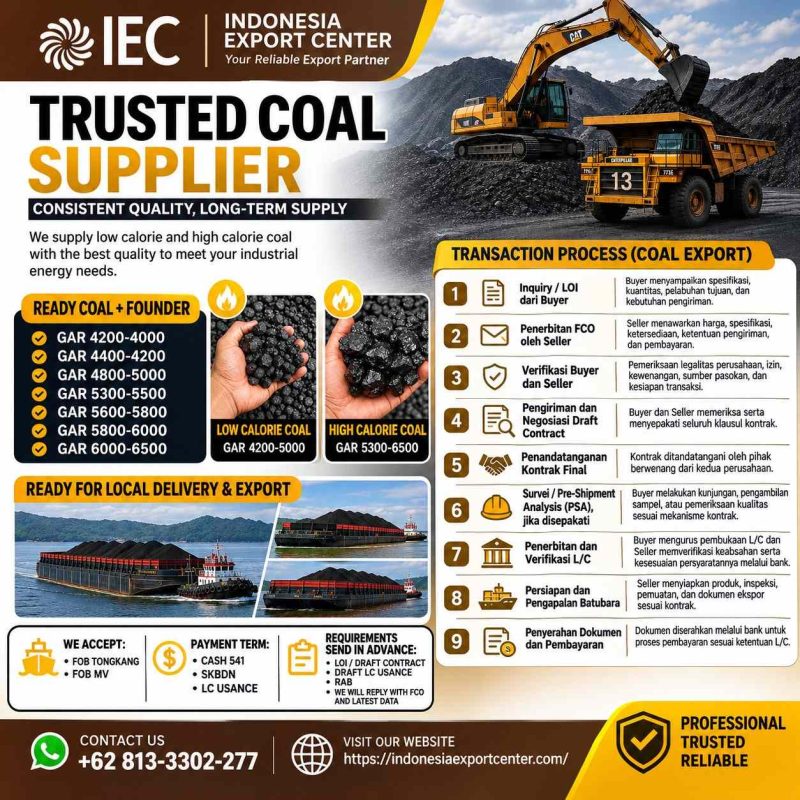
IEC welcomes inquiries for the following indicative coal grades:
| Coal Category | Gross Calorific Value |
|---|---|
| Indonesian GAR 4000–4200 Coal | 4000–4200 kcal/kg |
| Indonesian GAR 4200–4400 Coal | 4200–4400 kcal/kg |
| Indonesian GAR 4400–4800 Coal | 4400–4800 kcal/kg |
| Indonesian GAR 4800–5000 Coal | 4800–5000 kcal/kg |
These are indicative sourcing grades rather than guaranteed inventory specifications. Availability, final guaranteed calorific value, acceptable tolerance, and supply quantity depend on confirmation from the relevant source.
Coal buyers should provide complete technical requirements rather than relying only on a calorific value range.
Important characteristics include total moisture, inherent moisture, ash content, total sulfur, volatile matter, fixed carbon, and coal particle size.
For some industrial users, additional parameters such as Hardgrove Grindability Index, ash fusion characteristics, and chlorine may be important.
IEC encourages buyers to describe their complete fuel specifications before requesting a commercial quotation.
2. Why Buyers Choose Indonesian Low Calorie Steam Coal
Indonesian low calorie coal can be an option for power generation and industrial thermal applications where the combustion system is designed to handle its characteristics.
The economic attractiveness of a coal grade depends not only on its purchase price per metric ton but also on delivered energy content, freight, moisture, handling efficiency, emissions requirements, and operational performance.
Potentially Competitive Fuel Procurement
Lower-calorific-value coal may carry a different market price from higher-calorific-value products.
However, a lower price per ton does not necessarily mean a lower cost per unit of useful energy.
Buyers should compare coal quotations based on consistent quality assumptions, transportation costs, and actual operational requirements.
Suitable for Compatible Industrial Systems
Low calorie thermal coal may be used in industrial boilers, electricity generation, and thermal processing systems designed for the relevant fuel characteristics.
The suitability of a given grade must be assessed by the industrial buyer’s technical team.
Multiple Sourcing Regions
Kalimantan is an established coal-producing region in Indonesia.
Exploring multiple supply sources may help buyers evaluate differences in product quality, logistics, loading arrangements, and commercial conditions.
Long-Term Procurement Possibilities
For industrial operations requiring continuous fuel supply, buyers may discuss periodic deliveries and longer-term supply agreements.
Such arrangements require verification of production capacity, stockpile management, logistics availability, and the seller’s ability to perform contractual commitments.
3. Indonesian GAR 4200 Coal for Industrial Buyers
Indonesian GAR 4200 coal is frequently referenced in international thermal coal sourcing inquiries.
Buyers considering this category generally need to understand the total heat value of the fuel and how moisture affects the quantity of useful energy available during combustion.
GAR 4200 represents a gross calorific value on an as-received basis, not a complete technical specification.
Two coal shipments with similar GAR values may have different ash, sulfur, moisture, or handling characteristics.
Consequently, buyers should establish specific guaranteed values and rejection limits when preparing procurement documents.
When requesting GAR 4200 coal, buyers are encouraged to specify their required quantity, intended use, loading arrangement, and destination.
IEC can review these requirements and coordinate discussions with potential supply sources, subject to commercial and regulatory eligibility.
4. Indonesian GAR 4800–5000 Coal Supply
For industrial buyers seeking higher gross energy content within the lower-calorific-value sourcing range, GAR 4800–5000 coal may be considered.
This category is relevant to procurement teams evaluating intermediate thermal coal specifications.
However, the exact suitability of GAR 4800 or GAR 5000 coal depends on equipment requirements and the complete coal analysis.
IEC welcomes requests for these categories from international coal traders, industrial procurement companies, and direct end users.
A technical request should ideally include both target values and allowable limits for important parameters.
This approach reduces the risk of receiving quotations for products that do not meet the intended operating requirements.
Coal offers should clearly state whether the quoted specifications are typical values, guaranteed contractual values, or analytical results from an identified shipment.
5. Coal Sourcing from South, East, and Central Kalimantan
Indonesia Export Center focuses on coal sourcing opportunities connected with major coal-producing regions in Kalimantan.
South Kalimantan Coal Supply
South Kalimantan has established coal mining and transportation activities.
Depending on the location and supplier, shipments may involve road transportation, stockpile operations, river or coastal barging, and subsequent marine transportation.
East Kalimantan Coal Supply
East Kalimantan is another important Indonesian coal-producing region.
Buyers may explore supply arrangements involving different coal qualities, loading locations, and logistics configurations.
Central Kalimantan Coal Supply
Central Kalimantan provides additional sourcing possibilities for buyers considering Indonesian thermal coal.
Actual availability depends on the operating status, licensing, product characteristics, and commercial readiness of the relevant supplier.
Important: A regional sourcing possibility does not represent a confirmed stockpile or available shipment. All offers require source-specific verification.
6. FOB Barge and FOB Mother Vessel Coal Delivery
The selection of delivery terms is a major consideration in bulk coal procurement.
IEC coordinates inquiries for FOB barge and FOB mother vessel arrangements where commercially available.
FOB Barge – Coal Loading onto a Barge
In coal trading, the expression FOB barge is often used to describe arrangements involving delivery onto an agreed barge.
Because the exact delivery point and responsibilities can differ by contract, buyers and sellers should explicitly define cargo loading, risk transfer, quantity determination, inspections, and onward transportation.
Buyers should not assume that an informal FOB barge description automatically establishes every responsibility.
FOB Mother Vessel – Bulk Coal Shipment
Under an agreed FOB mother vessel arrangement, coal is loaded onto an identified ocean-going vessel at the named shipment port or loading place.
The parties should clarify their obligations regarding vessel nomination, laytime, demurrage, loading rates, and shipment documentation.
Where Incoterms 2020 FOB is expressly incorporated, the applicable international delivery and risk-transfer rules should be followed.
Domestic Coal Delivery Options
IEC also welcomes domestic Indonesian coal inquiries.
Delivery conditions for domestic transactions may include different inland transportation and payment arrangements, to be agreed with the seller.
7. Coal Export Transaction Procedure for International Buyers
A structured commercial process helps reduce misunderstandings during coal sourcing and procurement.
Indonesia Export Center uses the following nine-stage procedure as a proposed transaction framework.
Step 1 – Buyer Inquiry or Letter of Intent
The buyer provides a formal inquiry or LOI identifying the coal specifications, required quantity, delivery destination, proposed shipment schedule, and company details.
Step 2 – Full Corporate Offer
Subject to confirming the commercial basis, the seller issues an FCO containing available specifications, pricing, delivery arrangements, and proposed payment conditions.
Step 3 – Verification of Buyer and Seller
Both parties conduct appropriate due diligence concerning company identity, legal authority, relevant licenses, supply access, and transaction capability.
Step 4 – Contract Draft and Negotiation
The buyer and seller exchange and negotiate the draft Sales and Purchase Agreement.
Specifications, quality tolerances, payment conditions, inspections, shipment obligations, and dispute procedures must be addressed.
Step 5 – Final Contract Signing
Authorized representatives sign the mutually agreed contract.
The final agreement defines the obligations that govern the transaction.
Step 6 – Survey or Pre-Shipment Analysis
Where agreed, the buyer or an appointed independent inspector conducts sampling, stockpile verification, or pre-shipment quality analysis.
Step 7 – Letter of Credit Issuance
Where documentary credit payment is agreed, the buyer arranges the L/C and the seller verifies its terms through the appropriate banking channels.
Step 8 – Coal Preparation and Shipment
The seller coordinates cargo preparation, required inspections, loading, and shipping documentation in accordance with the contract.
Step 9 – Document Submission and Payment
Required documents are presented under the agreed payment arrangement.
Where an L/C is used, payment depends on compliance with the credit terms and the applicable banking rules.
This framework may be adjusted through mutual written agreement, provided essential verification, compliance, and payment safeguards are maintained.
8. Coal Inspection and Quality Assurance
Coal quality inspection is important because moisture, ash, sulfur, and particle-size variations can materially affect industrial performance.
Buyers may request independent analysis before or during shipment, as established in the contract.
A quality assessment may examine:
- Gross Calorific Value on an As-Received basis
- Total Moisture and Inherent Moisture
- Ash Content
- Total Sulfur
- Volatile Matter
- Fixed Carbon
- Particle Size Distribution
- Additional parameters required by the end user
The contract should identify the governing sampling and testing methods.
It should also establish the party responsible for testing costs, the treatment of quality discrepancies, and the contractual significance of inspection certificates.
A certificate of analysis should correspond to an identifiable source or tested consignment and must not be treated as proof of specifications for an unrelated shipment.
9. Payment Terms for Bulk Indonesian Coal
Payment security is an important part of international bulk commodity trading.
Depending on the counterparty, seller approval, and banking requirements, transactions may involve documentary Letters of Credit, usance L/C arrangements, or other agreed payment structures.
For domestic transactions, SKBDN or approved bank transfer arrangements may be considered.
A Letter of Credit should accurately reflect the contract’s shipment, documentary, and payment requirements.
Buyers and sellers should consult their banks before accepting complex documentary conditions.
IEC does not guarantee acceptance of a particular payment method. All arrangements are subject to commercial approval, bank verification, and applicable compliance obligations.
10. Indonesian Coal Export Documentation
Coal export documentation depends on the transaction structure, shipment destination, applicable Indonesian regulations, and contractual conditions.
Documents may include a commercial invoice, packing or cargo information, transport document, quality certificate, quantity certificate, export customs documents, and other required permits or certificates.
The parties must confirm the legally authorized exporter and the current regulatory requirements applicable to the transaction.
Indonesian coal export rules may require particular registrations, technical verification procedures, and designated export arrangements.
IEC encourages all buyers to verify the legal export pathway before committing to shipment dates or payment obligations.
11. Frequently Asked Questions
Can I buy Indonesian GAR 4200 coal in bulk?
IEC welcomes bulk GAR 4200 inquiries. Actual quantity, availability, loading terms, and pricing require confirmation from the relevant supplier.
Is GAR 5000 coal available from Kalimantan?
Kalimantan includes coal-producing areas with differing product characteristics. GAR 5000 inquiries can be evaluated against available sourcing opportunities, but no particular inventory is guaranteed.
What is the minimum order quantity?
The minimum order quantity depends on the source, loading method, shipping arrangement, and seller requirements.
Can IEC arrange pre-shipment inspection?
Inspection may be coordinated where agreed by the contracting parties and supported by the relevant loading and sampling arrangements.
What payment terms are available?
Potential structures include L/C, usance L/C, SKBDN for applicable domestic transactions, and other approved methods. Final acceptance must be confirmed by the seller.
Can international coal traders contact IEC?
Yes. IEC welcomes qualified international traders, importers, procurement companies, and industrial end users.
Do you offer monthly coal supply contracts?
Recurring supply may be discussed after the source, capacity, legal eligibility, logistics, and commercial conditions have been verified.
12. Request an Indonesian Low Calorie Coal Quotation
Are you searching for Indonesian low calorie coal GAR 4200, GAR 4400, GAR 4800, or GAR 5000?
Indonesia Export Center welcomes inquiries from international buyers looking for reliable sourcing coordination and transparent coal procurement procedures.
Please submit the following information:
- Buyer company name and country
- Required coal calorific value
- Complete quality specifications
- Required shipment quantity
- Monthly volume, if applicable
- Destination port
- Preferred delivery terms
- Proposed payment method
- Expected shipment schedule
- Company profile or formal LOI
Our team will evaluate the inquiry and coordinate an appropriate commercial response based on available supplier information.
INDONESIA EXPORT CENTER (IEC)
Your Reliable Export Partner
WhatsApp: +62 813-3302-277
Website: https://indonesiaexportcenter.com/
Indonesian Low Calorie Coal Supplier | GAR 4200 Coal | GAR 5000 Coal | Kalimantan Thermal Coal
Reliable Sourcing • Transparent Transactions • Long-Term Cooperation
Disclaimer: Coal specifications, availability, pricing, origin, quantities, delivery terms, and shipment schedules are subject to supplier confirmation, due diligence, applicable Indonesian regulations, and final written agreement. Indonesia Export Center coordinates sourcing opportunities and does not represent itself as the mine owner or guaranteed stockholder for every inquiry.
