

IEC | INDONESIA EXPORT CENTER
Thermal Coal Procurement | Power Generation Fuel | Bulk Cargo Specifications
Indonesian Thermal Coal Sourcing for Power Generation
Power utilities and industrial fuel procurement teams searching for a thermal coal supplier in Indonesia require coal that matches the technical, environmental, operational, and commercial requirements of their facilities.
Calorific value is important, but it is only one component of fuel suitability.
Moisture, ash, sulfur, grindability, ash behavior, and other parameters can affect fuel handling, boiler performance, maintenance requirements, and emissions.
Indonesia Export Center (IEC) facilitates inquiries with potential Indonesian coal suppliers. Actual product specifications, supply availability, and commercial terms must be verified with the responsible seller.
What Is Thermal Coal?
Thermal coal is coal used primarily as fuel to produce heat and energy.
It may be used in electricity generation and other industrial combustion applications.
Thermal coal differs from metallurgical coal, which is evaluated for specialized steelmaking processes.
Buyers should clearly identify the required coal category before requesting a quotation.
Understanding Calorific Value
Thermal coal is often described using calorific value expressed in kilocalories per kilogram.
Two commonly encountered terms are GAR and NAR.
GAR – Gross As Received
GAR describes gross calorific value based on the coal’s as-received condition.
NAR – Net As Received
NAR expresses net calorific value on an as-received basis.
A coal specification should not simply state a number such as 5,000 kcal/kg without identifying whether the value is GAR, NAR, or another analytical basis.
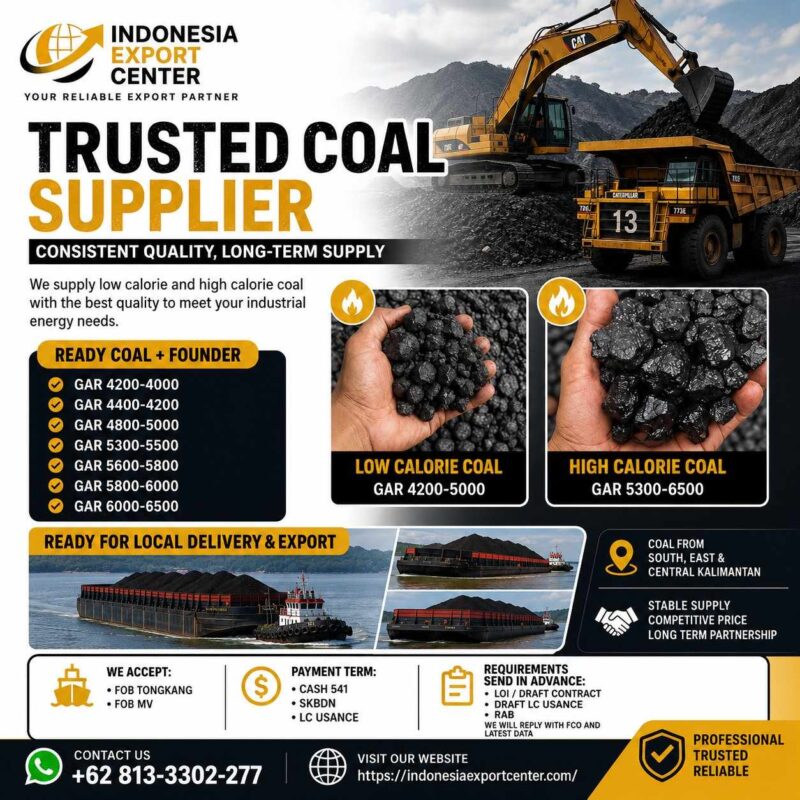
Indicative Indonesian Coal Categories
| Calorific Category | Buyer Evaluation |
|---|---|
| GAR 4,000–4,200 | Lower-energy fuel assessment |
| GAR 4,200–4,400 | Plant-specific suitability |
| GAR 4,800–5,000 | Intermediate fuel requirements |
| GAR 5,300–5,500 | Higher-energy fuel assessment |
| GAR 5,600–5,800 | Utility and industrial evaluation |
| GAR 5,800–6,000 | Higher-calorific-value inquiry |
| GAR 6,000–6,500 | High-energy coal inquiry |
These categories are indicative inquiry ranges only. They do not represent verified IEC inventory or guaranteed supplier offers.
Technical Parameters for Power Plants
| Parameter | Procurement Significance |
|---|---|
| Calorific Value | Energy content |
| Total Moisture | Fuel handling and energy performance |
| Ash | Residue generation |
| Total Sulfur | Emissions and corrosion considerations |
| Volatile Matter | Combustion characteristics |
| Fixed Carbon | Coal characterization |
| HGI | Pulverizer performance |
| Ash Fusion Temperatures | Slagging and fouling assessment |
| Chlorine | Corrosion and emissions considerations |
| Particle Size | Handling and combustion system compatibility |
Additional trace-element or environmental testing may be necessary.
Coal Suitability for Power Generation
A utility should assess whether the proposed coal is compatible with its boiler design, fuel preparation equipment, environmental controls, and operating procedures.
The purchasing specification should be reviewed by qualified plant engineers.
A higher calorific value does not automatically make a coal suitable for every boiler.
Supplier Quality Documentation
Buyers should request relevant coal analysis records and confirm:
- Sampling date.
- Sample origin.
- Laboratory identity.
- Analytical standards.
- Reporting basis.
- Actual results.
- Contractual tolerances.
- Relationship between the sample and offered cargo.
Historical analyses should not be presented as certificates for future shipments.
Bulk Shipment Planning
Power utilities may require large individual shipments or repeated deliveries.
A supplier’s ability to meet these requirements depends on actual mine output, inventory, logistics capacity, shipping arrangements, and export eligibility.
Long-term supply capability should be verified independently.
Contractual Quality Adjustments
Coal contracts may contain price adjustments or rejection conditions linked to calorific value, moisture, ash, sulfur, or other parameters.
The calculation methods should be clearly defined before contract execution.
Environmental and Regulatory Considerations
Coal combustion produces greenhouse gas emissions and may generate air pollutants and solid residues.
Buyers should evaluate applicable emissions limits, plant permits, pollution-control requirements, and their own energy-transition commitments.
Coal quality verification does not replace environmental compliance.
Bulk Thermal Coal RFQ
Subject: Indonesian Thermal Coal Procurement Inquiry
Dear IEC Team,
We are evaluating potential Indonesian thermal coal suppliers.
Company: [Name] Country: [Country] Application: [Power Generation / Industrial] Required GAR: [Value] Required NAR: [If Applicable] Total Moisture: [Maximum] Ash: [Maximum] Total Sulfur: [Maximum] HGI: [Range] Other Parameters: [Details] Quantity: [MT] Monthly Requirement: [MT] Destination Port: [Port] Preferred Incoterm: [Term] Payment Terms: [Proposal]
Please advise on supplier information, available analytical records, source verification, and the procedure for obtaining a seller-issued quotation.
Best regards,
[Name]
Frequently Asked Questions
Is GAR the same as NAR?
No.
Does IEC guarantee a particular coal grade?
No.
Can IEC coordinate bulk supplier inquiries?
Yes, subject to supplier capability and legal eligibility.
Are low-calorific-value coals suitable for all power plants?
No. Plant-specific technical assessment is necessary.
Can buyers request long-term supply?
They can submit requirements for verification.
Are coal prices fixed by GAR alone?
No. Other technical and commercial factors matter.
Request Thermal Coal Supplier Information
REQUEST THERMAL COAL QUOTATION INFORMATION
INDONESIA EXPORT CENTER
Website: https://indonesiaexportcenter.com/
WhatsApp: +62 813-3302-277
Related Resources
Bulk Coal Supply from Indonesia
Coal Procurement from Indonesia
