

INDONESIA EXPORT CENTER
Cosmetic Ingredient Research | Botanical Extract Sourcing | Safety Evaluation | International Procurement
Cinnamon Oleoresin for Cosmetic Formulation Research
Cosmetic ingredient developers may investigate cinnamon-derived botanical extracts for selected fragrance and personal care formulation applications.
However, cinnamon oleoresin for cosmetics requires particularly careful safety assessment because concentrated cinnamon-derived constituents can present skin sensitization and irritation concerns.
A food or flavor ingredient should not automatically be considered suitable for cosmetic use.
Indonesia Export Center (IEC) facilitates inquiries with potential Indonesian suppliers to investigate cinnamon oleoresin products and obtain relevant technical information.
IEC does not claim that a particular cinnamon oleoresin is cosmetic grade, dermatologically tested, or approved for cosmetic applications.
REQUEST CINNAMON OLEORESIN COSMETIC SOURCING INFORMATION
What Is Cinnamon Oleoresin?
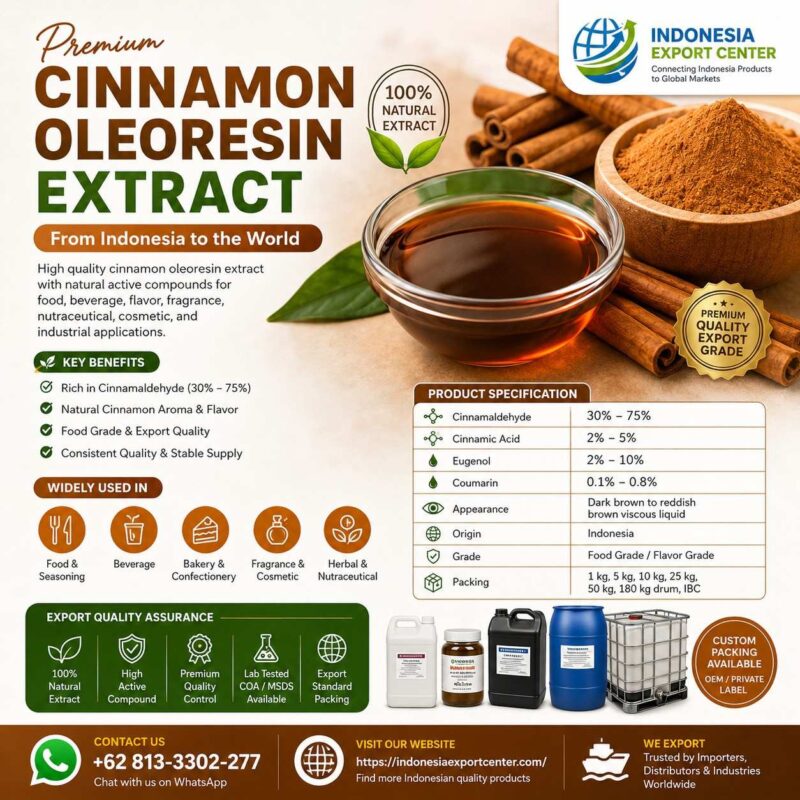
Cinnamon oleoresin is a concentrated botanical preparation obtained from cinnamon material through an extraction process.
Its chemical composition depends on the botanical species, plant part, extraction conditions, and finished formulation.
The extract may contain constituents relevant to fragrance development, but these constituents also require appropriate toxicological evaluation.
Cosmetic Ingredient Research Considerations
Cosmetic formulators should distinguish between an ingredient’s aromatic characteristics and its safety for application to human skin.
A pleasant or familiar botanical aroma does not establish cosmetic suitability.
The actual formulation, concentration, exposure conditions, and applicable regulations must be evaluated.
Potential Research Applications
Fragrance Formulation
Cinnamon-derived aromatic constituents may be investigated for selected fragrance compositions.
Personal Care Fragrance Systems
Potential applications require careful safety and compatibility assessment.
Botanical Ingredient Development
Researchers may investigate the chemical characteristics of cinnamon extracts.
Specialty Cosmetic R&D
Formulators may assess whether a particular extract is technically and legally appropriate for a defined product concept.
No skincare efficacy or therapeutic benefit is claimed.
Botanical Identity
Indonesian cinnamon sourcing may involve Cinnamomum burmannii.
However, the actual species and plant part must be verified.
Different species may have different constituent profiles and safety considerations.
Preliminary Technical Specifications
| Parameter | Preliminary Reference |
|---|---|
| Product | Cinnamon Oleoresin |
| Intended Application | Cosmetic/Fragrance Research |
| Botanical Species | To be confirmed |
| Proposed Origin | Indonesia |
| Appearance | Dark brown to reddish-brown viscous liquid |
| Cinnamaldehyde | 30–75%, unverified |
| Cinnamic Acid | 2–5%, unverified |
| Eugenol | 2–10%, unverified |
| Coumarin | 0.1–0.8%, unverified |
| Cosmetic Grade | Not established |
| Fragrance Compliance | Requires assessment |
| Skin Safety | Not established |
| Allergen Information | Supplier data required |
| Solubility | To be confirmed |
| Composition | Full declaration required where applicable |
The proposed chemical ranges are not verified results for a cosmetic ingredient.
Cinnamaldehyde and Sensitization Concerns
Cinnamaldehyde is associated with cinnamon aroma but is also relevant to skin sensitization and irritation risk.
The presence of a naturally occurring constituent does not mean it is harmless at all concentrations.
Cosmetic formulators should obtain appropriate toxicological and regulatory information before considering use.
Eugenol and Other Fragrance Constituents
Eugenol and other constituents may be relevant to fragrance allergen assessment and labeling requirements.
The actual chemical profile should be established through suitable analytical testing.
Coumarin Considerations
Coumarin content may be relevant to cosmetic safety assessment and fragrance-related restrictions.
Applicable requirements depend on the market, product type, and intended use.
Cosmetic Safety Evaluation
A qualified safety assessment should consider:
- Botanical identity.
- Full ingredient composition.
- Concentrations of relevant constituents.
- Skin sensitization potential.
- Irritation potential.
- Product exposure conditions.
- Intended application area.
- Relevant fragrance restrictions.
- Applicable labeling requirements.
- Finished product safety.
No safe usage percentage can be inferred from the preliminary product brief.
IFRA and Fragrance Compliance
Where relevant, fragrance developers should evaluate applicable International Fragrance Association standards and other regulatory requirements.
An IFRA certificate or compliance statement, where applicable, should relate to the actual fragrance material and intended use.
IEC has not verified any IFRA documentation for a specific cinnamon oleoresin product.
Cosmetic Ingredient Documentation
| Document | Purpose |
|---|---|
| Botanical Declaration | Verify species |
| TDS | Define product characteristics |
| Batch COA | Confirm analytical results |
| Composition Statement | Identify relevant constituents |
| Safety Data Sheet | Communicate hazard information |
| Allergen Information | Support safety and labeling review |
| Fragrance Compliance Documents | Assess applicable restrictions |
| Residual Solvent Report | Evaluate processing residues |
| Contaminant Testing | Support quality assessment |
| Stability Information | Assess storage characteristics |
Solubility and Formulation Compatibility
Cosmetic products may contain oils, water, surfactants, emulsifiers, and other ingredients.
Compatibility should be evaluated for the specific formulation.
A product that performs well in a fragrance concentrate may not be appropriate for direct use in a finished personal care product.
Product Stability
Cosmetic formulators should assess color, odor, physical stability, and relevant chemical changes under expected storage conditions.
Sample Qualification
Samples should be evaluated using appropriate laboratory and safety procedures.
The absence of an obvious immediate reaction is not proof of safety.
Supplier Verification
Buyers should verify the actual manufacturer, botanical species, extraction process, composition, quality documentation, and any claimed certifications.
Packaging, MOQ and Commercial Supply
Packaging, sample availability, MOQ, price, lead time, and production capacity require supplier confirmation.
No cosmetic-grade stock has been verified.
Frequently Asked Questions
Is cinnamon oleoresin safe for direct skin application?
Safety cannot be assumed. Concentrated cinnamon constituents may cause irritation or sensitization, and the actual product requires appropriate assessment.
Is food-grade cinnamon oleoresin automatically cosmetic grade?
No. Food and cosmetic suitability involve different requirements.
Can cinnamon oleoresin be used in fragrance research?
It may be investigated subject to relevant safety and regulatory evaluation.
Does IEC guarantee IFRA compliance?
No. Any compliance claim requires supporting documentation.
Can cosmetic developers request analytical information?
IEC can coordinate supplier documentation inquiries.
Can IEC provide cosmetic-grade samples?
Availability of an appropriate grade must be confirmed.
Request Cinnamon Oleoresin for Cosmetic Research
Indonesia Export Center welcomes inquiries from cosmetic ingredient developers, fragrance houses, formulation laboratories, and international sourcing teams.
Provide your intended product category, destination market, required composition, safety documentation, sample quantity, and expected commercial volume.
REQUEST BOTANICAL IDENTITY, COMPOSITION, SAFETY DOCUMENTS, SAMPLE AND RFQ
INDONESIA EXPORT CENTER
Connecting Indonesian Products to Global Markets
Website: https://indonesiaexportcenter.com/
WhatsApp: +62 813-3302-277
Related Pages
