

Food Safety and Quality Documentation for International Black Pepper Oleoresin Buyers
Indonesia Export Center facilitates Black Pepper Oleoresin sourcing inquiries from Indonesia for international importers, food ingredient manufacturers, regulatory specialists, quality assurance managers, and procurement companies.
For international food ingredient procurement, product quality documentation is an essential part of supplier evaluation.
Buyers need sufficient technical and safety information to assess product characteristics, manufacturing controls, batch quality, traceability, and regulatory suitability.
We help coordinate documentation requests with potential Indonesian suppliers based on buyer requirements and product availability.
Why Food Safety Documentation Matters
Black Pepper Oleoresin is a concentrated extract derived from black pepper (Piper nigrum L.).
It may be used in seasoning blends, sauces, marinades, processed foods, and other suitable food ingredient formulations.
Before using the product in a commercial food application, buyers should assess:
- Product identity and composition.
- Manufacturing process.
- Raw material traceability.
- Residual solvent levels.
- Microbiological quality.
- Chemical contaminants.
- Packaging and storage conditions.
- Applicable food regulations.
Complete and accurate documentation helps technical and regulatory teams evaluate these factors.
Essential Documents for Black Pepper Oleoresin
1. Certificate of Analysis (COA)
A COA provides actual analytical test results for a particular production batch.
It may include:
- Piperine content.
- Volatile oil content.
- Residual solvent.
- Appearance.
- Relevant physical parameters.
- Microbiological test results, where applicable.
- Other customer-specific testing parameters.
The COA should include batch identification, analytical methods, test results, and relevant acceptance criteria.
2. Technical Data Sheet (TDS)
A TDS describes the general characteristics and technical specifications of Black Pepper Oleoresin.
It may contain:
- Product name.
- Botanical source.
- Product description.
- Appearance.
- Aroma and taste.
- Piperine concentration.
- Volatile oil content.
- Physical characteristics.
- Storage conditions.
- Shelf life.
- Packaging information.
3. Safety Data Sheet (SDS)
An SDS communicates information about product hazards and safe handling procedures.
Depending on product classification, it generally contains information regarding:
- Product identification.
- Hazard identification.
- Composition and ingredients.
- First-aid measures.
- Firefighting measures.
- Accidental release measures.
- Handling and storage.
- Exposure controls and personal protection.
- Physical and chemical properties.
- Stability and reactivity.
- Toxicological information.
- Ecological information.
- Disposal considerations.
- Transport information.
- Regulatory information.
The SDS should reflect the actual product formulation and applicable classification requirements.
4. Allergen Declaration
An allergen declaration may be requested by food manufacturers to evaluate potential allergen-related risks.
Buyers should request supplier confirmation regarding ingredients, processing aids, and potential cross-contact risks.
5. Microbiological Analysis
For relevant food applications, buyers may request microbiological testing based on product characteristics and applicable requirements.
Testing parameters may include:
- Total plate count.
- Yeasts and molds.
- Escherichia coli.
- Salmonella.
- Other relevant microorganisms.
The required tests and acceptance limits should be established according to the intended use and applicable regulations.
6. Heavy Metal and Contaminant Analysis
Depending on buyer specifications and market requirements, testing may cover:
- Lead.
- Arsenic.
- Cadmium.
- Mercury.
- Pesticide residues.
- Other relevant contaminants.
7. Origin and Traceability Documents
Buyers may request supporting information regarding:
- Botanical identity.
- Raw material origin.
- Manufacturing location.
- Batch number.
- Production date.
- Supplier identification.
- Applicable origin documentation.
Indicative Black Pepper Oleoresin Product Specifications
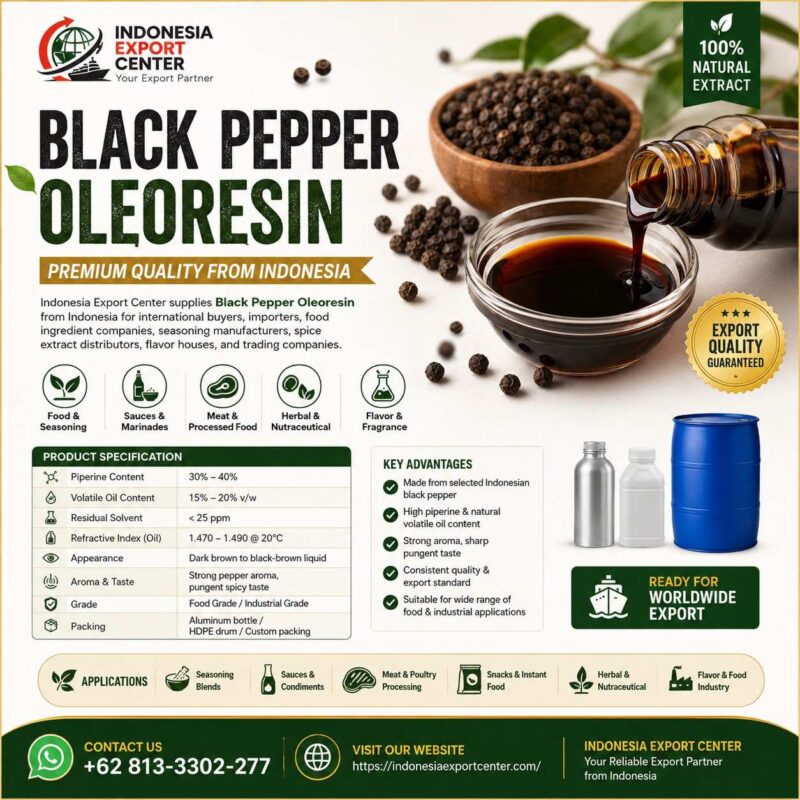
| Parameter | Indicative Specification |
|---|---|
| Product | Black Pepper Oleoresin |
| Botanical Name | Piper nigrum L. |
| Piperine Content | 30%–40% |
| Volatile Oil Content | 15%–20% v/w |
| Residual Solvent | Target below 25 ppm |
| Refractive Index (Oil) | 1.470–1.490 at 20°C |
| Appearance | Dark brown to black-brown liquid |
| Aroma | Strong black pepper aroma |
| Taste | Pungent and spicy |
| Grade | Food Grade / Industrial Grade |
These parameters are indicative and must be supported by actual supplier-issued documentation.
Traceability and Supplier Quality Management
Traceability helps buyers connect the finished product with its manufacturing and raw material records.
For commercial procurement, we recommend requesting:
- Batch identification.
- Raw material origin information.
- Production records, where available.
- Quality inspection procedures.
- Testing records.
- Product release information.
- Relevant supplier quality management documentation.
For recurring orders, buyers may also establish incoming inspection requirements and batch approval procedures.
Food Safety Requirements for Different Markets
Food ingredient requirements differ by destination country.
United States
Importers should assess relevant FDA food safety, facility registration, preventive control, and import requirements applicable to their business and product.
European Union
Importers should evaluate applicable food safety, contaminant, pesticide residue, food hygiene, and extraction solvent requirements.
Japan
Buyers should assess applicable food sanitation standards, import procedures, ingredient suitability, and required supporting documentation.
A supplier’s possession of a certificate or food safety management document does not automatically guarantee that a product meets every destination-market requirement.
Supplier Document Verification Checklist
Before approving a Black Pepper Oleoresin supplier, buyers should:
- Confirm the manufacturer’s identity.
- Check the document issuer.
- Verify the product name and grade.
- Match the COA with the actual batch.
- Review the testing methods.
- Confirm document validity and issue dates.
- Review applicable certifications.
- Evaluate traceability information.
- Confirm regulatory suitability for the destination market.
- Clarify missing or inconsistent information.
Documentation Requests Through Indonesia Export Center
Indonesia Export Center helps coordinate requests for available product and food safety documentation from potential Indonesian suppliers.
Document availability depends on the manufacturer, product grade, and purchasing requirements.
Our coordination may cover COA, TDS, SDS, allergen declarations, analytical reports, traceability information, and relevant quality documentation.
Request Black Pepper Oleoresin Food Safety Documents
Are you a food manufacturer, importer, or compliance manager looking for technical and safety documentation for Black Pepper Oleoresin?
Send us your document checklist, product specifications, intended application, and destination country.
INDONESIA EXPORT CENTER
Your Export Partner from Indonesia
WhatsApp: +62 813-3302-277
Website: https://indonesiaexportcenter.com/
Contact us for supplier documentation requests, technical information, and Black Pepper Oleoresin sourcing assistance.
