

IEC | INDONESIA EXPORT CENTER
Botanical Extract Quality Assurance | Analytical Testing | Batch COA | Supplier Qualification
Quality Testing Requirements for Alpinia purpurata Extract
Quality testing is an essential part of botanical ingredient procurement, particularly when an extract is intended for research, formulation development, or industrial supply.
For buyers evaluating Alpinia purpurata extract quality testing, the goal is to establish whether the material meets an agreed specification and whether the supplier can demonstrate consistent manufacturing quality.
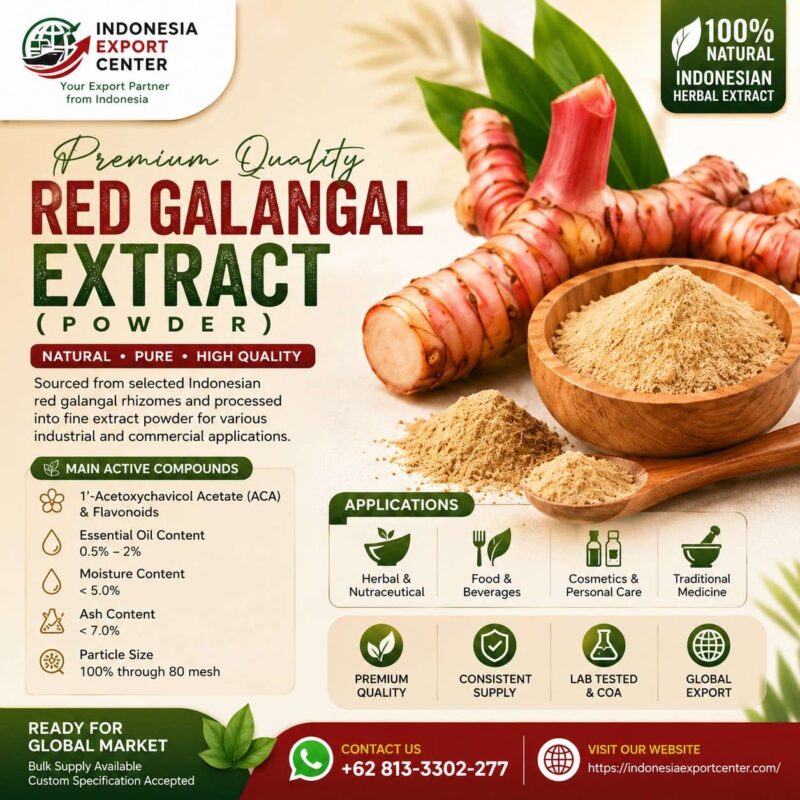
The proposed product is a powdered botanical extract associated with Alpinia purpurata. The botanical identity, plant part, extraction method, and actual commercial grade must be verified.
Indonesia Export Center (IEC) facilitates sourcing and documentation inquiries with potential Indonesian suppliers.
IEC does not claim that a specific batch has passed laboratory testing or that a certified quality management system has been verified.
REQUEST ALPINIA PURPURATA QUALITY DOCUMENTATION
Why Quality Testing Matters
Botanical materials can vary because of differences in species, plant part, growing conditions, processing, and storage.
Extraction introduces additional variables, including solvent selection, process conditions, concentration, drying, and formulation.
A quality testing program should address both the identity of the raw material and the characteristics of the finished extract.
Preliminary Quality Specification
| Parameter | Proposed Requirement | Verification |
|---|---|---|
| Species | Alpinia purpurata | Authentication required |
| Plant Part | Rhizome proposed | Source verification |
| Product Form | Extract powder | Supplier confirmation |
| Moisture | Below 5% | Batch test |
| Ash | Below 7% | Batch test |
| Particle Size | 100% through 80 mesh | Sieve test |
| Essential Oil | 0.5–2% | Method and result required |
| ACA and Flavonoids | Mentioned | Analytical relevance unverified |
| Extract Ratio | Not established | Supplier declaration |
| Residual Solvents | Not established | Risk-based testing |
| Microbiology | Not established | Application-specific testing |
| Heavy Metals | Not established | Relevant analysis |
| Pesticide Residues | Not established | Risk-based analysis |
| Shelf Life | Not established | Stability evidence |
The proposed values are not verified batch results.
1. Botanical Authentication
The first stage is confirming the scientific species.
Alpinia purpurata can be referenced through Plants of the World Online.
The supplier should demonstrate that the actual material corresponds to the declared species.
Authentication may involve suitable botanical, microscopic, chemical, or molecular methods, depending on the material and available evidence.
2. Plant-Part Verification
The source brief proposes rhizome-derived extract.
The supplier should confirm whether rhizomes are actually used.
Plant-part identity matters because different tissues may have different chemical compositions.
3. Physical Testing
Physical testing may include appearance, color, odor, moisture, ash, particle size, and bulk density.
The appropriate tests depend on the product’s physical form and intended application.
A proposed 80-mesh specification should identify the relevant sieve method.
4. Chemical Characterization
Chemical testing may involve chromatographic fingerprinting, marker identification, and quantitative assays.
The source brief mentions ACA and flavonoids, but their suitability as markers for the proposed extract has not been established.
No standardization claim should be made without supporting analytical evidence.
5. Microbiological Testing
Microbiological quality is particularly important for botanical ingredients used in sensitive applications.
The relevant tests and limits depend on the intended product category and destination market.
A supplier should provide actual results rather than relying on general statements such as “microbiologically safe.”
6. Heavy Metals and Pesticide Residues
Botanical raw materials may require testing for relevant environmental contaminants.
Testing programs should consider source risk, intended use, and applicable regulatory limits.
No specific contaminant results have been provided.
7. Residual Solvent Testing
If solvents are used during extraction, relevant residual solvent testing may be required.
The test should identify the solvent, method, reporting units, and result.
The absence of extraction method information prevents a meaningful assessment of residual solvent risk.
8. Stability Testing
Stability studies may evaluate changes in moisture, appearance, chemical profile, microbiological quality, and other relevant parameters over time.
Storage conditions and packaging should be considered.
No validated shelf life has been supplied.
9. Batch-to-Batch Consistency
A commercial supplier should establish suitable acceptance criteria and quality controls.
Buyers may compare results from multiple batches to assess variability.
A single passing sample does not guarantee future consistency.
10. Laboratory Methods and Reporting
Quality documents should identify the relevant analytical methods and results.
Where necessary, buyers should assess whether methods are suitable for the product and whether the laboratory has appropriate competence.
An accreditation claim should be verified rather than assumed.
Recommended Quality Documentation
| Document | Purpose |
|---|---|
| TDS | Defines product specification |
| Batch COA | Reports batch results |
| Botanical Identity Record | Supports species authentication |
| Plant-Part Declaration | Supports source identification |
| Composition Statement | Identifies ingredients and carriers |
| Extraction Method | Describes processing |
| Analytical Method Summary | Explains testing |
| Microbiology Report | Reports microbial quality |
| Contaminant Reports | Supports risk assessment |
| Stability Information | Supports storage conditions |
| Traceability Records | Links raw material and batch |
Supplier Qualification Workflow
A practical qualification process begins with the buyer’s intended application and required specification.
The supplier is then asked to provide botanical identity evidence, technical documents, representative samples, and quality results.
The buyer evaluates conformity, performs additional testing where necessary, and establishes commercial acceptance criteria before ordering.
IEC can coordinate inquiries throughout this process.
Frequently Asked Questions
Is Alpinia purpurata extract laboratory tested?
No verified batch-specific laboratory report has been provided.
Is the moisture limit below 5% confirmed?
No. It is a proposed requirement.
Can buyers request third-party testing?
Requirements may be discussed with the potential supplier.
Is the extract standardized for ACA?
No validated ACA specification has been established.
Can IEC request a batch COA?
Yes, subject to supplier availability.
Does a COA establish regulatory approval?
No. Regulatory suitability must be assessed separately.
Request Quality Testing Information
IEC welcomes inquiries from quality assurance managers, botanical ingredient importers, research laboratories, and industrial manufacturers.
Please provide your intended application, required test parameters, quantity, and destination.
REQUEST TDS, BATCH COA, TEST REPORTS, SAMPLE & RFQ
INDONESIA EXPORT CENTER
Website: https://indonesiaexportcenter.com/
WhatsApp: +62 813-3302-277
Related pages:
- Red Galangal Extract COA Requirements
- Alpinia Purpurata Extract Specification
- Red Galangal Extract Phytochemical Profile
SEO METADATA
SEO Title: Alpinia Purpurata Extract Quality Testing | IEC
Meta Description: Explore Alpinia purpurata extract quality testing, including botanical authentication, moisture, ash, chemical analysis, microbiology, contaminants, and batch COA.
Focus Keyword: alpinia purpurata extract quality testing
URL Slug: alpinia-purpurata-extract-quality-testing
Canonical URL: https://indonesiaexportcenter.com/alpinia-purpurata-extract-quality-testing/
Search Intent: Commercial / Technical
