

A Practical Guide for International Importers
Importing Black Pepper Oleoresin from Indonesia requires more than finding a supplier and requesting a price.
International buyers should evaluate product specifications, supplier capability, quality documentation, regulatory requirements, packaging, shipping arrangements, and commercial terms before confirming an order.
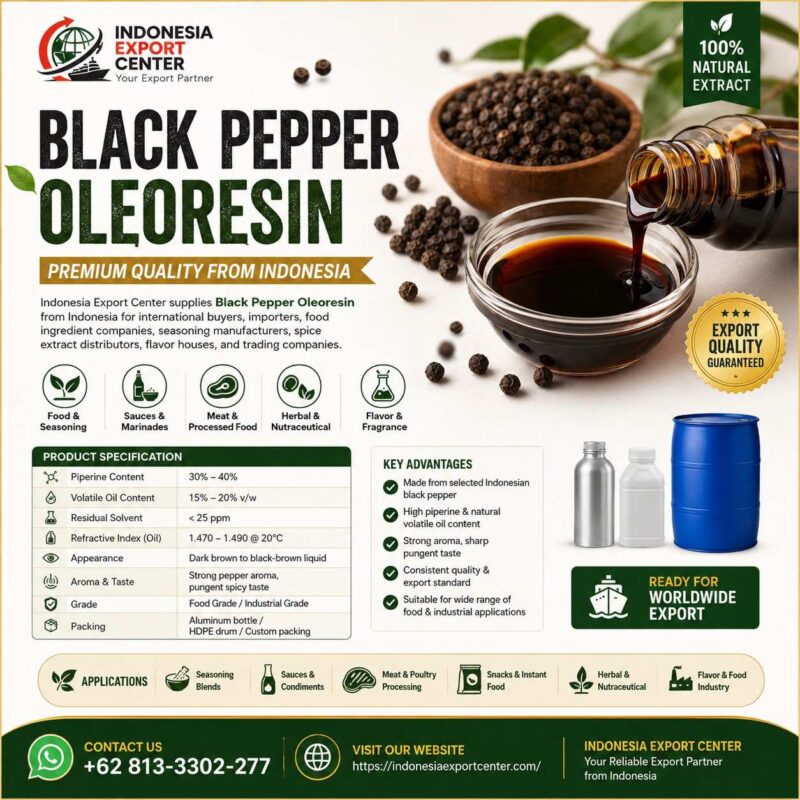
Black Pepper Oleoresin is a concentrated extract derived from black pepper (Piper nigrum). It may contain piperine and volatile aromatic components, making it relevant to seasoning manufacturers, food processors, flavor houses, and food ingredient distributors.
Indonesia Export Center facilitates sourcing inquiries for international buyers interested in Indonesian Black Pepper Oleoresin.
This guide explains the typical import process, from the first supplier inquiry to shipment coordination.
Step 1: Define Your Product Requirements
Before contacting suppliers, determine exactly what type of Black Pepper Oleoresin you need.
Your product specification should include:
- Product name.
- Intended application.
- Required piperine content.
- Required volatile oil content.
- Product grade.
- Appearance and sensory expectations.
- Residual solvent requirements.
- Packaging preference.
- Required quantity.
- Destination country.
A detailed specification helps suppliers assess whether they can provide a product that matches your requirements.
Example of an Initial Specification
| Parameter | Indicative Requirement |
|---|---|
| Product | Black Pepper Oleoresin |
| Piperine Content | 30%–40%, subject to confirmation |
| Volatile Oil Content | 15%–20% v/w, subject to confirmation |
| Residual Solvent | Target below 25 ppm, subject to verification |
| Appearance | Dark brown to black-brown liquid |
| Aroma and Taste | Strong pepper aroma, pungent spicy taste |
| Grade | Food grade, if required for food use |
| Packaging | Aluminum bottle or HDPE drum, subject to availability |
These values are preliminary reference figures and should be adjusted to your actual technical requirements.
Step 2: Identify and Screen Potential Indonesian Suppliers
Supplier screening is one of the most important stages of importing.
Do not rely only on a website, product brochure, or attractive quotation.
Ask potential suppliers for:
- Legal company name.
- Registered business address.
- Company registration details.
- Manufacturing or trading status.
- Product source and origin.
- Manufacturing or extraction information.
- Production capability, where applicable.
- Product specification.
- COA and TDS.
- Available certificates.
- References or verifiable transaction history, where available.
If the company is a trader or intermediary, ask it to clarify the actual manufacturer or production source.
A sourcing intermediary should not be presented as the manufacturer unless it actually operates the manufacturing facility.
Step 3: Request the Technical Documents
Before approving a product, request the relevant technical documents.
Certificate of Analysis (COA)
A COA provides analytical results for a specific batch or product sample.
Check:
- Product name.
- Batch or lot number.
- Test date.
- Analytical parameters.
- Test results.
- Units of measurement.
- Testing methods.
- Issuing laboratory or responsible party.
Technical Data Sheet (TDS)
A TDS provides technical information about the product, such as:
- Product description.
- Composition or key characteristics.
- Physical properties.
- Application information.
- Packaging.
- Storage instructions.
- Shelf-life information, where established.
Safety Data Sheet (SDS)
An SDS provides safety, handling, storage, and hazard information where applicable.
Additional Documents
Depending on the destination market and intended application, buyers may request:
- Ingredient declaration.
- Manufacturing process information.
- Residual solvent test results.
- Microbiological test results.
- Contaminant analysis.
- Country-of-origin documents.
- Traceability records.
- Relevant food safety certificates.
Not all documents are automatically available. Their existence and validity must be confirmed with the supplier.
Step 4: Evaluate Samples Before Ordering
If samples are available, request them before committing to a large purchase.
A sample evaluation may include:
- Visual inspection.
- Aroma assessment.
- Pungency assessment.
- Laboratory testing.
- Piperine content verification.
- Volatile oil analysis.
- Residual solvent testing, where relevant.
- Formulation compatibility.
- Stability evaluation.
For food applications, test the material in the actual formulation and under the intended processing conditions.
A sample that looks acceptable may still require laboratory verification before commercial approval.
Step 5: Confirm Regulatory Requirements in Your Country
Import requirements vary according to destination country, product composition, intended use, and tariff classification.
Before placing an order, confirm:
- Whether the ingredient is permitted for the intended application.
- Whether it is classified as a food ingredient, food additive, or another product category.
- Whether import permits or notifications are required.
- Whether specific testing or certificates are necessary.
- Whether labeling or language requirements apply.
- Whether the importer must meet registration or licensing requirements.
For food-related imports, consult the relevant food safety authority and a qualified customs broker in the destination market.
Do not assume that a product’s Indonesian origin or natural status automatically makes it compliant in every country.
Step 6: Confirm Packaging and Storage Requirements
Potential packaging formats for Black Pepper Oleoresin may include:
- Aluminum bottles.
- HDPE drums.
- Custom packaging, subject to supplier capability.
Before confirming packaging, ask about:
- Container material.
- Net weight per container.
- Compatibility with the product.
- Sealing method.
- Label information.
- Storage conditions.
- Shelf life.
- Shipment handling requirements.
The actual packaging should be approved by the buyer based on the supplier’s technical documentation.
Step 7: Agree on Commercial Terms and Incoterms
Before confirming the order, clarify the commercial arrangement.
Important terms include:
- Unit price.
- Order quantity.
- Minimum order quantity.
- Total order value.
- Currency.
- Payment terms.
- Production or preparation lead time.
- Packaging cost.
- Freight cost.
- Insurance.
- Delivery destination.
- Incoterms and named place or port.
Common Incoterms used in international trade include EXW, FCA, FOB, CFR, CIF, CPT, CIP, DAP, and DDP.
The appropriate term depends on the shipment method and the responsibilities agreed by the parties.
The quotation should clearly state which costs are included and which costs are excluded.
Step 8: Arrange Shipping from Indonesia
After the commercial agreement is confirmed, the parties can coordinate shipping.
Depending on the order size, urgency, product handling requirements, and destination, transportation may involve:
- Sea freight.
- Air freight.
- Other suitable logistics arrangements.
The shipment plan should identify:
- Exporter.
- Importer.
- Shipping origin.
- Destination port or airport.
- Product quantity.
- Packaging configuration.
- Freight arrangement.
- Insurance arrangement, where applicable.
- Required shipping documents.
Transit time and freight cost must be quoted by the logistics provider based on the actual shipment.
Step 9: Prepare Import and Export Documents
Common international trade documents may include:
- Commercial Invoice.
- Packing List.
- Bill of Lading or Air Waybill.
- Certificate of Origin, where applicable.
- Certificate of Analysis.
- Technical Data Sheet.
- Safety Data Sheet.
- Export or import permits, where required.
- Other product-specific certificates or declarations.
The exact documents depend on the product, destination, shipment arrangement, and applicable regulations.
Step 10: Inspect and Approve the Shipment
Before dispatch, buyers may request:
- Final product specification confirmation.
- Batch-specific COA.
- Packaging photographs.
- Container quantity and net weight.
- Label verification.
- Shipment details.
- Document review.
For larger or higher-risk orders, independent inspection or testing may be considered.
The buyer should confirm that the supplied product matches the agreed purchase specification.
Common Mistakes to Avoid When Importing
1. Buying based only on the product name
Different suppliers may offer products with different compositions and extraction methods.
2. Ignoring the COA
A product brochure is not a replacement for batch-specific analytical results.
3. Assuming food-grade status
Food-grade suitability must be confirmed through relevant supplier documentation and regulatory review.
4. Not checking the actual manufacturer
Clarify whether you are dealing directly with a manufacturer, exporter, trader, or sourcing intermediary.
5. Ignoring import regulations
A product that can be exported from Indonesia may still require additional approval or documentation in the destination market.
6. Confirming Incoterms without understanding responsibilities
Make sure both parties understand who arranges freight, insurance, customs procedures, and delivery.
How Indonesia Export Center Can Assist
Indonesia Export Center helps international buyers explore sourcing opportunities for Black Pepper Oleoresin from Indonesia.
Our role as a sourcing intermediary may include:
- Receiving product inquiries.
- Coordinating communication with potential suppliers.
- Requesting technical specifications.
- Following up on available COA and TDS documents.
- Discussing sample availability.
- Facilitating commercial quotations.
- Coordinating packaging discussions.
- Supporting initial export sourcing communication.
Supplier identity, product availability, technical claims, and commercial terms must be verified before any order is finalized.
Frequently Asked Questions
1. Can I import Black Pepper Oleoresin directly from Indonesia?
You can explore sourcing through potential Indonesian suppliers. The actual import arrangement depends on supplier availability, destination regulations, and agreed commercial terms.
2. What is the minimum order quantity?
MOQ varies by supplier, packaging, product grade, and order requirements. It must be confirmed during the quotation process.
3. Can I request a sample before placing an order?
Sample availability and shipping arrangements can be discussed with the selected supplier.
4. What documents should I request first?
Start with the COA, TDS, SDS, ingredient declaration, and available origin and traceability information.
5. How long does shipping take?
Transit time depends on destination, shipment method, carrier, and logistics conditions. Request a shipment estimate based on your destination.
6. Can Indonesia Export Center provide a quotation?
We can facilitate quotation requests based on your product requirements and potential supplier availability.
7. Does Indonesia Export Center manufacture Black Pepper Oleoresin?
Indonesia Export Center acts as a sourcing intermediary and coordinates inquiries with potential suppliers.
Start Your Black Pepper Oleoresin Import Inquiry
Are you a first-time importer, food ingredient distributor, seasoning manufacturer, or international buyer looking for Indonesian Black Pepper Oleoresin?
Indonesia Export Center welcomes your inquiry.
INDONESIA EXPORT CENTER
Your Reliable Export Partner from Indonesia
WhatsApp: +62 813-3302-277
Website: https://indonesiaexportcenter.com/
Request an Import Quotation
Please provide:
- Product specification.
- Required quantity.
- Target piperine content.
- Intended application.
- Destination country and port.
- Preferred packaging.
- Required documents.
- Preferred Incoterms.
Contact us to begin your sourcing process.
