

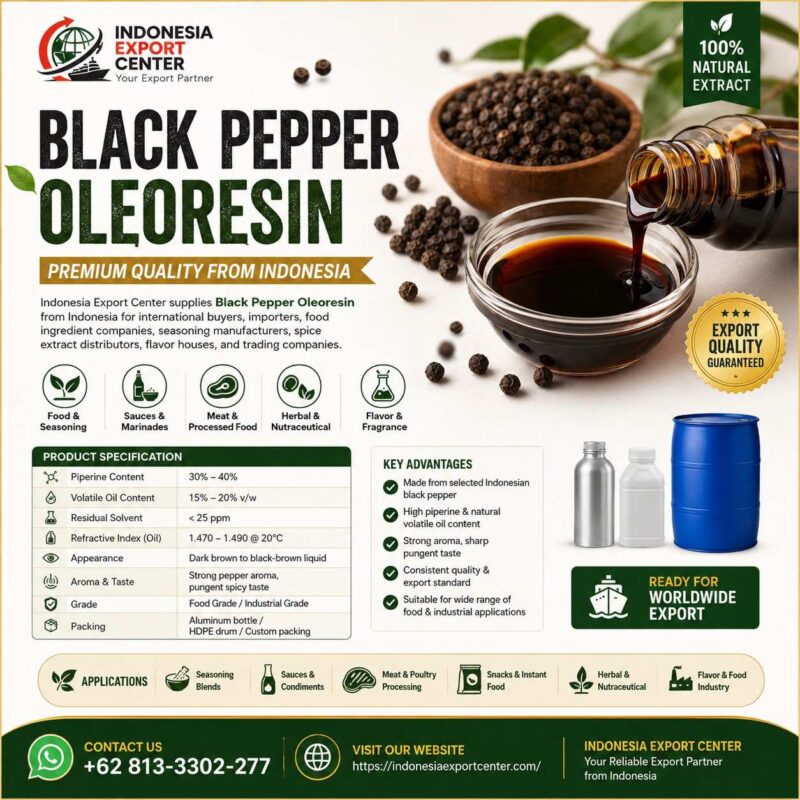
Why Supplier Verification Matters
Selecting a Black Pepper Oleoresin supplier is an important decision for food manufacturers, importers, distributors, and ingredient procurement teams.
A competitive price or professional website does not automatically prove that a supplier has the product, manufacturing capability, or documentation required by your business.
Supplier verification helps buyers reduce risks involving:
- Incorrect product specifications.
- Unverified manufacturing sources.
- Inconsistent documentation.
- Misrepresented product grades.
- Unclear product origin.
- Unavailable stock.
- Unreliable delivery arrangements.
- Incomplete commercial information.
Indonesia Export Center facilitates sourcing inquiries for buyers interested in Indonesian Black Pepper Oleoresin. This guide explains how international buyers can evaluate a potential supplier before making a purchase.
1. Verify the Company’s Legal Identity
Start by confirming the identity of the company offering the product.
Request:
- Full registered company name.
- Business registration details.
- Registered address.
- Company contact information.
- Authorized representative details.
- Official website and business email.
- Tax or business identification details, where relevant.
Check whether the company information is consistent across its website, quotation, invoice, and business documents.
If a company operates as a trader or intermediary, clarify its role and identify the actual manufacturer where possible.
2. Confirm Whether the Company Is a Manufacturer or Trader
Not every company selling Black Pepper Oleoresin manufactures the product.
A seller may operate as:
- Manufacturer.
- Processor.
- Exporter.
- Distributor.
- Trader.
- Sourcing intermediary.
Each role has different responsibilities and capabilities.
Ask:
- Who manufactures the product?
- Where is the production facility?
- Does the company own or operate the facility?
- Can the actual manufacturer be identified?
- Who issues the COA?
- Who is responsible for product quality?
- Who handles export documentation?
Clear answers help establish the supply chain.
3. Request Product Technical Specifications
A reliable supplier should be able to explain the product being offered.
Request a technical specification containing:
- Product identity.
- Botanical source.
- Extraction method, where available.
- Piperine content.
- Volatile oil content.
- Appearance.
- Aroma and taste.
- Residual solvent information.
- Product grade.
- Packaging.
- Storage requirements.
- Shelf-life information, where established.
Do not rely only on a general product description.
Make sure the offered product matches your intended application and purchase specification.
4. Verify the Certificate of Analysis
The COA is one of the most important documents in ingredient purchasing.
A buyer should check:
Product identity: Does the COA clearly identify the material as Black Pepper Oleoresin?
Batch number: Is the batch or lot number stated?
Test date: Is the test date identifiable and relevant?
Parameters: Are the required analytical parameters included?
Results: Are numerical results and units provided?
Methods: Are the analytical methods identified?
Laboratory: Is the testing laboratory or responsible testing party identified?
Authorization: Is the document issued or approved by an identifiable responsible party?
A COA should correspond to the actual batch being supplied. A generic specification sheet should not be treated as a batch-specific COA.
Where appropriate, buyers may request independent testing.
5. Check Piperine and Volatile Oil Results
For Black Pepper Oleoresin, piperine and volatile oil content may be important product specifications.
Request the actual test results and confirm:
- Reported percentage.
- Measurement basis.
- Analytical method.
- Batch identification.
- Testing laboratory.
- Acceptance criteria.
Do not assume that two products with the same advertised piperine content will have identical sensory characteristics or formulation performance.
6. Review Residual Solvent Information
Depending on the extraction method, residual solvent information may be relevant.
Ask the supplier:
- Which extraction solvent is used?
- What residual solvent specification applies?
- Is a test result available?
- Which analytical method is used?
- Does the result relate to the actual batch?
- Does it meet the requirements of the intended destination and application?
A statement such as “low residual solvent” is not a substitute for an analytical result.
7. Verify Product Grade and Intended Use
Confirm whether the offered material is intended for:
- Food applications.
- Industrial applications.
- Fragrance or other specialty applications.
- Research or technical use.
Do not assume that all Black Pepper Oleoresin is food grade.
For food manufacturing, request documentation supporting the intended food use and assess regulatory suitability in the destination market.
8. Evaluate Traceability and Country of Origin
If the product is marketed as Indonesian Black Pepper Oleoresin, ask for supporting origin information.
Relevant questions include:
- Where was the raw black pepper sourced?
- Where was the oleoresin manufactured?
- Where was the product packed?
- Can the batch be traced to a production record?
- Is country-of-origin documentation available?
- Can the supplier identify the production facility?
Raw material origin and manufacturing origin are not necessarily identical. Buyers should distinguish between them.
9. Verify Manufacturing Capability
If the supplier claims to be a manufacturer, request information about its production facility.
Possible verification steps include:
- Facility photographs or video.
- Production process information.
- Equipment information.
- Production capacity statements supported by records.
- Quality control procedures.
- Batch management practices.
- Storage facilities.
- Factory audit or third-party inspection, where appropriate.
For significant purchases, an independent audit or inspection may be worthwhile.
10. Request Samples and Conduct Independent Testing
Before committing to a large order, consider requesting a sample.
Evaluate:
- Appearance.
- Aroma.
- Pungency.
- Physical characteristics.
- Piperine content.
- Volatile oil content.
- Residual solvents, where relevant.
- Formulation compatibility.
- Stability under intended storage conditions.
Compare the sample against the supplier’s stated specification.
For critical applications, arrange testing through an independent laboratory.
11. Check Packaging and Storage Information
Ask for details about:
- Packaging material.
- Container capacity.
- Net weight.
- Sealing system.
- Storage temperature or conditions.
- Protection from light, heat, and moisture, where relevant.
- Shelf-life basis.
- Labeling information.
- Batch identification.
The supplier should provide product-specific storage instructions rather than relying on generic assumptions.
12. Review Commercial and Export Capability
Before making a payment, review the commercial offer.
Confirm:
- Legal seller and beneficiary identity.
- Product name and grade.
- Quantity.
- Unit price and currency.
- Total order value.
- Packaging.
- Payment terms.
- Delivery schedule.
- Incoterms and named place.
- Freight and insurance responsibilities.
- Export documents.
- Claims and dispute procedures.
Where possible, ensure the payment beneficiary matches the contracting entity or has a documented and legitimate explanation.
Supplier Verification Checklist
| Verification Area | What Buyers Should Confirm |
|---|---|
| Legal identity | Registered company details |
| Business role | Manufacturer, exporter, trader, or intermediary |
| Product identity | Confirmed Black Pepper Oleoresin |
| Specifications | TDS and agreed technical parameters |
| COA | Batch-specific analytical results |
| Piperine | Actual content and test method |
| Volatile oil | Actual result and measurement basis |
| Residual solvents | Relevant test results |
| Product grade | Food or industrial suitability |
| Origin | Raw material and manufacturing origin |
| Traceability | Batch and production records |
| Facility | Manufacturing evidence, where applicable |
| Samples | Availability and test results |
| Packaging | Material, net weight, and storage |
| Commercial terms | Quotation, payment, and Incoterms |
| Export capability | Relevant documents and shipping arrangements |
Red Flags When Evaluating a Supplier
Be cautious if a potential supplier:
- Refuses to identify the actual seller or manufacturer.
- Cannot provide a clear product specification.
- Uses a generic COA without batch identification.
- Provides inconsistent company information.
- Makes unsupported certification claims.
- Cannot explain the extraction method.
- Offers specifications that change between documents.
- Avoids sample requests without a reasonable explanation.
- Demands payment to an unrelated account without documentation.
- Pressures buyers to make immediate payment.
- Cannot explain packaging and shipping arrangements.
A single issue does not automatically prove fraud, but unresolved inconsistencies should be investigated before proceeding.
How Indonesia Export Center Approaches Supplier Inquiries
Indonesia Export Center acts as a sourcing intermediary for international buyers interested in Indonesian Black Pepper Oleoresin.
Our role may include:
- Receiving technical and commercial requirements.
- Coordinating inquiries with potential suppliers.
- Requesting available TDS and COA documents.
- Discussing sample availability.
- Facilitating supplier communication.
- Coordinating quotation requests.
- Discussing packaging and export arrangements.
Supplier identity, manufacturing capability, and product specifications must be independently confirmed before a transaction is finalized.
Frequently Asked Questions
1. How can I know whether a Black Pepper Oleoresin supplier is genuine?
Verify the company’s legal identity, business role, manufacturing source, technical documents, and commercial details.
2. Is a COA enough to verify a supplier?
No. A COA helps verify analytical information for a product or batch, but company identity, traceability, production capability, and commercial reliability also require evaluation.
3. Should I request a sample?
Yes, when possible. A sample can help you evaluate sensory properties, formulation compatibility, and laboratory results.
4. How do I verify piperine content?
Review the batch-specific COA and, when necessary, arrange independent laboratory testing.
5. Should I visit the factory?
A factory visit or independent audit may be useful for significant purchases, especially when manufacturing capability and traceability are important.
6. What if the supplier is a trader?
A trader can be a legitimate supplier. However, buyers should understand its role and request information about the actual manufacturing source.
7. Can Indonesia Export Center verify all supplier claims automatically?
No. Verification depends on available evidence, documents, and any independent checks arranged by the buyer or relevant parties.
Request Indonesian Black Pepper Oleoresin Sourcing Assistance
Looking for a potential Indonesian source of Black Pepper Oleoresin?
Indonesia Export Center facilitates inquiries and communication for international buyers seeking product specifications, supplier information, samples, and quotations.
INDONESIA EXPORT CENTER
Your Reliable Export Partner from Indonesia
WhatsApp: +62 813-3302-277
Website: https://indonesiaexportcenter.com/
Send Your Supplier Inquiry
Please provide your target specification, required quantity, intended application, destination, and documentation requirements.
We welcome inquiries from international procurement and quality teams.
