

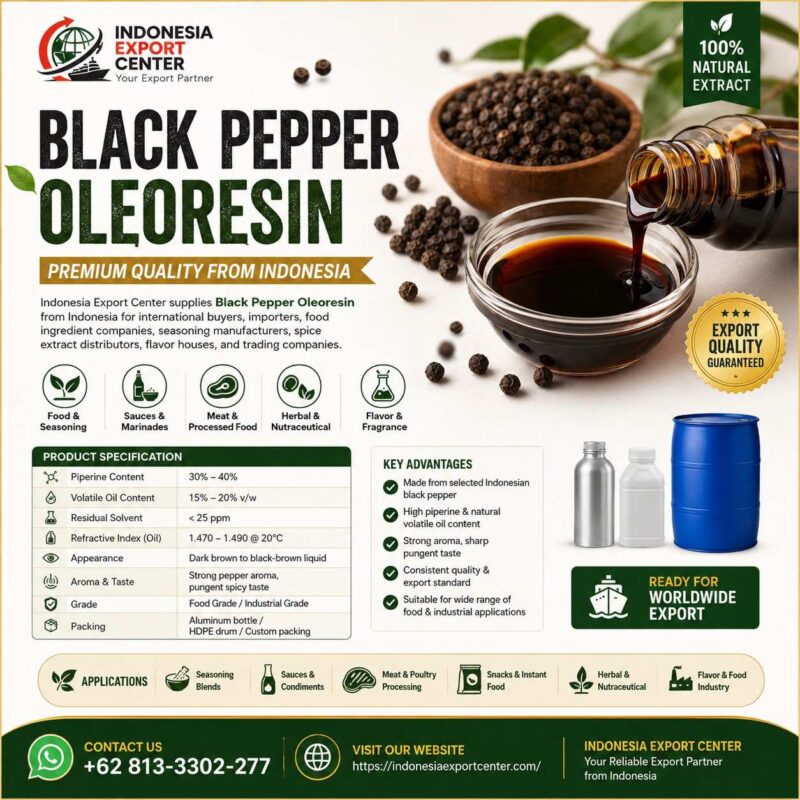
Proper Storage for Black Pepper Oleoresin
Proper storage is important when handling Black Pepper Oleoresin for food manufacturing, ingredient distribution, and industrial applications.
As a concentrated spice extract, its characteristics may be affected by temperature, light exposure, oxygen, moisture, packaging compatibility, and storage conditions.
For importers, distributors, warehouse managers, and quality assurance teams, understanding the supplier’s storage instructions helps protect the product during transportation and inventory management.
Indonesia Export Center facilitates sourcing inquiries for international buyers interested in Indonesian Black Pepper Oleoresin.
This guide explains general storage considerations and the importance of verifying shelf-life information with the actual manufacturer or supplier.
What Is Black Pepper Oleoresin?
Black Pepper Oleoresin is a concentrated extract obtained from black pepper (Piper nigrum).
Depending on the extraction process and product specification, it may contain:
- Piperine.
- Volatile aromatic compounds.
- Other non-volatile extractable constituents.
- Naturally occurring components of black pepper.
Its physical characteristics may vary between suppliers and grades.
A product may be supplied as a viscous liquid, thick liquid, or semi-solid material depending on its composition and processing.
These differences mean that storage recommendations should always be based on the specific product’s TDS and supplier instructions.
Why Proper Storage Matters
Improper storage may contribute to changes in product characteristics.
Potential concerns include:
Aroma Changes
Volatile aromatic compounds may be affected by exposure to heat, air, and unsuitable packaging.
Oxidation
Exposure to oxygen over time may contribute to changes in certain product constituents.
Light Exposure
Light-sensitive components may require protection from direct light.
Physical Changes
Temperature changes may affect viscosity, flow, or physical appearance.
Packaging Compatibility
Unsuitable containers may create compatibility, leakage, or contamination concerns.
Contamination
Improper handling and storage may introduce foreign material or compromise product integrity.
The actual stability behavior depends on the product composition, processing, packaging, and storage environment.
Recommended Storage Principles
The following are general handling principles. Always follow the specific supplier’s storage instructions.
1. Keep Containers Properly Sealed
Close containers securely after use.
This helps reduce unnecessary exposure to air, moisture, and external contamination.
2. Avoid Direct Sunlight
Store the product away from direct sunlight and excessive light exposure.
Use the packaging and storage conditions recommended by the supplier.
3. Control Temperature
Follow the storage temperature range stated in the TDS or product label.
Avoid unnecessary exposure to high temperatures and extreme temperature fluctuations.
Do not assume that refrigeration or freezing is required unless the supplier specifically recommends it.
4. Protect from Moisture
Keep containers dry and prevent water from entering the product.
Use appropriate warehouse practices to avoid condensation and moisture-related problems.
5. Use Suitable Packaging
Store the product in its original approved packaging or a compatible container recommended by the supplier.
Potential packaging formats may include:
- Aluminum bottles.
- HDPE drums.
- Other supplier-approved containers.
Packaging suitability must be confirmed for the specific product.
6. Maintain Clean Storage Areas
Keep storage areas clean, dry, and free from contaminants.
Separate the product from incompatible chemicals and other materials according to the relevant safety documentation.
7. Minimize Unnecessary Opening
Avoid repeatedly opening containers when it is not necessary.
After sampling or dispensing, reseal the container according to the supplier’s instructions.
Understanding Shelf Life
Shelf life is the period during which a product is expected to remain within its specified quality limits when stored under defined conditions.
There is no universal shelf-life period that can be applied to every Black Pepper Oleoresin product.
Shelf life depends on:
- Raw material quality.
- Extraction method.
- Product composition.
- Processing and packaging.
- Container material.
- Storage temperature.
- Exposure to light and oxygen.
- Manufacturer stability data.
- Product specification and acceptance criteria.
Buyers should request the manufacturer’s declared shelf life and supporting stability information.
Do not assume that every Black Pepper Oleoresin product has the same shelf life.
How to Check Shelf-Life Information
When reviewing a product’s shelf-life documentation, ask for:
- Manufacturing date.
- Recommended expiry or retest date.
- Storage conditions.
- Packaging type.
- Stability information, where available.
- Relevant quality parameters.
- Supplier instructions after opening.
- Retesting requirements, where applicable.
The shelf-life statement should relate to the actual product and packaging configuration being supplied.
Warehouse Management for Bulk Buyers
Importers and distributors should establish suitable inventory procedures.
Receiving Inspection
When receiving a shipment, check:
- Container condition.
- Packaging integrity.
- Label information.
- Batch number.
- Manufacturing or expiry information, where stated.
- Quantity and net weight.
- Accompanying documents.
Inventory Identification
Maintain clear records for each batch.
Useful information includes:
- Supplier name.
- Product name.
- Batch number.
- Receipt date.
- Manufacturing date.
- Declared shelf life.
- Storage location.
- Quantity received.
- Quantity issued.
Stock Rotation
Use a documented stock rotation method, such as First Expired, First Out (FEFO), where expiry dates are available and applicable.
Container Handling
Follow the product-specific handling and safety instructions.
Use suitable equipment and protective measures based on the SDS.
Quality Monitoring
If there is a change in appearance, aroma, packaging condition, or other relevant characteristic, isolate the affected material and consult the supplier or quality team before use.
Storage and Handling Checklist
| Checkpoint | Recommended Action |
|---|---|
| Container integrity | Check for damage and leakage |
| Sealing | Keep containers properly closed |
| Temperature | Follow supplier instructions |
| Light exposure | Avoid direct sunlight |
| Moisture | Keep product and packaging dry |
| Contamination | Maintain clean storage conditions |
| Packaging | Use supplier-approved containers |
| Batch identification | Maintain traceable records |
| Shelf life | Follow manufacturer documentation |
| Stock rotation | Apply suitable inventory procedures |
Documentation Buyers Should Request
Before accepting a commercial shipment, request relevant documents such as:
- Technical Data Sheet.
- Certificate of Analysis.
- Safety Data Sheet.
- Product specification.
- Storage instructions.
- Packaging information.
- Shelf-life statement.
- Stability information, where available.
- Batch identification and traceability records.
These documents help warehouse, procurement, and QA teams establish appropriate handling procedures.
Indicative Product Information
The preliminary reference information for Indonesian Black Pepper Oleoresin includes:
| Parameter | Indicative Specification |
|---|---|
| Piperine Content | 30%–40% |
| Volatile Oil Content | 15%–20% v/w |
| Residual Solvent | Target below 25 ppm; verification required |
| Refractive Index (Oil) | 1.470–1.490 at 20°C |
| Appearance | Dark brown to black-brown liquid |
| Aroma and Taste | Strong pepper aroma, pungent spicy taste |
| Packaging | Aluminum bottle, HDPE drum, or custom packaging, subject to availability |
These are preliminary reference figures, not a complete storage or stability specification. Actual product data must be obtained from the selected supplier.
Frequently Asked Questions
1. How should Black Pepper Oleoresin be stored?
Follow the supplier’s TDS and storage instructions. General good practices include keeping containers sealed, avoiding direct sunlight, controlling temperature, and protecting the product from moisture and contamination.
2. What is the shelf life of Black Pepper Oleoresin?
Shelf life varies by manufacturer, composition, packaging, and storage conditions. Request the declared shelf life and supporting information from the supplier.
3. Should Black Pepper Oleoresin be refrigerated?
Do not assume refrigeration is required. Follow the storage temperature specified by the manufacturer.
4. Can Black Pepper Oleoresin change viscosity during storage?
Physical characteristics may change depending on temperature and product composition. Consult the supplier if the change is unusual or outside the product specification.
5. What packaging is available?
Potential packaging includes aluminum bottles and HDPE drums, subject to supplier confirmation.
6. What should I do if a container is damaged?
Isolate the affected container, follow the relevant safety procedures, document the issue, and contact the supplier before using the material.
7. Can I use the product after its stated expiry date?
Do not assume it remains acceptable. Follow the manufacturer’s instructions and applicable quality procedures, including any authorized retesting process.
Source Black Pepper Oleoresin from Indonesia
Are you an importer, food manufacturer, distributor, or warehouse procurement team looking for Indonesian Black Pepper Oleoresin?
Indonesia Export Center facilitates sourcing inquiries and supplier coordination for international buyers.
INDONESIA EXPORT CENTER
Your Reliable Export Partner from Indonesia
WhatsApp: +62 813-3302-277
Website: https://indonesiaexportcenter.com/
Request Product Information
Please provide:
- Required quantity.
- Intended application.
- Target product specification.
- Preferred packaging.
- Destination country.
- Required storage and shelf-life documents.
Contact us to discuss your Black Pepper Oleoresin sourcing requirements.
