

IEC | INDONESIA EXPORT CENTER
Phytochemical Characterization | Botanical Research | Chemical Fingerprinting | Analytical Documentation
Understanding the Phytochemical Profile of Red Galangal Extract
A phytochemical profile describes the chemical constituents identified in a botanical material using defined analytical procedures.
For laboratories and ingredient manufacturers investigating the red galangal extract phytochemical profile, accurate botanical identification is essential. Chemical data from one plant species cannot automatically be used to describe another species, even when both are marketed under similar common names.
Indonesia Export Center (IEC) facilitates inquiries for potential Indonesian sources of botanical extract materials and technical documentation.
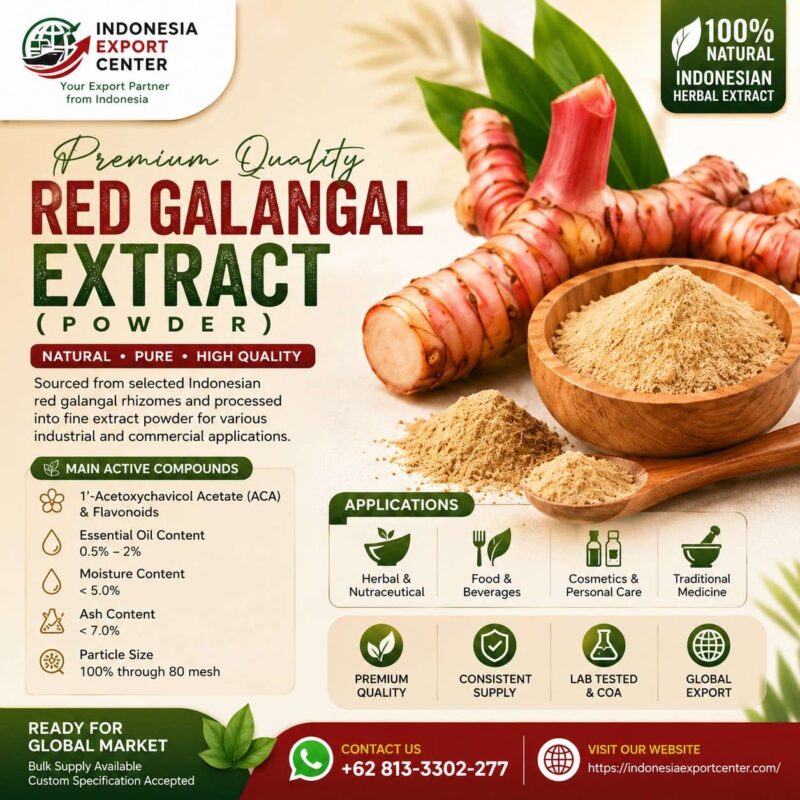
The proposed ingredient is associated with Alpinia purpurata. No authenticated commercial batch or validated phytochemical profile has been supplied.
REQUEST PHYTOCHEMICAL INFORMATION AND ANALYTICAL DOCUMENTATION
Botanical Identity
Alpinia purpurata belongs to the Zingiberaceae family and is recognized in botanical taxonomy.
Reference: Plants of the World Online.
However, the species of the actual raw material must be authenticated.
The common name red galangal may create confusion with other Alpinia species.
Preliminary Chemical and Physical Profile
| Parameter | Proposed Information |
|---|---|
| Scientific Species | Alpinia purpurata — verification required |
| Proposed Plant Part | Rhizome |
| Product Form | Extract powder |
| Moisture | Below 5% proposed |
| Ash | Below 7% proposed |
| Particle Size | 80 mesh proposed |
| Essential Oil | 0.5–2% proposed |
| ACA | Mentioned; presence unverified |
| Flavonoids | Mentioned; composition unverified |
| Extract Ratio | Not established |
| Extraction Solvent | Not established |
| Chemical Fingerprint | Not available |
| Validated Marker Content | Not available |
Factors Affecting Phytochemical Composition
The chemical composition of botanical extracts may vary according to species, plant part, growing conditions, geographic origin, harvesting stage, drying, extraction solvent, temperature, concentration, and storage.
A reliable phytochemical profile should therefore be associated with a specific sample and processing history.
1′-Acetoxychavicol Acetate and Flavonoids
The initial product brief mentions 1′-acetoxychavicol acetate (ACA) and flavonoids.
However, their presence and analytical relevance have not been demonstrated for the proposed Alpinia purpurata extract.
ACA should not be presented as a confirmed active constituent or standardization marker without appropriate evidence.
Similarly, the term flavonoids identifies a broad class of compounds rather than a specific quantified constituent.
Analytical Methods for Phytochemical Characterization
High-Performance Liquid Chromatography
HPLC may support separation and quantification of selected compounds when an appropriate method and reference standards are available.
Liquid Chromatography–Mass Spectrometry
LC-MS may assist in characterizing selected constituents and investigating complex chemical mixtures.
Gas Chromatography–Mass Spectrometry
GC-MS may be suitable for volatile or appropriately prepared compounds.
Thin-Layer Chromatography
TLC or HPTLC may be used for comparative chemical fingerprinting when suitable methods are established.
Spectroscopic Characterization
Appropriate spectroscopic methods may provide additional information about chemical composition.
No specific method has been validated for the proposed commercial extract.
Qualitative and Quantitative Analysis
Qualitative analysis investigates the identity or presence of selected constituents.
Quantitative analysis determines the amount of a compound using an appropriate method.
A chromatographic peak should not be assigned to a specific chemical without sufficient identification evidence.
Essential Oil Content
The proposed essential oil content is 0.5–2%.
No batch test result or analytical method has been supplied.
The supplier should clarify whether the value refers to the raw botanical material, the finished extract, or another measurement basis.
Chemical Standardization
A standardized extract should have defined analytical criteria supported by appropriate testing.
The proposed material has no verified marker specification.
An extract ratio alone does not establish the concentration of a particular constituent.
Recommended Analytical Testing
| Test | Objective |
|---|---|
| Botanical Authentication | Confirm species |
| Plant-Part Verification | Confirm source tissue |
| Moisture | Determine water content |
| Ash | Evaluate inorganic residue |
| Particle Size | Characterize powder |
| Chromatographic Fingerprint | Compare chemical profiles |
| Marker Identification | Establish selected compounds |
| Marker Quantification | Determine compound levels |
| Essential Oil Analysis | Evaluate proposed oil content |
| Residual Solvents | Assess extraction residues |
| Contaminant Testing | Support quality assessment |
| Stability Testing | Evaluate chemical changes |
Research Interpretation and Biological Claims
A phytochemical profile does not establish medicinal efficacy, cosmetic performance, or nutritional benefits.
Any proposed biological activity requires separate supporting evidence.
No therapeutic, antioxidant, antimicrobial, or anti-inflammatory efficacy claim has been established for the proposed commercial extract.
Supplier Documentation
Researchers should request the scientific name, plant-part declaration, extraction process, batch COA, analytical methods, chemical fingerprint, and traceability records.
IEC can coordinate such inquiries with potential suppliers.
Frequently Asked Questions
What are the active compounds in Alpinia purpurata extract?
No validated active-compound profile has been supplied for the proposed product.
Is ACA confirmed?
No. Its presence requires analytical verification.
Are flavonoids present?
The brief mentions flavonoids, but no specific analysis has been provided.
Is the extract standardized?
No standardized commercial grade has been established.
Can HPLC be used for quality testing?
It may be suitable for selected compounds when an appropriate method is established.
Can IEC request analytical reports?
IEC can facilitate document inquiries, subject to supplier availability.
Request Phytochemical Documentation
IEC welcomes inquiries from analytical laboratories, botanical researchers, formulation companies, and ingredient importers.
Please specify the required analytical methods, sample quantity, and intended research application.
REQUEST CHEMICAL PROFILE, COA, SAMPLE & QUOTATION
INDONESIA EXPORT CENTER
Website: https://indonesiaexportcenter.com/
WhatsApp: +62 813-3302-277
Related pages:
- Alpinia Purpurata Extract for Botanical Research
- Alpinia Purpurata Extract Quality Testing
- Alpinia Purpurata Extract Specification
SEO METADATA
SEO Title: Red Galangal Extract Phytochemical Profile | IEC
Meta Description: Explore red galangal extract phytochemical profiling, including Alpinia purpurata authentication, HPLC, LC-MS, GC-MS, chemical markers, and analytical sourcing.
Focus Keyword: red galangal extract phytochemical profile
URL Slug: red-galangal-extract-phytochemical-profile
Canonical URL: https://indonesiaexportcenter.com/red-galangal-extract-phytochemical-profile/
Search Intent: Commercial / Technical
