

IEC | INDONESIA EXPORT CENTER
Botanical Supplier Identification • Technical Qualification • Quality Verification • Export Procurement
How to Source Alpinia Purpurata Extract from Indonesia
Sourcing specialty botanical extracts requires a structured approach. Unlike standardized commodity ingredients, less-common botanical materials may have limited commercial documentation, inconsistent common names, and significant differences in processing methods.
For buyers researching how to source Alpinia purpurata extract, the first priority is confirming that the requested botanical species corresponds to the material the supplier can actually produce.
Indonesia Export Center (IEC) facilitates inquiries with potential Indonesian suppliers, helping buyers organize technical requirements, request available documentation, and seek seller-approved quotations.
No verified commercial supply of the proposed extract has been established solely from the preliminary product brief.
START AN ALPINIA PURPURATA SOURCING INQUIRY
Step 1: Define the Required Botanical Species
The proposed species is Alpinia purpurata, belonging to the Zingiberaceae family.
Its taxonomic identity can be reviewed through Plants of the World Online.
The buyer should not rely solely on the name red galangal.
The supplier should confirm the scientific species using appropriate supporting evidence.
Step 2: Specify the Plant Part
Different plant parts may produce extracts with different chemical characteristics.
The preliminary IEC brief refers to rhizomes.
However, the actual plant part has not been verified.
The RFQ should clearly state whether rhizome material is required.
Step 3: Define the Product Form
A buyer should distinguish among:
- Dried botanical powder.
- Crude extract.
- Spray-dried extract powder.
- Standardized extract.
- Liquid extract.
- Other processed botanical preparations.
These products are not automatically equivalent.
Step 4: Establish the Technical Specification
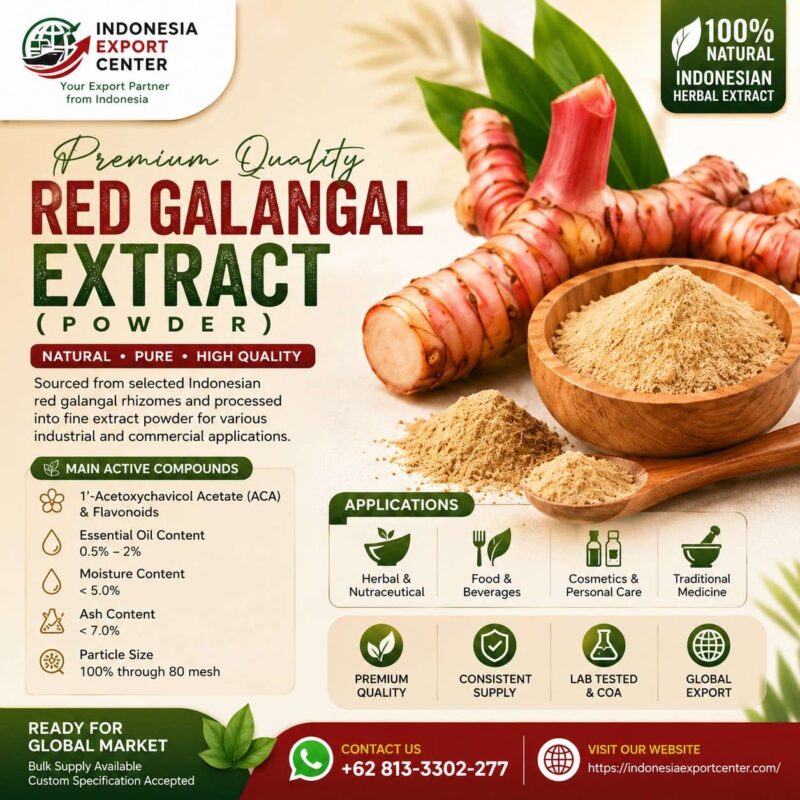
The preliminary product targets are:
| Parameter | Proposed Reference |
|---|---|
| Product | Alpinia Purpurata Extract Powder |
| Origin | Indonesia proposed |
| Plant Part | Rhizome; unverified |
| Moisture | Below 5% |
| Ash | Below 7% |
| Particle Size | 100% through 80 mesh |
| Essential Oil | 0.5–2% |
| Extraction Solvent | Not established |
| Extract Ratio | Not established |
| Chemical Markers | Not validated |
| Carrier Ingredients | Not established |
| Shelf Life | Not established |
These targets require confirmation before becoming contractual specifications.
Step 5: Identify the Actual Supplier
A sourcing intermediary, trader, exporter, and manufacturer may perform different roles.
Buyers should establish who produces the extract, who controls quality, who holds inventory, and who will be the seller of record.
IEC facilitates sourcing inquiries and does not automatically represent itself as the manufacturer.
Step 6: Request Manufacturing Information
Relevant information may include raw material preparation, extraction solvent, concentration method, drying process, carrier ingredients, and batch size.
This helps buyers determine whether the supplier can produce the required material.
Step 7: Request Technical Documentation
| Document | Procurement Purpose |
|---|---|
| Botanical Authentication | Confirm species |
| Plant-Part Declaration | Confirm source tissue |
| TDS | Define technical parameters |
| Batch COA | Review actual results |
| Composition Statement | Identify ingredients and carriers |
| Extraction Method | Understand processing |
| SDS | Review hazards where applicable |
| Microbiology Report | Assess microbial quality |
| Heavy Metal Report | Assess contaminants |
| Residual Solvent Report | Evaluate extraction residues |
| Traceability Records | Verify supply chain history |
| Stability Information | Assess storage and shelf life |
Step 8: Evaluate Regulatory Suitability
The buyer should define whether the material is intended for cosmetic research, botanical analysis, food, supplements, or another use.
Eligibility varies by destination market.
No food, supplement, cosmetic, or medicinal approval has been established for the proposed material.
Step 9: Request a Representative Sample
Sample evaluation may involve identity testing, chemical characterization, physical testing, and application-specific research.
The sample should be linked to available batch documentation.
Step 10: Review Quality and Analytical Results
The buyer should compare the sample against its required specification.
If chemical markers are important, appropriate analytical methods and reference standards should be agreed upon.
The initial brief mentions ACA and flavonoids, but these are not verified markers for the proposed commercial material.
Step 11: Confirm MOQ and Production Capability
Minimum order quantity may depend on raw material availability, extraction batch size, packaging, and processing requirements.
No MOQ or production capacity has been verified.
Step 12: Confirm Commercial Terms
A complete quotation should address product specification, quantity, unit price, packaging, Incoterms, lead time, payment terms, and quotation validity.
Final offers require seller confirmation.
Step 13: Verify Export Documentation
Requirements may include commercial invoice, packing list, transport documents, and applicable origin or regulatory documentation.
The exact requirements depend on the product and destination.
Step 14: Establish Batch Acceptance Criteria
Before repeat procurement, the buyer should approve a specification covering relevant identity, quality, and safety parameters.
Step 15: Monitor Repeat-Order Consistency
Buyers should review supplier changes, batch consistency, and documentation quality over time.
A successful sample evaluation does not guarantee future batch equivalence.
Common Sourcing Risks
Potential risks include species substitution, incomplete chemical data, unclear extraction methods, unsupported certifications, unverified inventory, and inconsistent commercial terms.
These risks should be addressed before payment or production commitments.
Recommended RFQ Information
| RFQ Field | Buyer Information |
|---|---|
| Scientific Species | Required botanical name |
| Plant Part | Required source tissue |
| Product Form | Powder or other form |
| Extraction Method | Required or acceptable methods |
| Quality Parameters | Buyer specification |
| Testing Requirements | COA and additional reports |
| Intended Use | Application category |
| Quantity | Sample and commercial volume |
| Packaging | Preferred configuration |
| Destination | Country and delivery location |
| Incoterm | Preferred delivery term |
| Delivery Schedule | Required date |
Frequently Asked Questions
Can IEC identify potential Indonesian suppliers?
IEC can facilitate sourcing inquiries.
Is a verified manufacturer already confirmed?
No manufacturer has been verified in the supplied information.
Can buyers request custom specifications?
Yes. IEC can submit the requirements for supplier feasibility review.
Is a COA available?
Availability requires supplier confirmation.
Can buyers order samples before bulk purchases?
Sample requests may be coordinated, subject to availability.
Does IEC issue the final quotation?
The final commercial offer must be confirmed by the actual seller.
Request Alpinia Purpurata Extract Sourcing Support
IEC welcomes inquiries from botanical ingredient importers, research laboratories, cosmetic manufacturers, and industrial distributors.
REQUEST SUPPLIER VERIFICATION, TDS, COA, SAMPLE & QUOTATION
INDONESIA EXPORT CENTER
Website: https://indonesiaexportcenter.com/
WhatsApp: +62 813-3302-277
Related pages:
- Alpinia Purpurata Extract Supplier
- Red Galangal Extract Supplier Due Diligence
- Red Galangal Extract Request for Quotation
SEO METADATA
SEO Title: How to Source Alpinia Purpurata Extract | Indonesia Export Center
Meta Description: Learn how to source Alpinia purpurata extract from Indonesia, including botanical authentication, supplier screening, COA, sample testing, MOQ, export terms, and RFQs.
Focus Keyword: how to source alpinia purpurata extract
URL Slug: how-to-source-alpinia-purpurata-extract
Canonical URL: https://indonesiaexportcenter.com/how-to-source-alpinia-purpurata-extract/
Search Intent: Informational / Commercial
