

IEC | INDONESIA EXPORT CENTER
Turmeric Oleoresin | Powdered Extracts | Formulation Compatibility | Ingredient Procurement
Understanding the Difference Between Turmeric Paste and Turmeric Powder Extract
Choosing the right turmeric ingredient requires more than comparing product names. For food manufacturers, beverage formulators, supplement producers, and ingredient distributors, the physical form of an extract can affect manufacturing efficiency, ingredient handling, stability, and finished-product quality.
The comparison between turmeric paste vs turmeric powder extract is especially important because these products may contain similar botanical constituents while behaving very differently during processing.
Turmeric paste extract is commonly supplied as a viscous oleoresin, whereas turmeric powder extract generally refers to a dried extract in powder form. Neither should automatically be confused with ordinary ground turmeric rhizome.
IEC | Indonesia Export Center facilitates inquiries for Indonesian turmeric-derived ingredients, helping international buyers request appropriate product specifications, samples, quality documentation, and supplier-approved quotations.
REQUEST TURMERIC EXTRACT SPECIFICATIONS
What Is Turmeric Paste Extract?
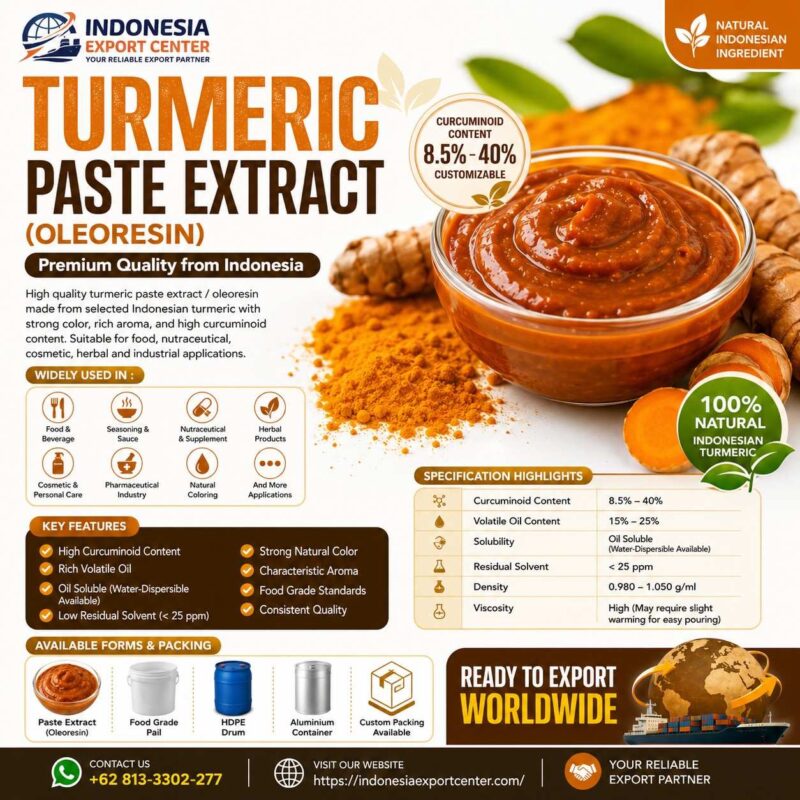
Turmeric paste extract, often described as turmeric oleoresin, is a concentrated turmeric-derived preparation that may contain curcuminoids, volatile components, and other extracted constituents.
The reference product is described as a viscous, oil-soluble material with a characteristic yellow-orange color and turmeric aroma.
Its actual composition depends on the manufacturing process and selected grade.
What Is Turmeric Powder Extract?
Turmeric powder extract is generally a dry ingredient produced from turmeric-derived extract material.
Depending on the manufacturing method, a powdered extract may contain carriers, processing aids, or other formulation components.
A powdered extract is not necessarily water-soluble, and its curcuminoid content cannot be assumed from its appearance.
Turmeric Paste vs Powder Extract: Comparison Table
| Parameter | Turmeric Paste Extract | Turmeric Powder Extract |
|---|---|---|
| Physical Form | Viscous paste or oleoresin | Dry powder |
| Processing | Extraction and concentration | Extraction followed by drying or powder formulation |
| Moisture / Water Content | Grade-dependent | Grade-dependent |
| Curcuminoid Content | Depends on grade | Depends on grade |
| Volatile Components | May retain volatile constituents | Depends on processing |
| Solubility | Product-specific | Product-specific |
| Handling | Pumping, pouring, or dispensing | Weighing and powder transfer |
| Packaging | May use pails or drums | May use bags or lined containers |
| Main Formulation Consideration | Viscosity and dispersion | Flowability and dissolution or dispersion |
| Storage | Requires validated conditions | Requires validated conditions |
These are general technical distinctions, not verified specifications for every commercial grade.
Why Water Content Matters
The term “paste” does not establish a fixed water percentage.
Some concentrated extracts may be highly viscous because of their extracted constituents rather than a high water content.
Likewise, a dry powder extract may contain carriers or other components.
Buyers should request moisture or loss-on-drying results and complete composition information where relevant.
Manufacturing and Handling Differences
Paste Extract Handling
Paste products may require suitable dispensing equipment, controlled transfer procedures, and attention to viscosity.
The reference brief mentions that slight warming may assist pouring, but the supplier must approve any handling temperature.
Powder Extract Handling
Powder extracts may be easier to weigh or blend into certain dry formulations.
However, powder flow, dust generation, hygroscopicity, and segregation should be evaluated.
Application Suitability
Food and Sauce Manufacturing
Paste extract may be considered for suitable oil-containing systems, while powder extracts may be evaluated for dry seasoning applications.
Actual compatibility requires testing.
Beverages
Neither form should automatically be assumed to dissolve in water.
A water-dispersible formulation may be necessary for certain beverage systems.
Supplements
Powder extracts may be evaluated for capsule or tablet manufacturing, while paste forms require a different formulation approach.
Cosmetics
The appropriate form depends on the cosmetic base, ingredient declaration, and formulation requirements.
Comparing Curcuminoid Concentrations
The supplied turmeric paste reference describes an 8.5–40% curcuminoid range.
This range should not be transferred to turmeric powder extract products.
For both forms, buyers should request a batch-specific assay and confirm whether the stated percentage refers to total curcuminoids or another defined parameter.
Questions to Ask Suppliers
- Is the product an oleoresin, dried extract, or formulated ingredient?
- What extraction process is used?
- What is the verified curcuminoid content?
- Are carriers or emulsifiers present?
- What is the moisture content?
- Is the product oil-soluble, water-dispersible, or neither?
- What packaging is available?
- What storage conditions are validated?
- Can the supplier provide a batch COA?
- Are samples available for formulation trials?
Buyer Verification Checklist
| Requirement | Verification |
|---|---|
| Product Identity | TDS and ingredient declaration |
| Botanical Source | Curcuma longa L. confirmation |
| Physical Form | Supplier specification |
| Curcuminoid Assay | Batch COA |
| Moisture | Laboratory result |
| Solubility | Technical testing |
| Carrier Disclosure | Composition statement |
| Contaminants | Relevant laboratory reports |
| Packaging | Supplier confirmation |
| MOQ and Lead Time | Commercial quotation |
Frequently Asked Questions
Is turmeric paste the same as turmeric powder extract?
No. They differ in physical form and may differ in composition and manufacturing process.
Does turmeric powder extract contain more curcuminoids?
Not necessarily. Concentration depends on the grade.
Is turmeric paste better for sauces?
It may be suitable for some formulations, but performance must be tested.
Can turmeric paste replace powder extract at the same dosage?
Not without evaluating concentration, composition, and formulation behavior.
Can IEC help compare supplier grades?
IEC can facilitate requests for specifications and samples from potential suppliers.
Request Turmeric Paste or Powder Extract Specifications
IEC welcomes inquiries from ingredient formulators, manufacturers, and procurement teams comparing turmeric ingredient formats.
Please share your intended application, preferred form, required concentration, order quantity, and destination country.
REQUEST COA, SAMPLE & SUPPLIER-APPROVED QUOTATION
INDONESIA EXPORT CENTER
Website: https://indonesiaexportcenter.com/
WhatsApp: +62 813-3302-277
Related pages:
- Turmeric Paste vs Turmeric Oleoresin
- Turmeric Paste Product Specifications
- Turmeric Extract Powder vs Turmeric Powder
SEO METADATA
SEO Title: Turmeric Paste vs Turmeric Powder Extract | IEC
Meta Description: Compare turmeric paste and turmeric powder extract for industrial sourcing. Learn about processing, water content, handling, applications, and supplier verification.
Focus Keyword: turmeric paste vs turmeric powder extract
Secondary Keywords: turmeric oleoresin vs powder extract, turmeric paste comparison, turmeric extract ingredient forms, turmeric powder extract supplier
URL Slug: turmeric-paste-vs-turmeric-powder-extract
Canonical URL: https://indonesiaexportcenter.com/turmeric-paste-vs-turmeric-powder-extract/
Search Intent: Informational / Commercial
