

IEC | INDONESIA EXPORT CENTER
Curcuma longa L. | Ground Rhizome Powder vs. Concentrated Extract | Curcuminoid Content | Manufacturing Processes | Ingredient Selection
Understanding the Difference Between Turmeric Extract Powder and Turmeric Powder
Turmeric powder and turmeric extract powder originate from the turmeric plant, but they are not necessarily interchangeable ingredients.
For purchasing teams comparing turmeric extract powder vs turmeric powder, understanding the difference is essential to accurate specifications, pricing, quality control, and formulation performance.
IEC | Indonesia Export Center facilitates inquiries for Indonesian turmeric-derived ingredients, helping buyers distinguish between ground turmeric and extracted ingredients before requesting supplier quotations.
What Is Turmeric Powder?
Turmeric powder is generally produced by cleaning, drying, and grinding turmeric rhizomes.
It retains a broader range of the original botanical material and is commonly used as a spice, seasoning, or ingredient in other products.
Its characteristics depend on raw material quality, processing, particle size, and storage.
What Is Turmeric Extract Powder?
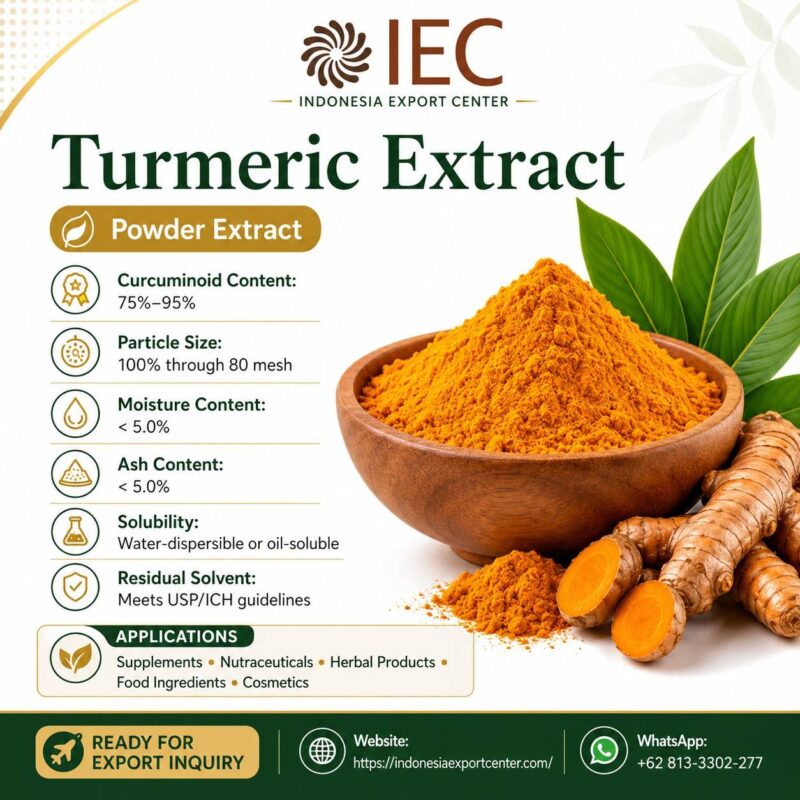
Turmeric extract powder is produced through an extraction process designed to recover selected constituents from turmeric material.
The resulting ingredient may be concentrated, standardized, or formulated with carriers.
Its composition depends on the extraction process and product specification.
Not every turmeric extract has the same curcuminoid concentration.
Key Differences
| Feature | Ground Turmeric Powder | Turmeric Extract Powder |
|---|---|---|
| Raw Material | Turmeric rhizome | Turmeric-derived input |
| Main Processing | Drying and grinding | Extraction and further processing |
| Product Composition | Ground botanical material | Process-dependent extract |
| Curcuminoid Concentration | Naturally variable | May be concentrated or standardized |
| Carriers | Not inherent to pure ground powder | May be present |
| Particle Properties | Milling-dependent | Processing-dependent |
| Applications | Spice and other permitted uses | Application-specific |
| Quality Testing | Identity, contaminants, composition | Identity, assay, solvents, contaminants |
| Pricing | Ground spice economics | Extraction and standardization economics |
| Regulatory Assessment | Product- and use-specific | Product- and use-specific |
Curcuminoid Content: Why the Percentage Matters
The turmeric powder reference supplied for IEC lists a curcumin content of 3.5–4.5%.
This is a reference specification for ground turmeric powder, not a verified laboratory result for a turmeric extract.
An extract may be marketed by a defined percentage of curcumin or total curcuminoids.
These two measures should not be confused.
Buyers should request the actual assay method, result, and product composition.
Extraction Ratio vs. Standardization
A ratio such as 10:1 generally refers to a relationship between starting botanical material and extract output, subject to the supplier’s definition.
It does not automatically mean 10% curcuminoids.
Likewise, a standardized assay does not necessarily indicate the amount of starting material used.
Buyers should request both details separately when relevant.
Choosing the Right Ingredient
Spice and Seasoning Applications
Ground turmeric may be suitable where the intended function is spice flavor, color, or other permitted food use.
Supplement Manufacturing
An extract may be evaluated where a defined constituent concentration is required.
Functional Beverages
Dispersibility, flavor, sedimentation, and stability may be more important than concentration alone.
Food Coloring
The ingredient’s intended technological function and applicable regulations should be reviewed.
Cosmetic Formulation
Ingredient identity, INCI naming, color effects, and compatibility require separate assessment.
Price and Cost Comparison
Ground turmeric and concentrated extract have different production economics.
The price per kilogram should not be the only comparison.
Manufacturers should consider the required inclusion level, constituent assay, formulation performance, quality testing, and total delivered cost.
A concentrated extract is not automatically the better choice for every application.
Quality Documentation Differences
Ground turmeric powder may be evaluated for botanical identity, moisture, particle size, contaminants, and other relevant parameters.
Turmeric extract powder may require additional information about extraction solvents, standardization, carrier ingredients, and analytical constituent profiles.
A certificate issued for ground turmeric should not be reused as evidence for an extract.
Supplier Selection Checklist
| Question | Why It Matters |
|---|---|
| Is it ground powder or extract? | Correct product identity |
| What is the botanical source? | Authenticity |
| Is the extract standardized? | Concentration control |
| What is the assay method? | Analytical reliability |
| Are carriers present? | Composition |
| Which solvents were used? | Process assessment |
| What is the intended application? | Suitability |
| What documents are available? | Supplier qualification |
IEC Sourcing Workflow
- Clarify whether the buyer needs ground powder or extract.
- Define the intended application.
- Establish the required composition.
- Request the appropriate specification.
- Coordinate supplier inquiries.
- Review quality documentation.
- Arrange samples where available.
- Conduct application testing.
- Confirm quantity and packaging.
- Request a supplier-approved quotation.
Frequently Asked Questions
Is turmeric extract powder the same as turmeric powder?
No. Extraction and grinding produce different ingredient types.
Is turmeric extract always 95% curcuminoids?
No. Concentrations vary by product and must be verified.
Does 10:1 mean 10% curcuminoids?
No. Extract ratio and constituent assay are different measures.
Can ground turmeric be substituted for extract?
Not automatically. The formulation and intended use must be evaluated.
Can IEC help buyers compare both products?
IEC can facilitate inquiries based on the required ingredient specification.
Request the Right Turmeric Ingredient
IEC welcomes inquiries from food manufacturers, supplement companies, spice wholesalers, and botanical ingredient distributors.
Please specify whether you need ground turmeric powder or turmeric extract, along with the intended use, quality requirements, quantity, and destination.
REQUEST TURMERIC INGREDIENT SPECS & QUOTATION
Website: https://indonesiaexportcenter.com/
WhatsApp: +62 813-3302-277
Related pages:
SEO METADATA
SEO Title: Turmeric Extract Powder vs Turmeric Powder | IEC
Meta Description: Compare turmeric extract powder vs turmeric powder. Learn about extraction, grinding, curcuminoid content, pricing, applications, and B2B sourcing.
Focus Keyword: turmeric extract powder vs turmeric powder
Secondary Keywords: turmeric extract vs ground turmeric, turmeric powder curcumin content, turmeric extract manufacturing difference, turmeric ingredient comparison
URL Slug: turmeric-extract-powder-vs-turmeric-powder
Canonical URL: https://indonesiaexportcenter.com/turmeric-extract-powder-vs-turmeric-powder/
Search Intent: Informational / Commercial
Primary CTA: Request Ingredient Specs & Supplier-Approved Quotation
