

IEC | INDONESIA EXPORT CENTER
NATURAL VANILLA EXTRACT SOURCING FROM INDONESIA
Vanilla Planifolia | Natural Food Ingredients | Botanical Traceability | Ingredient Authentication | Global B2B Procurement
Source Natural Vanilla Extract from Indonesia with Greater Confidence
Natural vanilla extract is a valuable ingredient for international food manufacturers, flavor houses, ingredient distributors, and businesses developing products with natural flavor positioning.
Indonesia is recognized as an important origin for Vanilla planifolia, a botanical species widely used in commercial vanilla production. Its agricultural heritage offers opportunities for international buyers interested in exploring Indonesian vanilla-derived ingredients.
However, purchasing natural vanilla extract from Indonesia requires more than confirming that vanilla beans originate from a tropical growing region.
For professional procurement teams, the most important considerations include botanical authenticity, extraction methods, ingredient composition, traceability, and evidence supporting any natural-origin claims.
IEC | Indonesia Export Center facilitates sourcing inquiries between international buyers and potential Indonesian suppliers. Our role focuses on coordinating technical requirements, requesting supplier documentation, and supporting preliminary commercial communication.
IEC does not automatically act as the manufacturer, product owner, or exporter of record. Product availability, composition, certification, and supply capability must be confirmed with the relevant supplier.
Whether you are sourcing natural vanilla extract for bakery products, dairy applications, beverages, or specialty food ingredients, IEC can help communicate your requirements to potential Indonesian supply partners.
REQUEST NATURAL VANILLA EXTRACT SPECIFICATIONS & QUOTATION
PRODUCT OVERVIEW
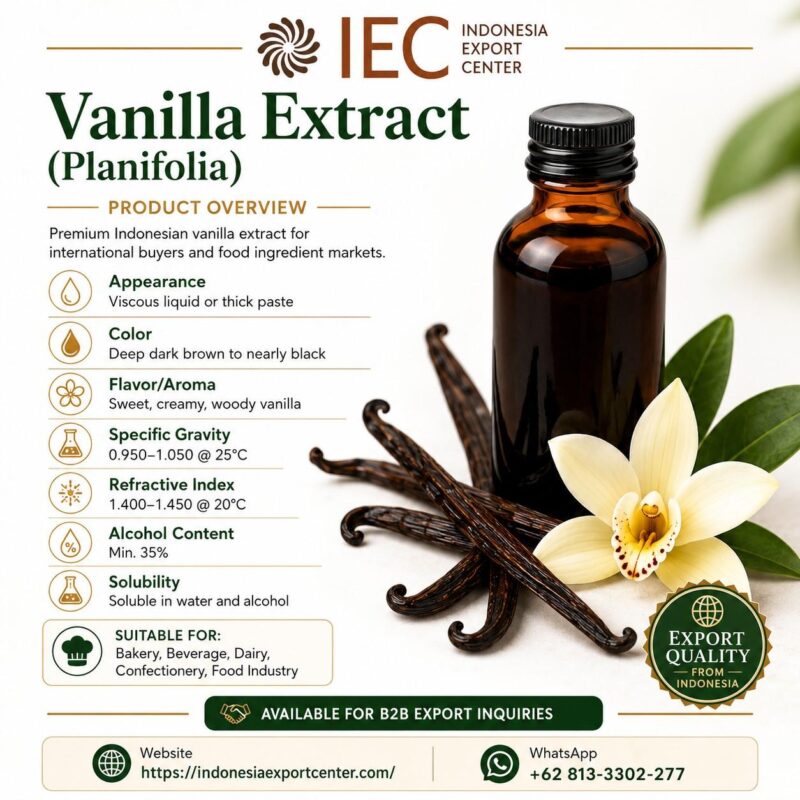
Indonesian Natural Vanilla Extract — Vanilla Planifolia
Natural vanilla extract is generally produced by extracting flavor compounds from cured vanilla beans using an appropriate extraction medium.
Vanilla contains numerous aromatic compounds, with vanillin being one of the principal contributors to its characteristic flavor.
The overall sensory profile of natural vanilla is more complex than vanillin alone. Depending on botanical origin, curing, extraction, and formulation, vanilla extract may display creamy, sweet, woody, warm, and occasionally floral or balsamic characteristics.
For international food ingredient buyers, the precise definition of natural vanilla extract depends on the destination market and applicable regulations.
A product described as natural in one market may require additional evidence or a different labeling approach in another.
Preliminary Product Reference
The following information reflects an initial product reference rather than a verified supplier specification.
| Parameter | Preliminary Reference |
|---|---|
| Product | Vanilla Extract |
| Botanical Source | Vanilla planifolia |
| Origin | Indonesia |
| Product Category | Vanilla-derived flavoring ingredient |
| Appearance | Viscous liquid or thick paste |
| Color | Deep dark brown to nearly black |
| Aroma | Sweet, creamy, woody vanilla |
| Specific Gravity | 0.950–1.050 at 25°C |
| Refractive Index | 1.400–1.450 at 20°C |
| Alcohol Content | Minimum 35% — unverified reference |
| Solubility | Water and alcohol — formulation-dependent |
| Natural-Origin Status | Requires supplier documentation |
| Ingredient Composition | Pending verification |
| Certifications | Not verified |
| Packaging | Subject to supplier confirmation |
| MOQ | Subject to supplier confirmation |
These physical and chemical values are not universal specifications for natural vanilla extract. Their applicability depends on the formulation, extraction process, and regulatory definition.
Buyers should obtain supplier-issued documentation before using any reference values as contractual acceptance criteria.
Why Indonesian Vanilla Origin Matters
Botanical Origin and Agricultural Background
Indonesia has an established history of vanilla cultivation, particularly Vanilla planifolia.
The tropical environment supports vanilla-growing activities, while agricultural practices and post-harvest handling influence the characteristics of the cured beans used in further processing.
For natural ingredient buyers, botanical origin can form part of a broader sourcing strategy involving agricultural traceability and product differentiation.
However, country of origin should not be confused with the location of extraction or final manufacturing.
A product made using Indonesian vanilla beans may undergo extraction, blending, or packaging elsewhere.
Buyers requiring Indonesian-manufactured vanilla extract should specifically request evidence of the manufacturing location.
Vanilla Bean Quality and Curing
Vanilla beans undergo post-harvest curing to develop their characteristic aroma.
Curing typically involves controlled processing and conditioning stages that influence moisture content, aroma development, and final bean characteristics.
These factors can affect the raw material used for vanilla extraction.
For industrial procurement, the supplier’s raw material specifications and sourcing controls may be more important than broad claims about origin quality.
Natural Ingredient Positioning
Many food manufacturers seek natural flavoring ingredients to support product development and consumer labeling strategies.
Natural vanilla extract may be relevant for these applications, provided its composition and manufacturing process satisfy the applicable regulatory definitions.
The term “natural” should be supported by appropriate evidence rather than used solely as a marketing description.
Understanding Natural Vanilla Extract Authenticity
Authenticity is one of the most important considerations in natural vanilla procurement.
Vanillin can originate from several sources, including vanilla beans, chemical synthesis, and certain biotechnology-based processes.
Although vanillin molecules may be chemically identical regardless of origin, the source and production method can affect whether a particular ingredient qualifies for specific natural vanilla labeling claims.
Natural Vanilla Extract Versus Synthetic Vanillin
Natural vanilla extract contains a mixture of compounds extracted from vanilla material.
Synthetic vanillin is a single flavor compound produced through chemical manufacturing processes.
Both can contribute vanilla-like flavor, but they are not necessarily interchangeable for labeling, formulation, or regulatory purposes.
Buyers should distinguish between:
- Vanilla extract derived from vanilla beans.
- Natural flavoring preparations containing vanilla-derived ingredients.
- Natural vanillin obtained through other permitted processes.
- Synthetic vanillin.
- Blended vanilla flavor formulations.
A product containing natural vanillin is not automatically equivalent to natural vanilla extract.
Potential Adulteration Risks
Vanilla is a relatively high-value agricultural ingredient, making authenticity verification commercially important.
Potential concerns may include undeclared synthetic vanillin, inaccurate botanical declarations, undisclosed blending, or misleading ingredient descriptions.
These risks should be addressed through supplier qualification and suitable analytical verification rather than assumptions about any particular origin.
Laboratory Authentication
Depending on procurement requirements, buyers may consider analytical techniques such as chromatography, isotope-ratio analysis, or other validated testing methods.
The appropriate testing strategy depends on the suspected adulteration, product composition, and required claim.
No single test should automatically be treated as conclusive for every form of vanilla authenticity assessment.
Extraction Methods and Ingredient Composition
The extraction process affects the composition and characteristics of the finished vanilla ingredient.
Ethanol-Based Extraction
Ethanol-water mixtures are commonly used in vanilla extraction.
The solvent composition, extraction conditions, and raw material ratio can influence flavor characteristics and final product specifications.
Buyers should confirm the actual ethanol concentration and applicable product definition.
Alternative Extraction and Flavoring Preparations
Some commercial vanilla flavoring preparations may use alternative processing methods or permitted formulation ingredients.
These products may have different regulatory classifications and labeling requirements.
For example, an alcohol-free vanilla flavoring preparation should not automatically be described as equivalent to a standardized vanilla extract.
Ingredient Declaration
A complete ingredient declaration may be necessary to establish whether a product meets the buyer’s requirements.
Depending on formulation, buyers may need information concerning water, ethanol, vanilla-derived materials, sweeteners, carriers, stabilizers, or other additives.
IEC can coordinate requests for this information, but the composition must be confirmed by the supplier.
Traceability and Naturalness Evidence
International buyers should consider traceability as part of supplier qualification.
Traceability can help establish the relationship between agricultural raw materials, processing batches, and finished ingredients.
Botanical Source Documentation
Buyers may request confirmation of the vanilla species used in the extraction process.
Where appropriate, supporting documentation may include raw material declarations and supplier traceability records.
Raw Material Origin
Country-of-origin declarations should identify the relevant raw material or finished product origin accurately.
Buyers should clarify which origin claim is being made.
Manufacturing Traceability
Batch records, production dates, and lot identification may help buyers evaluate supplier traceability systems.
The availability of these records depends on the supplier.
Naturalness Declarations
A supplier may provide a declaration describing the ingredient’s origin, extraction method, and compliance with a particular natural flavoring definition.
Such declarations should be reviewed against the requirements of the destination market.
Independent Verification
Where authenticity is commercially critical, buyers may consider independent testing or third-party verification.
The required scope should be agreed upon before procurement.
Applications for Natural Vanilla Extract
Bakery and Confectionery
Natural vanilla extract may be evaluated for cakes, biscuits, pastries, chocolate, confectionery fillings, and other baked products.
Buyers should consider flavor intensity, thermal processing, dosage, and consistency.
Dairy and Ice Cream
Vanilla extract is widely associated with ice cream, yogurt, custard, and dairy desserts.
The suitability of a particular extract should be evaluated through formulation trials.
Beverage Manufacturing
Vanilla flavor ingredients can be incorporated into various beverage applications.
Solubility, alcohol content, clarity, and sensory performance require particular attention.
Premium Food Ingredients
Businesses developing natural-origin ingredient portfolios may evaluate vanilla extract as part of their product offerings.
Any premium or natural positioning should be supported by documented product characteristics.
Supplier Documents to Request
Professional buyers should request documentation relevant to their application and destination market.
| Document | Procurement Purpose |
|---|---|
| Technical Data Sheet | Product identity and technical specifications |
| Certificate of Analysis | Analytical results and batch evaluation |
| Ingredient Composition | Verification of formulation |
| Botanical Declaration | Confirmation of vanilla source |
| Naturalness Declaration | Evidence supporting natural-origin claims |
| Traceability Records | Raw material and batch tracking |
| Safety Data Sheet | Handling and transport information, where applicable |
| Certification Documents | Verification of any claimed certification |
| Sample Documentation | Identification of the evaluated sample |
Document availability is supplier-dependent.
IEC does not claim that these documents are currently available from a particular supplier.
IEC Natural Vanilla Extract Sourcing Process
Step 1 — Define Your Natural Ingredient Requirements
Provide the intended application, destination market, target quantity, and required natural-origin criteria.
Step 2 — Clarify Botanical and Composition Requirements
Identify whether the product must be derived exclusively from vanilla beans and whether specific extraction methods or ingredient restrictions apply.
Step 3 — Contact Potential Suppliers
IEC may coordinate inquiries with potential Indonesian supply partners.
Step 4 — Request Technical Evidence
Relevant documentation may be requested to support product identity, composition, and naturalness claims.
Step 5 — Arrange Sample Evaluation
Where available, samples may be requested for sensory, analytical, or application testing.
Step 6 — Obtain a Supplier-Approved Quotation
Commercial terms are requested after the technical requirements have been sufficiently clarified.
Final availability, pricing, and supply conditions require supplier approval.
Frequently Asked Questions
Is all Indonesian vanilla extract natural?
Not necessarily. Natural status depends on actual composition, processing methods, and applicable regulatory definitions. Indonesian origin alone does not establish naturalness.
How can buyers verify natural vanilla extract authenticity?
Buyers can review supplier declarations, ingredient composition, traceability records, and suitable analytical testing results.
Is natural vanillin the same as natural vanilla extract?
No. Natural vanillin may be derived from sources other than vanilla beans, while vanilla extract is a more complex preparation derived from vanilla material under the applicable product definition.
Can IEC provide certified natural vanilla extract?
IEC can coordinate certification inquiries, but certification status must be confirmed with the relevant supplier.
Can I request samples before a commercial order?
Sample requests may be coordinated subject to supplier availability and agreed commercial arrangements.
What information is needed for a quotation?
Buyers should provide the product specification, natural-origin requirements, quantity, packaging preference, destination country, and required documentation.
Request Natural Vanilla Extract Specifications and Quotation
Sourcing natural vanilla extract requires a careful balance of botanical authenticity, technical suitability, documentation, and commercial feasibility.
IEC | Indonesia Export Center helps international buyers structure their sourcing inquiries and communicate with potential Indonesian suppliers.
REQUEST SPECS & SUPPLIER-APPROVED QUOTATION
Website: https://indonesiaexportcenter.com/
WhatsApp: +62 813-3302-277
Explore our main sourcing page: Vanilla Extract Supplier in Indonesia.
Additional Market Reference
CBI — Vanilla Extract Market Potential
SEO METADATA
SEO Title: Natural Vanilla Extract from Indonesia | B2B Sourcing Guide
Meta Description: Explore natural vanilla extract sourcing from Indonesia. Learn about botanical origin, authenticity, extraction methods, traceability, samples, and B2B quotations.
Focus Keyword: natural vanilla extract indonesia
Secondary Keywords: Indonesian natural vanilla extract, natural vanilla extract supplier, vanilla planifolia extract Indonesia, natural vanilla ingredient sourcing, vanilla extract authenticity, natural vanilla extract wholesale
URL Slug: natural-vanilla-extract-indonesia
Canonical URL: https://indonesiaexportcenter.com/natural-vanilla-extract-indonesia/
Search Intent: Commercial / Natural Ingredient Procurement
Primary CTA: Request Specs & Supplier-Approved Quotation
