

IEC | INDONESIA EXPORT CENTER
HOW TO VERIFY INDONESIAN CLOVE SUPPLIERS BEFORE INTERNATIONAL PURCHASES
Supplier Screening | Company Verification | Product Samples | COA | Inspection | Payment Controls
Why Indonesian Clove Supplier Verification Matters
Before purchasing cloves internationally, buyers should take appropriate steps to verify a clove supplier in Indonesia.
A professional quotation or attractive product photograph does not, by itself, establish that a company is legally registered, has access to the offered product, or can fulfill an export contract.
IEC | Indonesia Export Center facilitates Indonesian clove sourcing enquiries and encourages international buyers to conduct appropriate supplier and transaction due diligence.
A structured verification process can help buyers assess commercial credibility, product quality, documentation, and payment risk.
DISCUSS INDONESIAN CLOVE SUPPLIER SOURCING
Step 1: Confirm the Legal Company Identity
Request the prospective supplier’s registered company name, business address, and relevant registration information.
Where appropriate, independently check the information through official records or reliable verification channels.
The entity issuing the invoice should be clearly identified.
Step 2: Identify the Supplier’s Actual Role
A company may operate as a producer, processor, trader, broker, sourcing agent, or exporter.
These roles are not interchangeable.
Buyers should establish whether the counterparty owns the goods, sources them from third parties, or acts only as an intermediary.
The exporter of record and contractual seller should also be identified.
Step 3: Verify Product Specifications
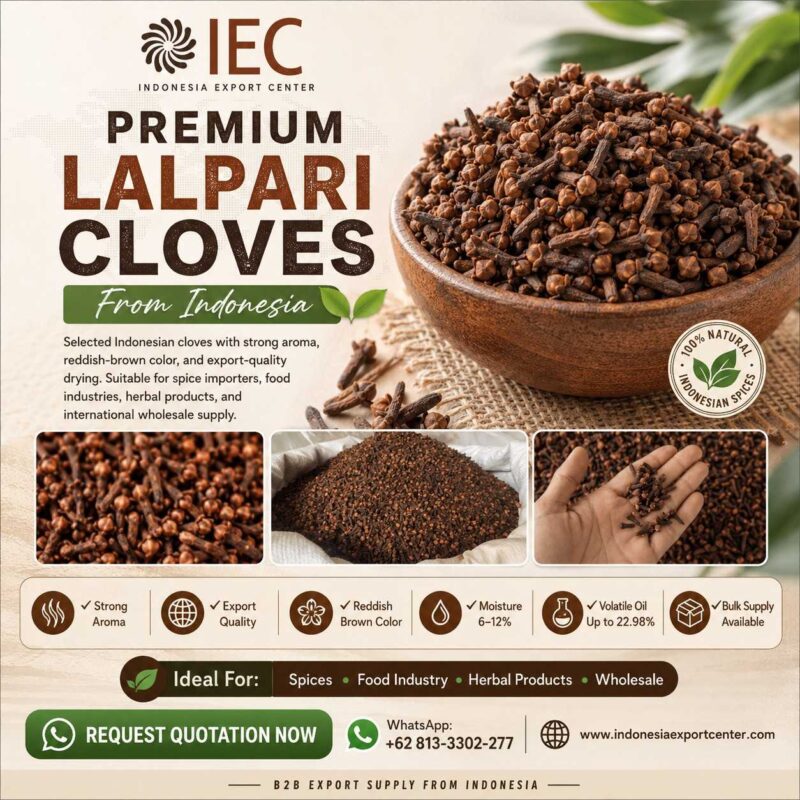
For dried Indonesian cloves, IEC’s promotional reference includes:
| Parameter | Reference |
|---|---|
| Product | Indonesian Dried Cloves |
| Botanical Name | Syzygium aromaticum |
| Origin | Indonesia |
| Promotional Grade | Premium Lalpari |
| Appearance | Reddish-brown |
| Aroma | Strong |
| Moisture | 6–12% promotional reference |
| Volatile Oil | Up to 22.98% promotional reference |
| Whole-Bud Percentage | Buyer-defined |
| Foreign Matter | Buyer-defined |
These figures are not guaranteed for every supplier or shipment.
Buyers should request written lot-specific specifications.
Step 4: Request Product Samples
Representative samples can support visual inspection, sensory evaluation, and laboratory testing.
Buyers should determine whether a sample represents actual available stock or is only a promotional reference.
Step 5: Evaluate the Certificate of Analysis
A COA may provide relevant test results for the offered product.
Check the product description, lot number, laboratory identity, test methods, reporting date, and results.
A COA from an unrelated lot should not be treated as evidence of the proposed shipment’s quality.
Step 6: Assess Supplier Processing and Storage
Depending on the transaction, buyers may ask about:
- Cleaning and sorting procedures
- Moisture management
- Pest control
- Warehouse conditions
- Food safety practices
- Lot identification
- Packaging capability
- Contamination prevention
- Inspection cooperation
- Export documentation arrangements
Any factory or warehouse inspection should be arranged with the relevant party’s permission.
Step 7: Consider Independent Inspection
Where commercially justified, buyers may request third-party inspection or sampling.
The inspection agency, scope, sampling procedure, and costs should be agreed before the inspection.
Inspection reduces some uncertainties but cannot guarantee that all possible risks have been eliminated.
Step 8: Verify Bank and Payment Details
Payment instructions should be checked carefully.
Useful controls may include:
- Confirming the contractual payee.
- Checking the relationship between the seller and beneficiary account.
- Independently confirming changes to bank details.
- Using appropriate written contracts.
- Agreeing on payment milestones.
- Considering suitable bank-supported payment arrangements.
- Keeping records of communications and invoices.
- Avoiding unexplained third-party payment requests.
The appropriate payment method depends on the transaction and commercial risk.
Step 9: Review the Export Contract
The contract should define product identity, quantity, quality tolerances, inspection, packing, price, Incoterm, payment, shipment window, documents, and dispute resolution.
A clear contract supports both the buyer and seller.
Step 10: Verify Shipping Responsibilities
Confirm who is responsible for export clearance, main freight, insurance, import clearance, and local destination costs.
FOB, CFR, CIF, or another suitable term should be used consistently with the actual shipment arrangement.
Supplier Due Diligence Checklist
| Verification Area | Buyer Action |
|---|---|
| Company Identity | Confirm legal name and registration |
| Business Role | Identify producer, trader, or intermediary |
| Product Access | Request credible availability evidence |
| Product Quality | Review samples and specifications |
| COA | Verify relevance and authenticity |
| Facility Controls | Assess where appropriate |
| Export Capability | Confirm responsible exporter |
| Payment | Verify beneficiary details |
| Inspection | Agree on independent checks if needed |
| Contract | Define obligations and remedies |
| Documentation | Verify destination requirements |
| Shipment | Confirm logistics and delivery responsibilities |
Packaging, Terms, and Shipping
The supplier should confirm packaging capability and provide a quotation with clearly identified inclusions and exclusions.
The buyer should evaluate the suitability of the selected Incoterm and verify the required export and import documents.
Request Supplier Sourcing Information
Subject: Indonesian Clove Supplier Verification and RFQ
Company: [Name]
Destination Country: [Country]
Product: Dried Indonesian Cloves
Grade: [Specify]
Quantity: [MT]
Required Specifications: [Attach]
Sample Requirement: [Specify]
Laboratory Testing: [Specify]
Inspection Requirement: [Specify]
Packaging: [Specify]
Destination Port: [Port]
Incoterm: [Specify]
Preferred Payment Terms: [Specify]
Please provide information about potential supplier options, product documentation, commercial terms, and the proposed transaction structure.
Frequently Asked Questions
How can I verify an Indonesian clove supplier?
Check the company’s legal identity, business role, product evidence, documents, payment details, and contract terms.
Does a product photo prove stock availability?
No. Photographs alone do not establish current inventory or ownership.
Is a COA enough to verify a shipment?
No. The COA must be relevant and authentic, and other commercial and inspection checks may still be necessary.
Can independent inspection be requested?
Yes, subject to supplier cooperation and agreed arrangements.
What are the MOQ, sample, and lead-time conditions?
These depend on the actual supplier and proposed transaction.
Does IEC guarantee every supplier?
IEC facilitates sourcing enquiries. Each supplier and transaction should undergo appropriate verification before contracting.
Source Indonesian Cloves with Clear Procurement Requirements
IEC | INDONESIA EXPORT CENTER
B2B SOURCING COORDINATION FOR INTERNATIONAL SPICE BUYERS
DISCUSS INDONESIAN CLOVE SUPPLIER SOURCING
WhatsApp: +62 813-3302-277
Website: https://indonesiaexportcenter.com/
Connecting Indonesian Products to the World.
Supplier verification, documentation, inspection, and commercial safeguards must be tailored to the actual transaction.
