

IEC | INDONESIA EXPORT CENTER
A STEP-BY-STEP SOURCING AND IMPORT GUIDE FOR INTERNATIONAL CLOVE BUYERS
Supplier Verification | Product Specifications | Export Documents | Shipping | Customs Clearance
How to Import Cloves from Indonesia
Planning to import Indonesian cloves for your wholesale spice business, food manufacturing operation, or international trading company?
Understanding how to import cloves from Indonesia can help you organize supplier selection, product quality approval, trade documentation, freight arrangements, and customs clearance.
Indonesia is a recognized clove-producing country, and Indonesian cloves are used in international spice and food ingredient markets.
IEC | Indonesia Export Center facilitates sourcing enquiries and helps international buyers communicate their commercial requirements to potential Indonesian suppliers.
IEC’s role is to support sourcing coordination. The identity of the contractual seller, exporter of record, and other responsible parties must be confirmed for each transaction.
START YOUR INDONESIAN CLOVE SOURCING ENQUIRY
Step 1: Define Your Product Requirements
Begin with a clear product specification.
For whole dried cloves, buyers may consider:
| Parameter | Reference or Requirement |
|---|---|
| Product | Dried Cloves |
| Botanical Name | Syzygium aromaticum |
| Origin | Indonesia |
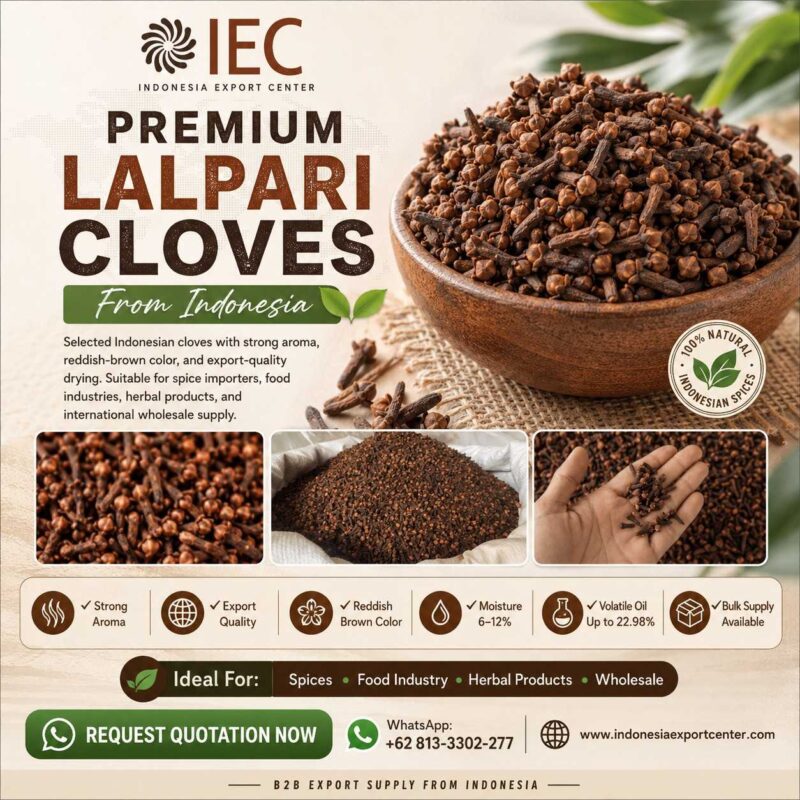
| Promotional Grade | Premium Lalpari |
| Appearance | Reddish-brown |
| Aroma | Strong |
| Moisture | 6–12% promotional reference |
| Volatile Oil | Up to 22.98% promotional reference |
| Whole-Bud Percentage | Buyer-defined |
| Foreign Matter | Buyer-defined |
| Microbiology | Destination requirements |
| Packaging | Buyer-defined |
Promotional specifications must be verified for the proposed lot.
Step 2: Prepare Your Request for Quotation
A complete RFQ should identify the product, grade, quantity, destination, packing requirements, quality tests, and preferred trade terms.
Without these details, supplier quotations may not be directly comparable.
Step 3: Verify the Supplier and Contractual Seller
Before making payment, buyers should evaluate the legal identity of the counterparty and its ability to fulfill the proposed transaction.
Checks may include:
- Company registration
- Business contact information
- Bank account ownership
- Product availability evidence
- Supplier or processor capabilities
- Export experience where relevant
- Contractual seller identity
- Exporter-of-record arrangements
- Sample and inspection cooperation
- Commercial references where independently verifiable
Step 4: Confirm Product Classification
Cloves are generally classified within HS heading 0907, but the correct national tariff classification depends on the product form and destination-country tariff schedule.
Whole cloves, crushed cloves, ground cloves, and other clove-derived products may require different subheadings or classifications.
Importers should confirm the applicable tariff code with their customs broker or relevant authority.
Step 5: Check Destination Import Requirements
Before contracting, confirm whether the destination requires food importer registration, plant health documentation, specific laboratory tests, customs declarations, or other approvals.
Regulations differ by country and may change.
Step 6: Request Samples and Quality Documents
Representative samples can help buyers evaluate appearance, aroma, physical purity, and other relevant characteristics.
Where necessary, request laboratory testing for moisture, microbiological quality, residues, and applicable contaminants.
A sample should not be treated as a guarantee of the final shipment unless a suitable sampling and acceptance procedure is agreed.
Step 7: Agree on Commercial Terms
The purchase contract should define:
- Product identity and grade.
- Quantity and tolerances.
- Unit price and currency.
- Incoterm and named port.
- Packaging.
- Quality specifications.
- Inspection and acceptance.
- Payment conditions.
- Shipment window.
- Required documents.
- Claims and dispute procedures.
Step 8: Select Shipping Terms
FOB, CFR, and CIF are common sea-shipment terms.
The parties should understand who arranges the main freight, insurance, export clearance, and destination import procedures.
For containerized shipments, FCA may also be worth evaluating depending on the handover arrangement.
Step 9: Prepare Export and Import Documents
Documents may include:
- Commercial invoice
- Packing list
- Bill of lading or other transport document
- Certificate of origin, where required
- Phytosanitary certificate, if applicable
- Laboratory or inspection documents
- Insurance certificate where applicable
- Other destination-specific documents
Not every document is mandatory for every shipment.
Step 10: Arrange Inspection and Loading
Before shipment, buyers may arrange agreed quality inspection, packaging verification, and container checks.
The scope and costs should be established contractually.
Step 11: Complete Destination Customs Clearance
The importer or appointed customs broker should handle the required declarations, duties, taxes, inspections, and release procedures.
A supplier quotation does not automatically include destination clearance.
Step 12: Inspect the Received Cargo
On arrival, check packaging, quantities, lot identification, and product condition.
Any discrepancies should be documented promptly in accordance with the purchase contract.
Common Importing Mistakes to Avoid
- Purchasing based only on a grade name.
- Comparing quotations with different Incoterms.
- Assuming certificates are automatically available.
- Paying an unverified counterparty.
- Omitting destination food safety checks.
- Failing to agree on inspection methods.
- Ignoring packaging and moisture protection.
- Using outdated freight or market prices.
- Confusing a sourcing intermediary with the exporter of record.
- Failing to calculate total landed cost.
Request an Indonesian Clove Import Quotation
Subject: Import Cloves from Indonesia – RFQ
Company: [Name]
Destination Country: [Country]
Business Type: [Importer / Distributor / Manufacturer]
Product Form: [Whole / Ground]
Required Grade: [Specify]
Quantity: [MT]
Maximum Moisture: [%]
Required Quality Tests: [Specify]
Packaging: [Specify]
Destination Port: [Port]
Preferred Incoterm: [FOB / CFR / CIF / FCA]
Shipment Window: [Date]
Required Import Documents: [Specify]
Please provide potential supplier options, sample arrangements, MOQ, lead time, and quotations.
SEND INDONESIAN CLOVE IMPORT RFQ
Frequently Asked Questions
Can international buyers import cloves directly from Indonesia?
Potentially, provided the supplier, transaction, and destination import requirements are properly established.
What is the minimum order quantity?
MOQ depends on the selected supplier, grade, packaging, and commercial terms.
Can samples be requested before ordering?
Yes, subject to supplier agreement.
How long does importing take?
The timeline depends on availability, preparation, testing, documentation, shipping, and customs clearance.
Is a phytosanitary certificate always required?
No universal answer applies. The requirement must be verified for the destination and product.
Does IEC act as the exporter of record?
IEC facilitates sourcing enquiries. The contractual seller and exporter-of-record arrangements must be identified for each transaction.
Start Importing Indonesian Cloves
IEC | INDONESIA EXPORT CENTER
INDONESIAN SPICE SOURCING FOR INTERNATIONAL IMPORTERS
REQUEST CLOVE IMPORT QUOTATION
WhatsApp: +62 813-3302-277
Website: https://indonesiaexportcenter.com/
Connecting Indonesian Products to the World.
Import regulations, supplier identities, technical specifications, and trade documents must be verified before shipment.
