

IEC | INDONESIA EXPORT CENTER
QUALITY VERIFICATION FOR INDONESIAN CLOVE IMPORTERS
Representative Sampling | Laboratory Testing | Supplier Inspection | Pre-Shipment Quality Control
Why Clove Samples and Pre-Shipment Inspection Matter
For international spice buyers, a structured clove sample and pre-shipment inspection process can help reduce uncertainty before a commercial shipment leaves Indonesia.
Cloves are agricultural products whose characteristics may vary between suppliers, harvests, processing methods, and individual lots.
A sample that looks attractive does not necessarily establish the condition of an entire commercial shipment.
IEC | Indonesia Export Center facilitates Indonesian clove sourcing enquiries and can help buyers discuss sampling, inspection, and laboratory documentation requirements with potential suppliers.
Inspection arrangements should be agreed before the purchase contract is finalized.
REQUEST CLOVE SAMPLE AND INSPECTION INFORMATION
Quality Verification for International Buyers
Importers may use sampling and inspection to:
- Assess product appearance.
- Confirm physical grading.
- Measure moisture.
- Evaluate aroma.
- Check whole-bud integrity.
- Identify foreign matter.
- Review laboratory results.
- Verify packing.
- Confirm shipment quantity.
- Reduce contractual disputes.
The inspection scope should reflect the buyer’s intended use and risk assessment.
Indonesian Clove Product Reference
| Parameter | Reference |
|---|---|
| Product | Indonesian Dried Cloves |
| Botanical Name | Syzygium aromaticum |
| Origin | Indonesia |
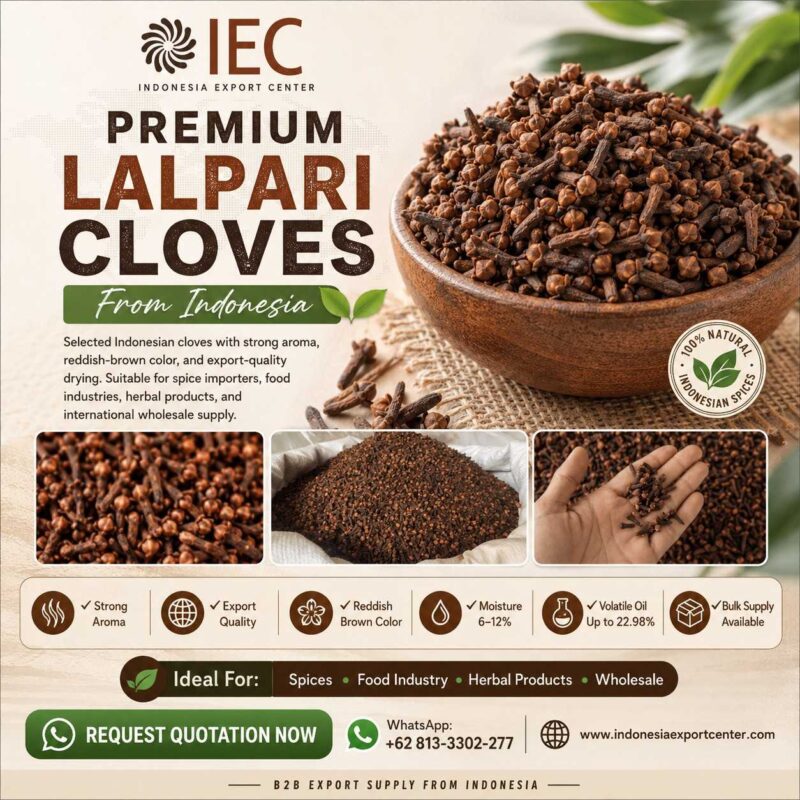
| Promotional Grade | Premium Lalpari |
| Appearance | Reddish-brown |
| Aroma | Strong |
| Moisture | 6–12% promotional reference |
| Volatile Oil | Up to 22.98% promotional reference |
| Whole-Bud Percentage | Buyer-defined |
| Foreign Matter | Buyer-defined |
| Testing Scope | Buyer-defined |
| Inspection Standard | Contractually agreed |
The promotional specifications must be verified against the proposed shipment.
Step 1: Establish the Purchasing Specification
Before sampling, buyers should define measurable acceptance criteria.
The specification may include moisture, volatile oil, whole-bud percentage, broken material, foreign matter, insect damage, and applicable microbiological or chemical limits.
A vague description such as Premium Export Grade is insufficient for a robust acceptance procedure.
Step 2: Request Representative Samples
A sample should be representative of the product or lot being offered.
Buyers should establish whether the sample is:
- A promotional sample.
- A production sample.
- A warehouse stock sample.
- A sample drawn from a specific commercial lot.
- A pre-shipment inspection sample.
These sample types do not provide the same level of assurance.
Step 3: Define a Sampling Protocol
A sampling protocol should establish:
- Lot identification.
- Number of sampling points.
- Sampling locations.
- Sample quantity.
- Sampling equipment.
- Composite sample preparation.
- Sample sealing.
- Chain of custody.
- Laboratory selection.
- Retained sample procedures.
Where appropriate, an agreed recognized sampling standard may be used.
Step 4: Conduct Laboratory Testing
Testing may include:
Moisture
Confirms the measured water content of the sampled material.
Volatile Oil
Evaluates the relevant aromatic oil content when required by the purchasing specification.
Physical Purity
Measures broken material, loose stems, foreign matter, and other agreed grading characteristics.
Microbiological Testing
Assesses relevant microbiological parameters according to the buyer’s food safety programme.
Chemical Contaminants
May include pesticide residues, mycotoxins, heavy metals, or other applicable parameters.
The appropriate tests depend on the intended market and use.
Step 5: Pre-Shipment Inspection
A pre-shipment inspection may cover:
- Product identity
- Lot numbers
- Physical condition
- Moisture
- Packing condition
- Net and gross weights
- Bag counts
- Labeling
- Container suitability
- Loading conditions
- Contractual compliance
Inspection does not eliminate all risk, but it can provide additional evidence about the inspected cargo.
Independent Inspection Agencies
Buyers may request an independent inspection company where appropriate.
The parties should agree on the agency, scope of work, timing, costs, sampling methods, and reporting requirements.
IEC does not claim that every shipment has already undergone third-party inspection.
Retained Samples and Disputes
A retained sample may help support investigation if the delivered cargo is disputed.
The contract should establish:
- Who collects the sample.
- How the sample is sealed.
- Where it is stored.
- How long it is retained.
- Which laboratory is used for retesting.
- Which results govern acceptance.
- Who pays for testing.
- How disagreements are resolved.
Clear procedures can reduce uncertainty for both parties.
Packaging and Shipment Verification
Inspectors may review packaging integrity, labeling, container condition, and cargo loading.
The buyer should ensure that packaging specifications are included in the purchase contract.
Shipment documentation should match the agreed product and quantity.
Export Terms and Inspection Responsibilities
Under FOB, CFR, or CIF contracts, the parties should separately define who arranges and pays for inspection.
Incoterms do not replace a detailed product quality agreement.
The contract should also state when and where quality acceptance takes place.
Request Clove Samples and Pre-Shipment Inspection
Subject: Indonesian Cloves – Sampling and Inspection RFQ
Company: [Name]
Destination Country: [Country]
Product: Dried Cloves
Quantity: [MT]
Grade: [Specify]
Required Specifications: [Attach]
Sample Type: [Promotional / Lot-Specific / Pre-Shipment]
Laboratory Tests: [Specify]
Inspection Agency Preference: [Specify]
Inspection Scope: [Specify]
Packaging: [Specify]
Loading Port: [Port]
Destination Port: [Port]
Incoterm: [FOB / CFR / CIF]
Target Shipment Date: [Date]
Please provide available supplier information, sample arrangements, inspection options, estimated costs, and commercial quotations.
Frequently Asked Questions
Why is a clove sample important?
A sample helps buyers assess product characteristics before placing an order, although it does not guarantee the quality of an entire shipment.
Is a promotional sample the same as a shipment sample?
No. Promotional samples may not represent the final commercial lot.
Can third-party inspection be arranged?
Inspection arrangements may be discussed subject to supplier cooperation and the availability of qualified service providers.
Can laboratory testing be requested?
Yes, subject to agreed sampling, testing methods, and costs.
What happens if a shipment fails inspection?
The contract should establish the applicable rejection, correction, retesting, or dispute procedures.
What are the MOQ, lead time, and document requirements?
These depend on the supplier, testing scope, shipment terms, and destination-market requirements.
Verify Your Indonesian Clove Purchase Before Shipment
IEC | INDONESIA EXPORT CENTER
QUALITY-FOCUSED SOURCING FOR INTERNATIONAL SPICE BUYERS
REQUEST CLOVE SAMPLE AND INSPECTION INFORMATION
WhatsApp: +62 813-3302-277
Website: https://indonesiaexportcenter.com/
Connecting Indonesian Products to the World.
Sampling, laboratory testing, inspection services, supplier availability, and destination-market compliance must be confirmed for each transaction.
